

33
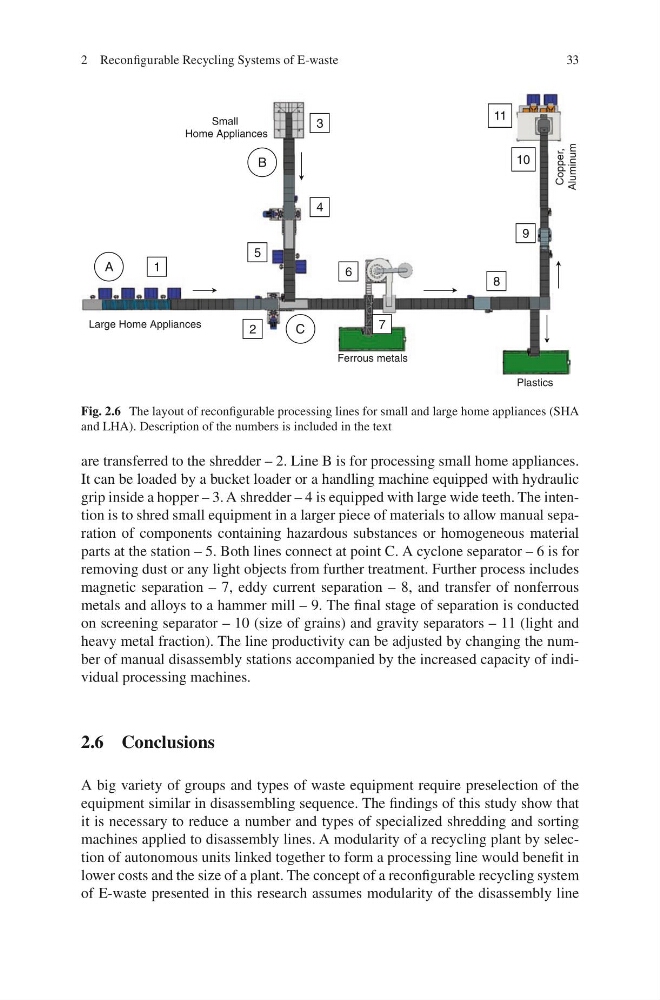
are transferred to the shredder – 2. Line B is for processing small home appliances.
It can be loaded by a bucket loader or a handling machine equipped with hydraulic
grip inside a hopper – 3. A shredder – 4 is equipped with large wide teeth. The intention is to shred small equipment in a larger piece of materials to allow manual separation of components containing hazardous substances or homogeneous material
parts at the station – 5. Both lines connect at point C. A cyclone separator – 6 is for
removing dust or any light objects from further treatment. Further process includes
magnetic separation – 7, eddy current separation – 8, and transfer of nonferrous
metals and alloys to a hammer mill – 9. The final stage of separation is conducted
on screening separator – 10 (size of grains) and gravity separators – 11 (light and
heavy metal fraction). The line productivity can be adjusted by changing the number of manual disassembly stations accompanied by the increased capacity of individual processing machines.
2.6 Conclusions
A big variety of groups and types of waste equipment require preselection of the
equipment similar in disassembling sequence. The findings of this study show that
it is necessary to reduce a number and types of specialized shredding and sorting
machines applied to disassembly lines. A modularity of a recycling plant by selection of autonomous units linked together to form a processing line would benefit in
lower costs and the size of a plant. The concept of a reconfigurable recycling system
of E-waste presented in this research assumes modularity of the disassembly line
A
B
C
1
2
3
4
6
5
7
8
9
11
10
Large Home Appliances
Small
Home Appliances
Ferrous metals
Plastics
Copper,
Aluminum
Fig. 2.6 The layout of reconfigurable processing lines for small and large home appliances (SHA
and LHA). Description of the numbers is included in the text
2 Reconfigurable Recycling Systems of E-waste
are transferred to the shredder – 2. Line B is for processing small home appliances.
It can be loaded by a bucket loader or a handling machine equipped with hydraulic
grip inside a hopper – 3. A shredder – 4 is equipped with large wide teeth. The intention is to shred small equipment in a larger piece of materials to allow manual separation of components containing hazardous substances or homogeneous material
parts at the station – 5. Both lines connect at point C. A cyclone separator – 6 is for
removing dust or any light objects from further treatment. Further process includes
magnetic separation – 7, eddy current separation – 8, and transfer of nonferrous
metals and alloys to a hammer mill – 9. The final stage of separation is conducted
on screening separator – 10 (size of grains) and gravity separators – 11 (light and
heavy metal fraction). The line productivity can be adjusted by changing the number of manual disassembly stations accompanied by the increased capacity of individual processing machines.
2.6 Conclusions
A big variety of groups and types of waste equipment require preselection of the
equipment similar in disassembling sequence. The findings of this study show that
it is necessary to reduce a number and types of specialized shredding and sorting
machines applied to disassembly lines. A modularity of a recycling plant by selection of autonomous units linked together to form a processing line would benefit in
lower costs and the size of a plant. The concept of a reconfigurable recycling system
of E-waste presented in this research assumes modularity of the disassembly line
A
B
C
1
2
3
4
6
5
7
8
9
11
10
Large Home Appliances
Small
Home Appliances
Ferrous metals
Plastics
Copper,
Aluminum
Fig. 2.6 The layout of reconfigurable processing lines for small and large home appliances (SHA
and LHA). Description of the numbers is included in the text
2 Reconfigurable Recycling Systems of E-waste