

29
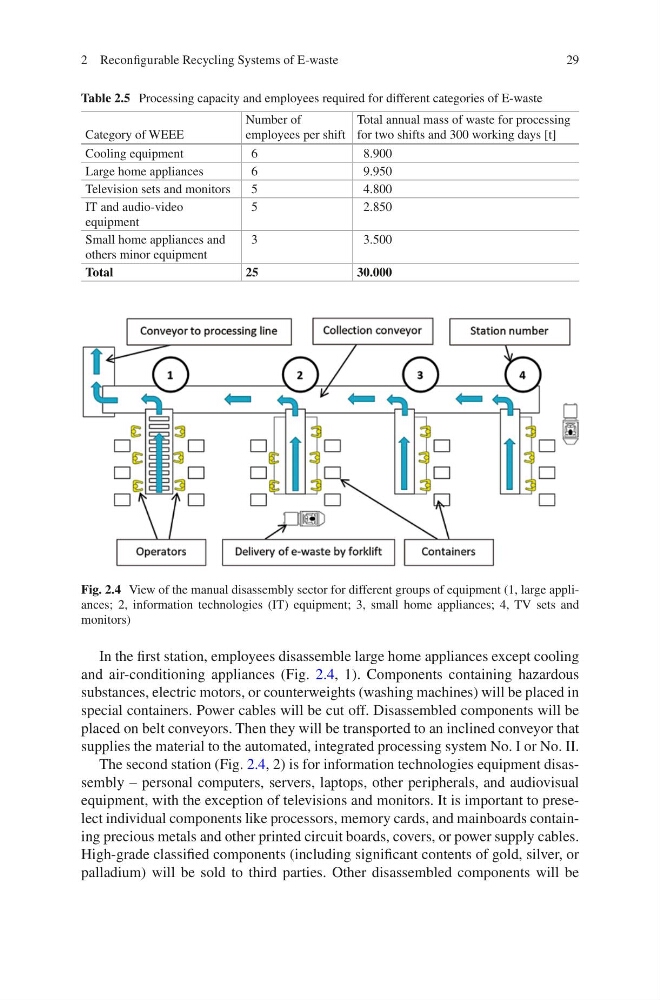
In the first station, employees disassemble large home appliances except cooling
and air-conditioning appliances (Fig. 2.4, 1). Components containing hazardous
substances, electric motors, or counterweights (washing machines) will be placed in
special containers. Power cables will be cut off. Disassembled components will be
placed on belt conveyors. Then they will be transported to an inclined conveyor that
supplies the material to the automated, integrated processing system No. I or No. II.
The second station (Fig. 2.4, 2) is for information technologies equipment disassembly – personal computers, servers, laptops, other peripherals, and audiovisual
equipment, with the exception of televisions and monitors. It is important to preselect individual components like processors, memory cards, and mainboards containing precious metals and other printed circuit boards, covers, or power supply cables.
High-grade classified components (including significant contents of gold, silver, or
palladium) will be sold to third parties. Other disassembled components will be
Table 2.5 Processing capacity and employees required for different categories of E-waste
Category of WEEE
Number of
employees per shift
Total annual mass of waste for processing
for two shifts and 300 working days [t]
Cooling equipment
6
8.900
Large home appliances
6
9.950
Television sets and monitors
5
4.800
IT and audio-video
equipment
5
2.850
Small home appliances and
others minor equipment
3
3.500
Total
25
30.000
Fig. 2.4 View of the manual disassembly sector for different groups of equipment (1, large appliances; 2, information technologies (IT) equipment; 3, small home appliances; 4, TV sets and
monitors)
2 Reconfigurable Recycling Systems of E-waste
In the first station, employees disassemble large home appliances except cooling
and air-conditioning appliances (Fig. 2.4, 1). Components containing hazardous
substances, electric motors, or counterweights (washing machines) will be placed in
special containers. Power cables will be cut off. Disassembled components will be
placed on belt conveyors. Then they will be transported to an inclined conveyor that
supplies the material to the automated, integrated processing system No. I or No. II.
The second station (Fig. 2.4, 2) is for information technologies equipment disassembly – personal computers, servers, laptops, other peripherals, and audiovisual
equipment, with the exception of televisions and monitors. It is important to preselect individual components like processors, memory cards, and mainboards containing precious metals and other printed circuit boards, covers, or power supply cables.
High-grade classified components (including significant contents of gold, silver, or
palladium) will be sold to third parties. Other disassembled components will be
Table 2.5 Processing capacity and employees required for different categories of E-waste
Category of WEEE
Number of
employees per shift
Total annual mass of waste for processing
for two shifts and 300 working days [t]
Cooling equipment
6
8.900
Large home appliances
6
9.950
Television sets and monitors
5
4.800
IT and audio-video
equipment
5
2.850
Small home appliances and
others minor equipment
3
3.500
Total
25
30.000
Fig. 2.4 View of the manual disassembly sector for different groups of equipment (1, large appliances; 2, information technologies (IT) equipment; 3, small home appliances; 4, TV sets and
monitors)
2 Reconfigurable Recycling Systems of E-waste