

184
For the US Environmental Protection Agency (EPA), electrical and electronic
equipment are devices that run on electrical currents or electromagnetic fields.
These devices include the appliances used in the generation, transfer, and measurement of these currents and fields. In other words, if a product requires a battery or a
power supply, it is considered an electrical and electronic equipment. Moreover, this
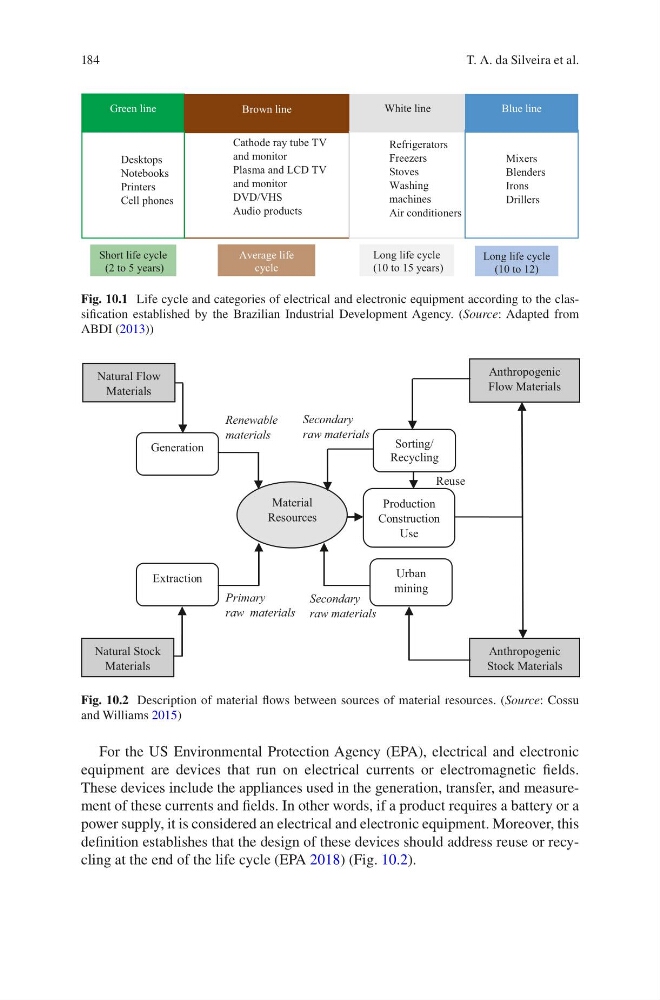
definition establishes that the design of these devices should address reuse or recycling at the end of the life cycle (EPA 2018) (Fig. 10.2).
Green line
Brown line
White line
Blue line
Cathode ray tube TV
and monitor
Plasma and LCD TV
and monitor
DVD/VHS
Audio products
Refrigerators
Freezers
Stoves
Washing
machines
Air conditioners
Mixers
Blenders
Irons
Drillers
Desktops
Notebooks
Printers
Cell phones
Short life cycle
(2 to 5 years)
Average life
cycle
Long life cycle
(10 to 15 years)
Long life cycle
(10 to 12)
Fig. 10.1 Life cycle and categories of electrical and electronic equipment according to the classification established by the Brazilian Industrial Development Agency. (Source: Adapted from
ABDI (2013))
Renewable
materials
Secondary
raw materials
Reuse
Primary
raw materials
Secondary
raw materials
Natural Flow
Materials
Natural Stock
Materials
Anthropogenic
Flow Materials
Anthropogenic
Stock Materials
Generation
Extraction
Urban
mining
Production
Construction
Use
Sorting/
Recycling
Material
Resources
Fig. 10.2 Description of material flows between sources of material resources. (Source: Cossu
and Williams 2015)
T. A. da Silveira et al.
For the US Environmental Protection Agency (EPA), electrical and electronic
equipment are devices that run on electrical currents or electromagnetic fields.
These devices include the appliances used in the generation, transfer, and measurement of these currents and fields. In other words, if a product requires a battery or a
power supply, it is considered an electrical and electronic equipment. Moreover, this
definition establishes that the design of these devices should address reuse or recycling at the end of the life cycle (EPA 2018) (Fig. 10.2).
Green line
Brown line
White line
Blue line
Cathode ray tube TV
and monitor
Plasma and LCD TV
and monitor
DVD/VHS
Audio products
Refrigerators
Freezers
Stoves
Washing
machines
Air conditioners
Mixers
Blenders
Irons
Drillers
Desktops
Notebooks
Printers
Cell phones
Short life cycle
(2 to 5 years)
Average life
cycle
Long life cycle
(10 to 15 years)
Long life cycle
(10 to 12)
Fig. 10.1 Life cycle and categories of electrical and electronic equipment according to the classification established by the Brazilian Industrial Development Agency. (Source: Adapted from
ABDI (2013))
Renewable
materials
Secondary
raw materials
Reuse
Primary
raw materials
Secondary
raw materials
Natural Flow
Materials
Natural Stock
Materials
Anthropogenic
Flow Materials
Anthropogenic
Stock Materials
Generation
Extraction
Urban
mining
Production
Construction
Use
Sorting/
Recycling
Material
Resources
Fig. 10.2 Description of material flows between sources of material resources. (Source: Cossu
and Williams 2015)
T. A. da Silveira et al.