

137
category, such as Germany, Croatia, Malta, the Netherlands, Slovakia, Italy,
Romania, France, the United Kingdom, and Iceland. The good performance in this
particular category partly explains the high efficiency levels for the total WEEE
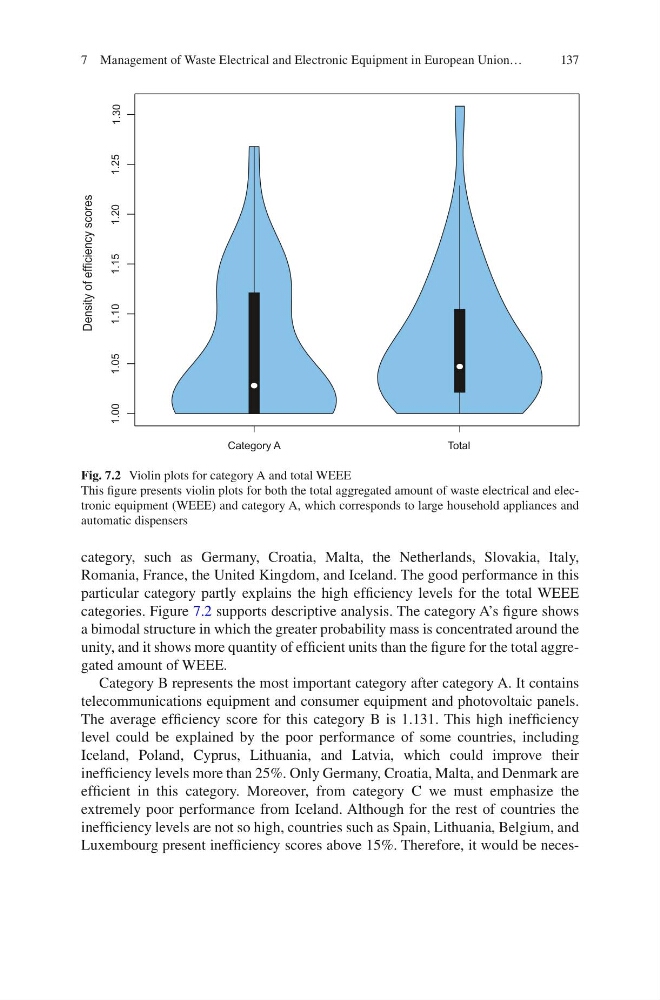
categories. Figure 7.2 supports descriptive analysis. The category A’s figure shows
a bimodal structure in which the greater probability mass is concentrated around the
unity, and it shows more quantity of efficient units than the figure for the total aggregated amount of WEEE.
Category B represents the most important category after category A. It contains
telecommunications equipment and consumer equipment and photovoltaic panels.
The average efficiency score for this category B is 1.131. This high inefficiency
level could be explained by the poor performance of some countries, including
Iceland, Poland, Cyprus, Lithuania, and Latvia, which could improve their
inefficiency levels more than 25%. Only Germany, Croatia, Malta, and Denmark are
efficient in this category. Moreover, from category C we must emphasize the
extremely poor performance from Iceland. Although for the rest of countries the
inefficiency levels are not so high, countries such as Spain, Lithuania, Belgium, and
Luxembourg present inefficiency scores above 15%. Therefore, it would be necesCategory A
T otal
1.15
1.20
Density of efficiency scores
1.25
1.00
1.30
1.05
1.10
Fig. 7.2 Violin plots for category A and total WEEE
This figure presents violin plots for both the total aggregated amount of waste electrical and electronic equipment (WEEE) and category A, which corresponds to large household appliances and
automatic dispensers
7 Management of Waste Electrical and Electronic Equipment in European Union…
category, such as Germany, Croatia, Malta, the Netherlands, Slovakia, Italy,
Romania, France, the United Kingdom, and Iceland. The good performance in this
particular category partly explains the high efficiency levels for the total WEEE
categories. Figure 7.2 supports descriptive analysis. The category A’s figure shows
a bimodal structure in which the greater probability mass is concentrated around the
unity, and it shows more quantity of efficient units than the figure for the total aggregated amount of WEEE.
Category B represents the most important category after category A. It contains
telecommunications equipment and consumer equipment and photovoltaic panels.
The average efficiency score for this category B is 1.131. This high inefficiency
level could be explained by the poor performance of some countries, including
Iceland, Poland, Cyprus, Lithuania, and Latvia, which could improve their
inefficiency levels more than 25%. Only Germany, Croatia, Malta, and Denmark are
efficient in this category. Moreover, from category C we must emphasize the
extremely poor performance from Iceland. Although for the rest of countries the
inefficiency levels are not so high, countries such as Spain, Lithuania, Belgium, and
Luxembourg present inefficiency scores above 15%. Therefore, it would be necesCategory A
T otal
1.15
1.20
Density of efficiency scores
1.25
1.00
1.30
1.05
1.10
Fig. 7.2 Violin plots for category A and total WEEE
This figure presents violin plots for both the total aggregated amount of waste electrical and electronic equipment (WEEE) and category A, which corresponds to large household appliances and
automatic dispensers
7 Management of Waste Electrical and Electronic Equipment in European Union…