

118
6.3.2 Mechanochemical Treatment
Mechanochemistry-mechanical and multiphase characteristics need higher
energized mills with various operating parameters like density, shear, and impact
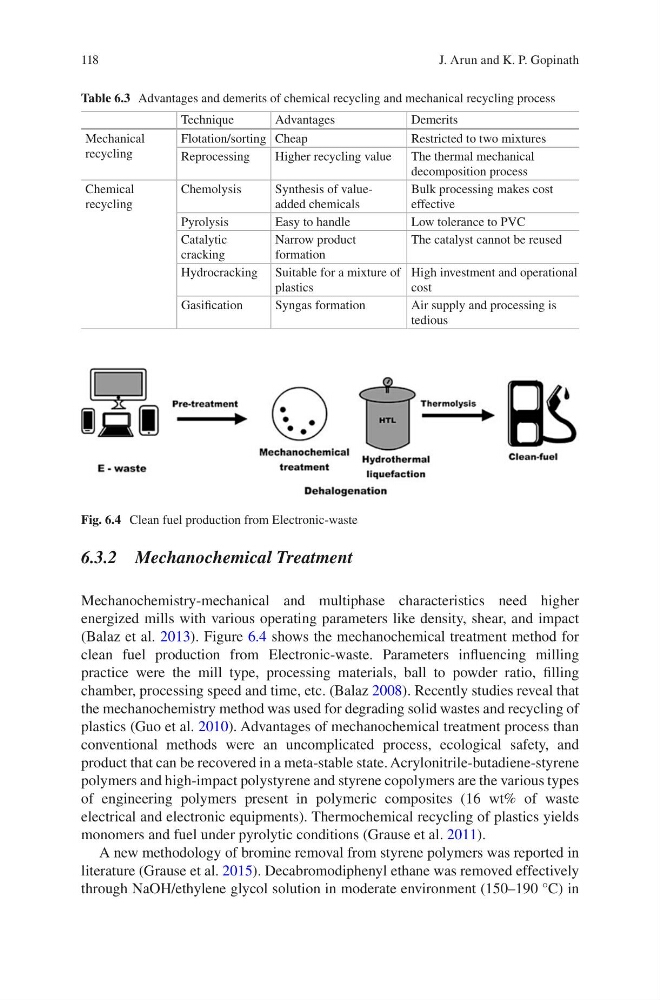
(Balaz et al. 2013). Figure 6.4 shows the mechanochemical treatment method for
clean fuel production from Electronic-waste. Parameters influencing milling
practice were the mill type, processing materials, ball to powder ratio, filling
chamber, processing speed and time, etc. (Balaz 2008). Recently studies reveal that
the mechanochemistry method was used for degrading solid wastes and recycling of
plastics (Guo et al. 2010). Advantages of mechanochemical treatment process than
conventional methods were an uncomplicated process, ecological safety, and
product that can be recovered in a meta-stable state. Acrylonitrile-butadiene-styrene
polymers and high-impact polystyrene and styrene copolymers are the various types
of engineering polymers present in polymeric composites (16 wt% of waste
electrical and electronic equipments). Thermochemical recycling of plastics yields
monomers and fuel under pyrolytic conditions (Grause et al. 2011).
A new methodology of bromine removal from styrene polymers was reported in
literature (Grause et al. 2015). Decabromodiphenyl ethane was removed effectively
through NaOH/ethylene glycol solution in moderate environment (150–190 °C) in
Table 6.3 Advantages and demerits of chemical recycling and mechanical recycling process
Technique
Advantages
Demerits
Mechanical
recycling
Flotation/sorting Cheap
Restricted to two mixtures
Reprocessing
Higher recycling value
The thermal mechanical
decomposition process
Chemical
recycling
Chemolysis
Synthesis of valueadded chemicals
Bulk processing makes cost
effective
Pyrolysis
Easy to handle
Low tolerance to PVC
Catalytic
cracking
Narrow product
formation
The catalyst cannot be reused
Hydrocracking Suitable for a mixture of
plastics
High investment and operational
cost
Gasification
Syngas formation
Air supply and processing is
tedious
Fig. 6.4 Clean fuel production from Electronic-waste
J. Arun and K. P. Gopinath
6.3.2 Mechanochemical Treatment
Mechanochemistry-mechanical and multiphase characteristics need higher
energized mills with various operating parameters like density, shear, and impact
(Balaz et al. 2013). Figure 6.4 shows the mechanochemical treatment method for
clean fuel production from Electronic-waste. Parameters influencing milling
practice were the mill type, processing materials, ball to powder ratio, filling
chamber, processing speed and time, etc. (Balaz 2008). Recently studies reveal that
the mechanochemistry method was used for degrading solid wastes and recycling of
plastics (Guo et al. 2010). Advantages of mechanochemical treatment process than
conventional methods were an uncomplicated process, ecological safety, and
product that can be recovered in a meta-stable state. Acrylonitrile-butadiene-styrene
polymers and high-impact polystyrene and styrene copolymers are the various types
of engineering polymers present in polymeric composites (16 wt% of waste
electrical and electronic equipments). Thermochemical recycling of plastics yields
monomers and fuel under pyrolytic conditions (Grause et al. 2011).
A new methodology of bromine removal from styrene polymers was reported in
literature (Grause et al. 2015). Decabromodiphenyl ethane was removed effectively
through NaOH/ethylene glycol solution in moderate environment (150–190 °C) in
Table 6.3 Advantages and demerits of chemical recycling and mechanical recycling process
Technique
Advantages
Demerits
Mechanical
recycling
Flotation/sorting Cheap
Restricted to two mixtures
Reprocessing
Higher recycling value
The thermal mechanical
decomposition process
Chemical
recycling
Chemolysis
Synthesis of valueadded chemicals
Bulk processing makes cost
effective
Pyrolysis
Easy to handle
Low tolerance to PVC
Catalytic
cracking
Narrow product
formation
The catalyst cannot be reused
Hydrocracking Suitable for a mixture of
plastics
High investment and operational
cost
Gasification
Syngas formation
Air supply and processing is
tedious
Fig. 6.4 Clean fuel production from Electronic-waste
J. Arun and K. P. Gopinath