

3.3 Scattering by a Particle with a Shifted Nucleus
45
×
cos
β
2
2σ +m
+m
sin
β
2
2n−2σ −m−m
,
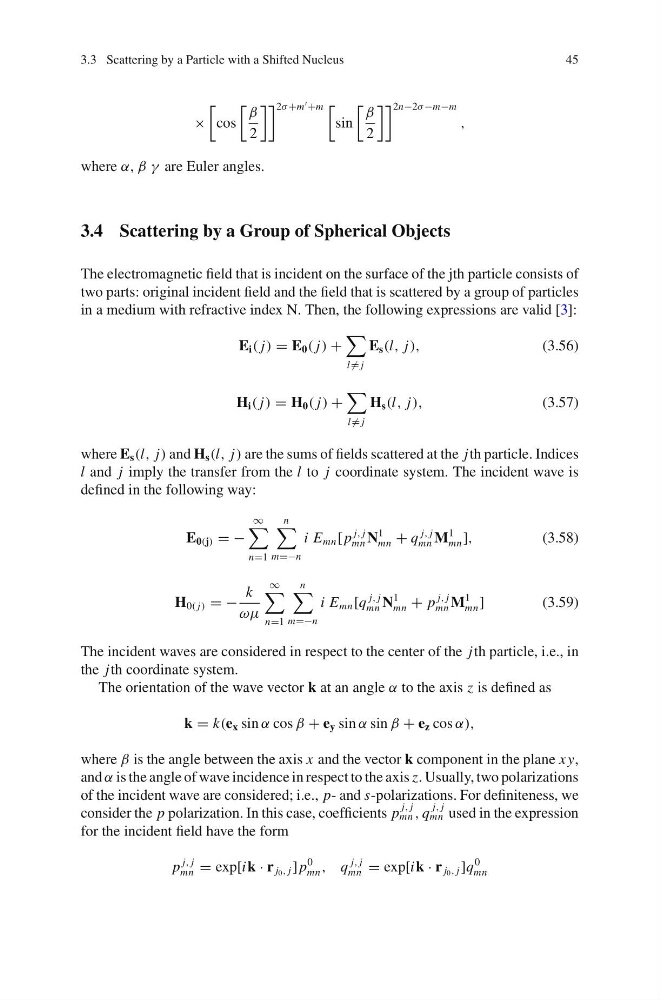
where α, β γ are Euler angles.
3.4 Scattering by a Group of Spherical Objects
The electromagnetic field that is incident on the surface of the jth particle consists of
two parts: original incident field and the field that is scattered by a group of particles
in a medium with refractive index N. Then, the following expressions are valid [3]:
E i ( j) = E 0 ( j) +
l = j
E s (l, j),
(3.56)
H i ( j) = H 0 ( j) +
l = j
H s (l, j),
(3.57)
where E s (l, j) and H s (l, j) are the sums of fields scattered at the jth particle. Indices
l and j imply the transfer from the l to j coordinate system. The incident wave is
defined in the following way:
E 0(j) = −
∞
n=1
n
m=−n
i E mn [ p
j, j
mn N
1
mn + q
j, j
mn M
1
mn ],
(3.58)
H 0( j) = −
k
ωμ
∞
n=1
n
m=−n
i E mn [q
j, j
mn N
1
mn + p
j, j
mn M
1
mn ]
(3.59)
The incident waves are considered in respect to the center of the jth particle, i.e., in
the jth coordinate system.
The orientation of the wave vector k at an angle α to the axis z is defined as
k = k(e x sin α cos β + e y sin α sin β + e z cos α),
where β is the angle between the axis x and the vector k component in the plane x y,
and α is the angle of wave incidence in respect to the axis z. Usually, two polarizations
of the incident wave are considered; i.e., p- and s-polarizations. For definiteness, we
consider the p polarization. In this case, coefficients p
j, j
mn , q
j, j
mn used in the expression
for the incident field have the form
p
j, j
mn = exp[ik · r j 0 , j ] p
0
mn , q
j, j
mn = exp[ik · r j 0 , j ]q
0
mn
45
×
cos
β
2
2σ +m
+m
sin
β
2
2n−2σ −m−m
,
where α, β γ are Euler angles.
3.4 Scattering by a Group of Spherical Objects
The electromagnetic field that is incident on the surface of the jth particle consists of
two parts: original incident field and the field that is scattered by a group of particles
in a medium with refractive index N. Then, the following expressions are valid [3]:
E i ( j) = E 0 ( j) +
l = j
E s (l, j),
(3.56)
H i ( j) = H 0 ( j) +
l = j
H s (l, j),
(3.57)
where E s (l, j) and H s (l, j) are the sums of fields scattered at the jth particle. Indices
l and j imply the transfer from the l to j coordinate system. The incident wave is
defined in the following way:
E 0(j) = −
∞
n=1
n
m=−n
i E mn [ p
j, j
mn N
1
mn + q
j, j
mn M
1
mn ],
(3.58)
H 0( j) = −
k
ωμ
∞
n=1
n
m=−n
i E mn [q
j, j
mn N
1
mn + p
j, j
mn M
1
mn ]
(3.59)
The incident waves are considered in respect to the center of the jth particle, i.e., in
the jth coordinate system.
The orientation of the wave vector k at an angle α to the axis z is defined as
k = k(e x sin α cos β + e y sin α sin β + e z cos α),
where β is the angle between the axis x and the vector k component in the plane x y,
and α is the angle of wave incidence in respect to the axis z. Usually, two polarizations
of the incident wave are considered; i.e., p- and s-polarizations. For definiteness, we
consider the p polarization. In this case, coefficients p
j, j
mn , q
j, j
mn used in the expression
for the incident field have the form
p
j, j
mn = exp[ik · r j 0 , j ] p
0
mn , q
j, j
mn = exp[ik · r j 0 , j ]q
0
mn