

3.3 Scattering by a Particle with a Shifted Nucleus
33
E I 2 ( j) =
∞
n=1
n
m=−n
E nm [d
j
nm 2 o
N
3
nm + c
j
nm 2 o
M
3
nm +
+ f
j
nm 2 o
M
4
nm + g
j
nm 2 o
N
4
nm ],
(3.12)
H I 2 ( j) =
k
j
2
ωμ
j
2
∞
n=1
n
m=−n
E nm [d
j
nm 2 o
M
3
nm + c
j
nm 2 o
N
3
nm +
+ f
j
nm 2 o
N
4
nm + g
j
nm 2 o
M
4
nm ].
(3.13)
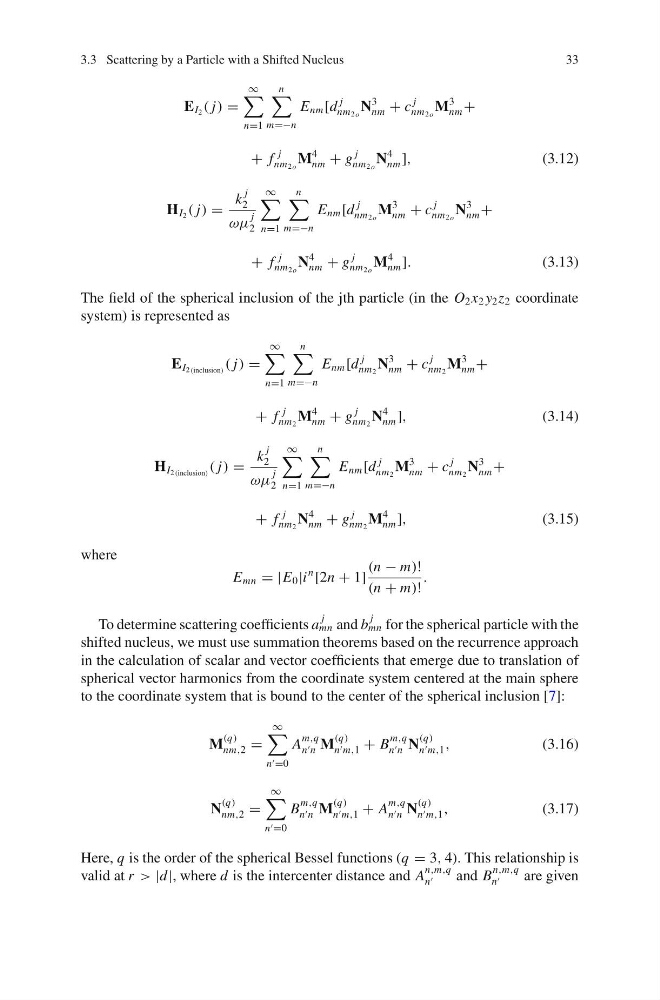
The field of the spherical inclusion of the jth particle (in the O 2 x 2 y 2 z 2 coordinate
system) is represented as
E I 2 (inclusion) ( j) =
∞
n=1
n
m=−n
E nm [d
j
nm 2
N
3
nm + c
j
nm 2
M
3
nm +
+ f
j
nm 2
M
4
nm + g
j
nm 2
N
4
nm ],
(3.14)
H I 2 (inclusion) ( j) =
k
j
2
ωμ
j
2
∞
n=1
n
m=−n
E nm [d
j
nm 2
M
3
nm + c
j
nm 2
N
3
nm +
+ f
j
nm 2
N
4
nm + g
j
nm 2
M
4
nm ],
(3.15)
where
E mn = |E 0 |i
n
[2n + 1]
(n − m)!
(n + m)!
.
To determine scattering coefficients a
j
mn and b
j
mn for the spherical particle with the
shifted nucleus, we must use summation theorems based on the recurrence approach
in the calculation of scalar and vector coefficients that emerge due to translation of
spherical vector harmonics from the coordinate system centered at the main sphere
to the coordinate system that is bound to the center of the spherical inclusion [7]:
M
(q)
nm,2 =
∞
n =0
A
m,q
n n M
(q)
n m,1 + B
m,q
n n N
(q)
n m,1 ,
(3.16)
N
(q)
nm,2 =
∞
n =0
B
m,q
n n M
(q)
n m,1 + A
m,q
n n N
(q)
n m,1 ,
(3.17)
Here, q is the order of the spherical Bessel functions (q = 3, 4). This relationship is
valid at r > |d|, where d is the intercenter distance and A
n,m,q
n
and B
n,m,q
n
are given
33
E I 2 ( j) =
∞
n=1
n
m=−n
E nm [d
j
nm 2 o
N
3
nm + c
j
nm 2 o
M
3
nm +
+ f
j
nm 2 o
M
4
nm + g
j
nm 2 o
N
4
nm ],
(3.12)
H I 2 ( j) =
k
j
2
ωμ
j
2
∞
n=1
n
m=−n
E nm [d
j
nm 2 o
M
3
nm + c
j
nm 2 o
N
3
nm +
+ f
j
nm 2 o
N
4
nm + g
j
nm 2 o
M
4
nm ].
(3.13)
The field of the spherical inclusion of the jth particle (in the O 2 x 2 y 2 z 2 coordinate
system) is represented as
E I 2 (inclusion) ( j) =
∞
n=1
n
m=−n
E nm [d
j
nm 2
N
3
nm + c
j
nm 2
M
3
nm +
+ f
j
nm 2
M
4
nm + g
j
nm 2
N
4
nm ],
(3.14)
H I 2 (inclusion) ( j) =
k
j
2
ωμ
j
2
∞
n=1
n
m=−n
E nm [d
j
nm 2
M
3
nm + c
j
nm 2
N
3
nm +
+ f
j
nm 2
N
4
nm + g
j
nm 2
M
4
nm ],
(3.15)
where
E mn = |E 0 |i
n
[2n + 1]
(n − m)!
(n + m)!
.
To determine scattering coefficients a
j
mn and b
j
mn for the spherical particle with the
shifted nucleus, we must use summation theorems based on the recurrence approach
in the calculation of scalar and vector coefficients that emerge due to translation of
spherical vector harmonics from the coordinate system centered at the main sphere
to the coordinate system that is bound to the center of the spherical inclusion [7]:
M
(q)
nm,2 =
∞
n =0
A
m,q
n n M
(q)
n m,1 + B
m,q
n n N
(q)
n m,1 ,
(3.16)
N
(q)
nm,2 =
∞
n =0
B
m,q
n n M
(q)
n m,1 + A
m,q
n n N
(q)
n m,1 ,
(3.17)
Here, q is the order of the spherical Bessel functions (q = 3, 4). This relationship is
valid at r > |d|, where d is the intercenter distance and A
n,m,q
n
and B
n,m,q
n
are given