

12.2 Algorithm for Solving the Inverse Problem
181
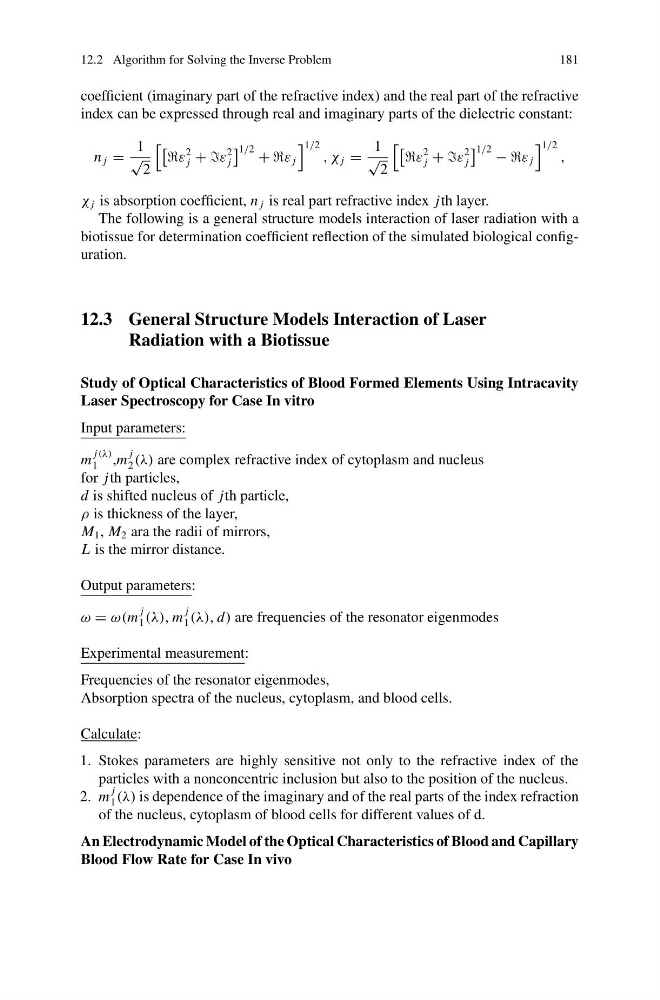
coefficient (imaginary part of the refractive index) and the real part of the refractive
index can be expressed through real and imaginary parts of the dielectric constant:
n j =
1
√
2
ε
2
j + +ε
2
j
1/2 + +ε j
1/2 , χ j =
1
√
2
ε
2
j + +ε
2
j
1/2 − −ε j
1/2 ,
χ j is absorption coefficient, n j is real part refractive index jth layer.
The following is a general structure models interaction of laser radiation with a
biotissue for determination coefficient reflection of the simulated biological configuration.
12.3 General Structure Models Interaction of Laser
Radiation with a Biotissue
Study of Optical Characteristics of Blood Formed Elements Using Intracavity
Laser Spectroscopy for Case In vitro
Input parameters:
m
j (λ)
1 ,m
j
2 (λ) are complex refractive index of cytoplasm and nucleus
for jth particles,
d is shifted nucleus of jth particle,
ρ is thickness of the layer,
M 1 , M 2 ara the radii of mirrors,
L is the mirror distance.
Output parameters:
ω = ω(m
j
1 (λ), m
j
1 (λ), d) are frequencies of the resonator eigenmodes
Experimental measurement:
Frequencies of the resonator eigenmodes,
Absorption spectra of the nucleus, cytoplasm, and blood cells.
Calculate:
1. Stokes parameters are highly sensitive not only to the refractive index of the
particles with a nonconcentric inclusion but also to the position of the nucleus.
2. m
j
1 (λ) is dependence of the imaginary and of the real parts of the index refraction
of the nucleus, cytoplasm of blood cells for different values of d.
An Electrodynamic Model of the Optical Characteristics of Blood and Capillary
Blood Flow Rate for Case In vivo
181
coefficient (imaginary part of the refractive index) and the real part of the refractive
index can be expressed through real and imaginary parts of the dielectric constant:
n j =
1
√
2
ε
2
j + +ε
2
j
1/2 + +ε j
1/2 , χ j =
1
√
2
ε
2
j + +ε
2
j
1/2 − −ε j
1/2 ,
χ j is absorption coefficient, n j is real part refractive index jth layer.
The following is a general structure models interaction of laser radiation with a
biotissue for determination coefficient reflection of the simulated biological configuration.
12.3 General Structure Models Interaction of Laser
Radiation with a Biotissue
Study of Optical Characteristics of Blood Formed Elements Using Intracavity
Laser Spectroscopy for Case In vitro
Input parameters:
m
j (λ)
1 ,m
j
2 (λ) are complex refractive index of cytoplasm and nucleus
for jth particles,
d is shifted nucleus of jth particle,
ρ is thickness of the layer,
M 1 , M 2 ara the radii of mirrors,
L is the mirror distance.
Output parameters:
ω = ω(m
j
1 (λ), m
j
1 (λ), d) are frequencies of the resonator eigenmodes
Experimental measurement:
Frequencies of the resonator eigenmodes,
Absorption spectra of the nucleus, cytoplasm, and blood cells.
Calculate:
1. Stokes parameters are highly sensitive not only to the refractive index of the
particles with a nonconcentric inclusion but also to the position of the nucleus.
2. m
j
1 (λ) is dependence of the imaginary and of the real parts of the index refraction
of the nucleus, cytoplasm of blood cells for different values of d.
An Electrodynamic Model of the Optical Characteristics of Blood and Capillary
Blood Flow Rate for Case In vivo