

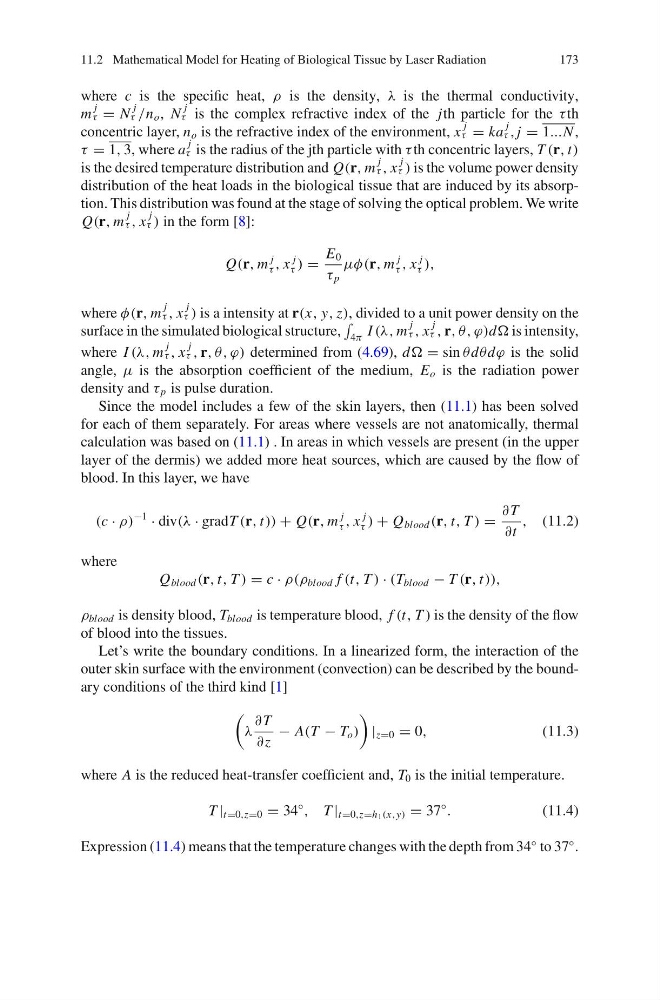
11.2 Mathematical Model for Heating of Biological Tissue by Laser Radiation
173
where c is the specific heat, ρ is the density, λ is the thermal conductivity,
m
j
τ = N
j
τ /n o , N
j
τ is the complex refractive index of the jth particle for the τ th
concentric layer, n o is the refractive index of the environment, x
j
τ = ka
j
τ , j = 1...N ,
τ = 1, 3, where a
j
τ is the radius of the jth particle with τ th concentric layers, T (r, t)
is the desired temperature distribution and Q(r, m
j
τ , x
j
τ ) is the volume power density
distribution of the heat loads in the biological tissue that are induced by its absorption. This distribution was found at the stage of solving the optical problem. We write
Q(r, m
j
τ , x
j
τ ) in the form [8]:
Q(r, m
j
τ , x
j
τ ) =
E 0
τ p
μφ(r, m
j
τ , x
j
τ ),
where φ(r, m
j
τ , x
j
τ ) is a intensity at r(x, y, z), divided to a unit power density on the
surface in the simulated biological structure,
4π I (λ, m
j
τ , x
j
τ , r, θ, ϕ)d is intensity,
where I (λ, m
j
τ , x
j
τ , r, θ, ϕ) determined from (4.69), d = sin θ dθ dϕ is the solid
angle, μ is the absorption coefficient of the medium, E o is the radiation power
density and τ p is pulse duration.
Since the model includes a few of the skin layers, then (11.1) has been solved
for each of them separately. For areas where vessels are not anatomically, thermal
calculation was based on (11.1) . In areas in which vessels are present (in the upper
layer of the dermis) we added more heat sources, which are caused by the flow of
blood. In this layer, we have
(c · ρ)
−1
· div(λ · gradT (r, t)) + Q(r, m
j
τ , x
j
τ ) + Q blood (r, t, T ) =
∂ T
∂t
, (11.2)
where
Q blood (r, t, T ) = c · ρ(ρ blood f (t, T ) · (T blood − T (r, t)),
ρ blood is density blood, T blood is temperature blood, f (t, T ) is the density of the flow
of blood into the tissues.
Let’s write the boundary conditions. In a linearized form, the interaction of the
outer skin surface with the environment (convection) can be described by the boundary conditions of the third kind [1]
λ
∂ T
∂z
− A(T − T o )
| z=0 = 0,
(11.3)
where A is the reduced heat-transfer coefficient and, T 0 is the initial temperature.
T | t=0,z=0 = 34
◦
, T | t=0,z=h 1 (x,y) = 37
◦
.
(11.4)
Expression (11.4) means that the temperature changes with the depth from 34
◦ to 37
◦ .
173
where c is the specific heat, ρ is the density, λ is the thermal conductivity,
m
j
τ = N
j
τ /n o , N
j
τ is the complex refractive index of the jth particle for the τ th
concentric layer, n o is the refractive index of the environment, x
j
τ = ka
j
τ , j = 1...N ,
τ = 1, 3, where a
j
τ is the radius of the jth particle with τ th concentric layers, T (r, t)
is the desired temperature distribution and Q(r, m
j
τ , x
j
τ ) is the volume power density
distribution of the heat loads in the biological tissue that are induced by its absorption. This distribution was found at the stage of solving the optical problem. We write
Q(r, m
j
τ , x
j
τ ) in the form [8]:
Q(r, m
j
τ , x
j
τ ) =
E 0
τ p
μφ(r, m
j
τ , x
j
τ ),
where φ(r, m
j
τ , x
j
τ ) is a intensity at r(x, y, z), divided to a unit power density on the
surface in the simulated biological structure,
4π I (λ, m
j
τ , x
j
τ , r, θ, ϕ)d is intensity,
where I (λ, m
j
τ , x
j
τ , r, θ, ϕ) determined from (4.69), d = sin θ dθ dϕ is the solid
angle, μ is the absorption coefficient of the medium, E o is the radiation power
density and τ p is pulse duration.
Since the model includes a few of the skin layers, then (11.1) has been solved
for each of them separately. For areas where vessels are not anatomically, thermal
calculation was based on (11.1) . In areas in which vessels are present (in the upper
layer of the dermis) we added more heat sources, which are caused by the flow of
blood. In this layer, we have
(c · ρ)
−1
· div(λ · gradT (r, t)) + Q(r, m
j
τ , x
j
τ ) + Q blood (r, t, T ) =
∂ T
∂t
, (11.2)
where
Q blood (r, t, T ) = c · ρ(ρ blood f (t, T ) · (T blood − T (r, t)),
ρ blood is density blood, T blood is temperature blood, f (t, T ) is the density of the flow
of blood into the tissues.
Let’s write the boundary conditions. In a linearized form, the interaction of the
outer skin surface with the environment (convection) can be described by the boundary conditions of the third kind [1]
λ
∂ T
∂z
− A(T − T o )
| z=0 = 0,
(11.3)
where A is the reduced heat-transfer coefficient and, T 0 is the initial temperature.
T | t=0,z=0 = 34
◦
, T | t=0,z=h 1 (x,y) = 37
◦
.
(11.4)
Expression (11.4) means that the temperature changes with the depth from 34
◦ to 37
◦ .