

1.2 The Structure and Optical Properties of Biological Tissues
3
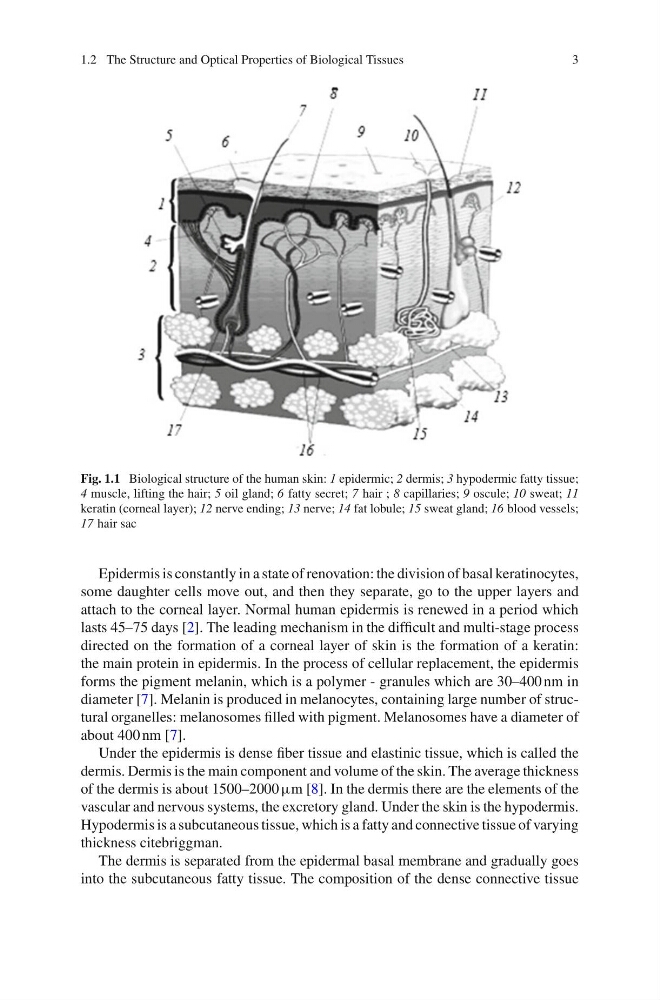
Fig. 1.1 Biological structure of the human skin: 1 epidermic; 2 dermis; 3 hypodermic fatty tissue;
4 muscle, lifting the hair; 5 oil gland; 6 fatty secret; 7 hair ; 8 capillaries; 9 oscule; 10 sweat; 11
keratin (corneal layer); 12 nerve ending; 13 nerve; 14 fat lobule; 15 sweat gland; 16 blood vessels;
17 hair sac
Epidermis is constantly in a state of renovation: the division of basal keratinocytes,
some daughter cells move out, and then they separate, go to the upper layers and
attach to the corneal layer. Normal human epidermis is renewed in a period which
lasts 45–75 days [2]. The leading mechanism in the difficult and multi-stage process
directed on the formation of a corneal layer of skin is the formation of a keratin:
the main protein in epidermis. In the process of cellular replacement, the epidermis
forms the pigment melanin, which is a polymer - granules which are 30–400 nm in
diameter [7]. Melanin is produced in melanocytes, containing large number of structural organelles: melanosomes filled with pigment. Melanosomes have a diameter of
about 400 nm [7].
Under the epidermis is dense fiber tissue and elastinic tissue, which is called the
dermis. Dermis is the main component and volume of the skin. The average thickness
of the dermis is about 1500–2000 µm [8]. In the dermis there are the elements of the
vascular and nervous systems, the excretory gland. Under the skin is the hypodermis.
Hypodermis is a subcutaneous tissue, which is a fatty and connective tissue of varying
thickness citebriggman.
The dermis is separated from the epidermal basal membrane and gradually goes
into the subcutaneous fatty tissue. The composition of the dense connective tissue
3
Fig. 1.1 Biological structure of the human skin: 1 epidermic; 2 dermis; 3 hypodermic fatty tissue;
4 muscle, lifting the hair; 5 oil gland; 6 fatty secret; 7 hair ; 8 capillaries; 9 oscule; 10 sweat; 11
keratin (corneal layer); 12 nerve ending; 13 nerve; 14 fat lobule; 15 sweat gland; 16 blood vessels;
17 hair sac
Epidermis is constantly in a state of renovation: the division of basal keratinocytes,
some daughter cells move out, and then they separate, go to the upper layers and
attach to the corneal layer. Normal human epidermis is renewed in a period which
lasts 45–75 days [2]. The leading mechanism in the difficult and multi-stage process
directed on the formation of a corneal layer of skin is the formation of a keratin:
the main protein in epidermis. In the process of cellular replacement, the epidermis
forms the pigment melanin, which is a polymer - granules which are 30–400 nm in
diameter [7]. Melanin is produced in melanocytes, containing large number of structural organelles: melanosomes filled with pigment. Melanosomes have a diameter of
about 400 nm [7].
Under the epidermis is dense fiber tissue and elastinic tissue, which is called the
dermis. Dermis is the main component and volume of the skin. The average thickness
of the dermis is about 1500–2000 µm [8]. In the dermis there are the elements of the
vascular and nervous systems, the excretory gland. Under the skin is the hypodermis.
Hypodermis is a subcutaneous tissue, which is a fatty and connective tissue of varying
thickness citebriggman.
The dermis is separated from the epidermal basal membrane and gradually goes
into the subcutaneous fatty tissue. The composition of the dense connective tissue