

6.7 Numerical Calculations for a Model Medium and Conclusions
127
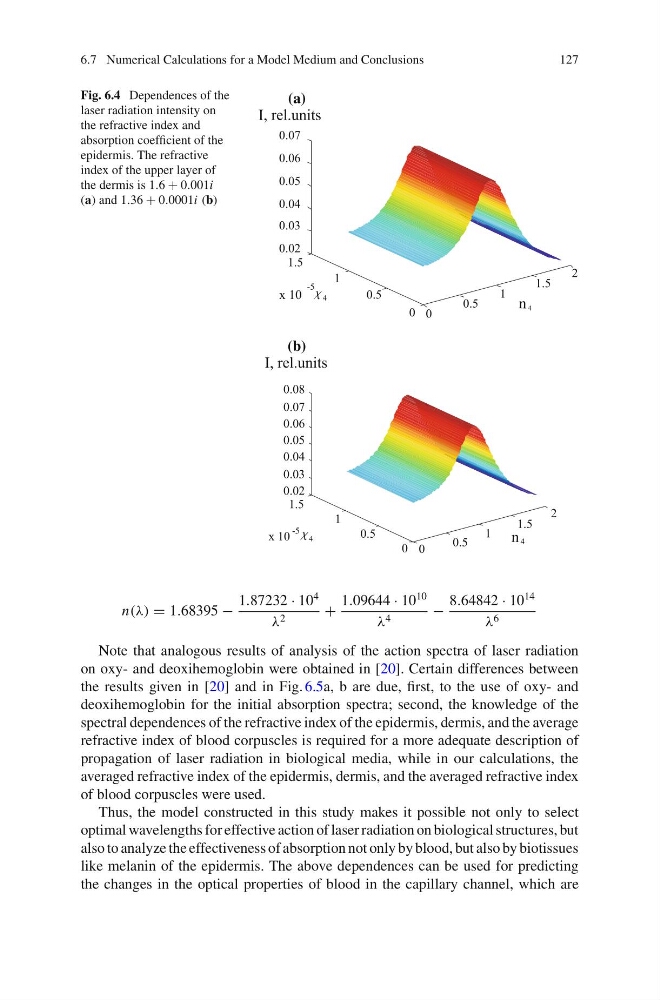
Fig. 6.4 Dependences of the
laser radiation intensity on
the refractive index and
absorption coefficient of the
epidermis. The refractive
index of the upper layer of
the dermis is 1.6 + 0.001i
(a) and 1.36 + 0.0001i (b)
0
0.5
1
1.5
2
0
0.5
1
1.5
-5
0.02
0.03
0.04
0.05
0.06
0.07
n 4
0
0.5
1
1.5
2
0
0.5
1
1.5
-5
0.02
0.03
0.04
0.05
0.06
0.07
0.08
n 4
(a)
(b)
n(λ) = 1.68395 −
1.87232 · 10
4
λ 2
+
1.09644 · 10
10
λ 4
−
8.64842 · 10
14
λ 6
Note that analogous results of analysis of the action spectra of laser radiation
on oxy- and deoxihemoglobin were obtained in [20]. Certain differences between
the results given in [20] and in Fig. 6.5a, b are due, first, to the use of oxy- and
deoxihemoglobin for the initial absorption spectra; second, the knowledge of the
spectral dependences of the refractive index of the epidermis, dermis, and the average
refractive index of blood corpuscles is required for a more adequate description of
propagation of laser radiation in biological media, while in our calculations, the
averaged refractive index of the epidermis, dermis, and the averaged refractive index
of blood corpuscles were used.
Thus, the model constructed in this study makes it possible not only to select
optimal wavelengths for effective action of laser radiation on biological structures, but
also to analyze the effectiveness of absorption not only by blood, but also by biotissues
like melanin of the epidermis. The above dependences can be used for predicting
the changes in the optical properties of blood in the capillary channel, which are
127
Fig. 6.4 Dependences of the
laser radiation intensity on
the refractive index and
absorption coefficient of the
epidermis. The refractive
index of the upper layer of
the dermis is 1.6 + 0.001i
(a) and 1.36 + 0.0001i (b)
0
0.5
1
1.5
2
0
0.5
1
1.5
-5
0.02
0.03
0.04
0.05
0.06
0.07
n 4
0
0.5
1
1.5
2
0
0.5
1
1.5
-5
0.02
0.03
0.04
0.05
0.06
0.07
0.08
n 4
(a)
(b)
n(λ) = 1.68395 −
1.87232 · 10
4
λ 2
+
1.09644 · 10
10
λ 4
−
8.64842 · 10
14
λ 6
Note that analogous results of analysis of the action spectra of laser radiation
on oxy- and deoxihemoglobin were obtained in [20]. Certain differences between
the results given in [20] and in Fig. 6.5a, b are due, first, to the use of oxy- and
deoxihemoglobin for the initial absorption spectra; second, the knowledge of the
spectral dependences of the refractive index of the epidermis, dermis, and the average
refractive index of blood corpuscles is required for a more adequate description of
propagation of laser radiation in biological media, while in our calculations, the
averaged refractive index of the epidermis, dermis, and the averaged refractive index
of blood corpuscles were used.
Thus, the model constructed in this study makes it possible not only to select
optimal wavelengths for effective action of laser radiation on biological structures, but
also to analyze the effectiveness of absorption not only by blood, but also by biotissues
like melanin of the epidermis. The above dependences can be used for predicting
the changes in the optical properties of blood in the capillary channel, which are