

124
6 Light Scattering by Dielectric Bodies of Irregular …
In analysis of the efficiency of photochemical and photophysical processes, we
will use the concept of action spectrum. The spectrum of light action on a tissue
component is the total power of radiation absorbed by this component in unit volume
of the medium when monochromatic light of unit power density is incident on the
surface of the medium [20]:
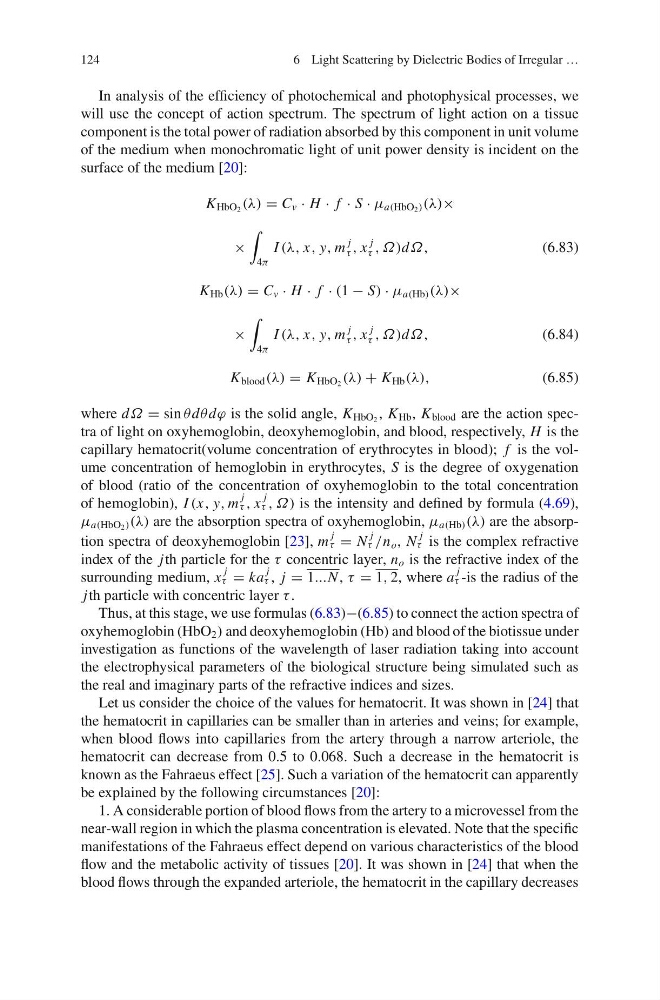
K HbO 2 (λ) = C v · H · f · S · μ a(HbO 2 ) (λ)×
×
4π
I (λ, x, y, m
j
τ , x
j
τ , Ω)dΩ,
(6.83)
K Hb (λ) = C v · H · f · (1 − S) · μ a(Hb) (λ)×
×
4π
I (λ, x, y, m
j
τ , x
j
τ , Ω)dΩ,
(6.84)
K blood (λ) = K HbO 2 (λ) + K Hb (λ),
(6.85)
where dΩ = sin θ dθ dϕ is the solid angle, K HbO 2 , K Hb , K blood are the action spectra of light on oxyhemoglobin, deoxyhemoglobin, and blood, respectively, H is the
capillary hematocrit(volume concentration of erythrocytes in blood); f is the volume concentration of hemoglobin in erythrocytes, S is the degree of oxygenation
of blood (ratio of the concentration of oxyhemoglobin to the total concentration
of hemoglobin), I (x, y, m
j
τ , x
j
τ , Ω) is the intensity and defined by formula (4.69),
μ a(HbO 2 ) (λ) are the absorption spectra of oxyhemoglobin, μ a(Hb) (λ) are the absorption spectra of deoxyhemoglobin [23], m
j
τ = N
j
τ /n o , N
j
τ is the complex refractive
index of the jth particle for the τ concentric layer, n o is the refractive index of the
surrounding medium, x
j
τ = ka
j
τ , j = 1...N , τ = 1, 2, where a
j
τ -is the radius of the
jth particle with concentric layer τ .
Thus, at this stage, we use formulas (6.83)−(6.85) to connect the action spectra of
oxyhemoglobin (HbO 2 ) and deoxyhemoglobin (Hb) and blood of the biotissue under
investigation as functions of the wavelength of laser radiation taking into account
the electrophysical parameters of the biological structure being simulated such as
the real and imaginary parts of the refractive indices and sizes.
Let us consider the choice of the values for hematocrit. It was shown in [24] that
the hematocrit in capillaries can be smaller than in arteries and veins; for example,
when blood flows into capillaries from the artery through a narrow arteriole, the
hematocrit can decrease from 0.5 to 0.068. Such a decrease in the hematocrit is
known as the Fahraeus effect [25]. Such a variation of the hematocrit can apparently
be explained by the following circumstances [20]:
1. A considerable portion of blood flows from the artery to a microvessel from the
near-wall region in which the plasma concentration is elevated. Note that the specific
manifestations of the Fahraeus effect depend on various characteristics of the blood
flow and the metabolic activity of tissues [20]. It was shown in [24] that when the
blood flows through the expanded arteriole, the hematocrit in the capillary decreases
6 Light Scattering by Dielectric Bodies of Irregular …
In analysis of the efficiency of photochemical and photophysical processes, we
will use the concept of action spectrum. The spectrum of light action on a tissue
component is the total power of radiation absorbed by this component in unit volume
of the medium when monochromatic light of unit power density is incident on the
surface of the medium [20]:
K HbO 2 (λ) = C v · H · f · S · μ a(HbO 2 ) (λ)×
×
4π
I (λ, x, y, m
j
τ , x
j
τ , Ω)dΩ,
(6.83)
K Hb (λ) = C v · H · f · (1 − S) · μ a(Hb) (λ)×
×
4π
I (λ, x, y, m
j
τ , x
j
τ , Ω)dΩ,
(6.84)
K blood (λ) = K HbO 2 (λ) + K Hb (λ),
(6.85)
where dΩ = sin θ dθ dϕ is the solid angle, K HbO 2 , K Hb , K blood are the action spectra of light on oxyhemoglobin, deoxyhemoglobin, and blood, respectively, H is the
capillary hematocrit(volume concentration of erythrocytes in blood); f is the volume concentration of hemoglobin in erythrocytes, S is the degree of oxygenation
of blood (ratio of the concentration of oxyhemoglobin to the total concentration
of hemoglobin), I (x, y, m
j
τ , x
j
τ , Ω) is the intensity and defined by formula (4.69),
μ a(HbO 2 ) (λ) are the absorption spectra of oxyhemoglobin, μ a(Hb) (λ) are the absorption spectra of deoxyhemoglobin [23], m
j
τ = N
j
τ /n o , N
j
τ is the complex refractive
index of the jth particle for the τ concentric layer, n o is the refractive index of the
surrounding medium, x
j
τ = ka
j
τ , j = 1...N , τ = 1, 2, where a
j
τ -is the radius of the
jth particle with concentric layer τ .
Thus, at this stage, we use formulas (6.83)−(6.85) to connect the action spectra of
oxyhemoglobin (HbO 2 ) and deoxyhemoglobin (Hb) and blood of the biotissue under
investigation as functions of the wavelength of laser radiation taking into account
the electrophysical parameters of the biological structure being simulated such as
the real and imaginary parts of the refractive indices and sizes.
Let us consider the choice of the values for hematocrit. It was shown in [24] that
the hematocrit in capillaries can be smaller than in arteries and veins; for example,
when blood flows into capillaries from the artery through a narrow arteriole, the
hematocrit can decrease from 0.5 to 0.068. Such a decrease in the hematocrit is
known as the Fahraeus effect [25]. Such a variation of the hematocrit can apparently
be explained by the following circumstances [20]:
1. A considerable portion of blood flows from the artery to a microvessel from the
near-wall region in which the plasma concentration is elevated. Note that the specific
manifestations of the Fahraeus effect depend on various characteristics of the blood
flow and the metabolic activity of tissues [20]. It was shown in [24] that when the
blood flows through the expanded arteriole, the hematocrit in the capillary decreases