

6.3 Explicit Expressions for the Integrals with Vector …
109
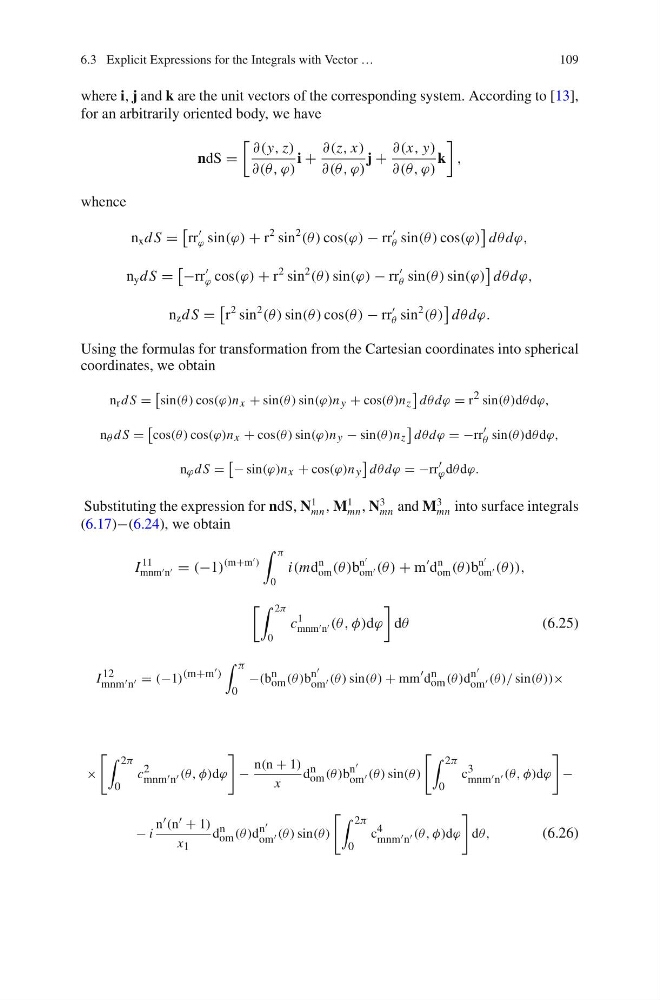
where i, j and k are the unit vectors of the corresponding system. According to [13],
for an arbitrarily oriented body, we have
ndS =
∂(y, z)
∂(θ, ϕ)
i +
∂(z, x)
∂(θ, ϕ)
j +
∂(x, y)
∂(θ, ϕ)
k
,
whence
n x d S =
rr
ϕ sin(ϕ) + r
2 sin
2
(θ ) cos(ϕ) − rr
θ sin(θ ) cos(ϕ)
dθ dϕ,
n y d S =
−rr
ϕ cos(ϕ) + r
2 sin
2
(θ ) sin(ϕ) − rr
θ sin(θ ) sin(ϕ)
dθ dϕ,
n z d S =
r
2 sin
2
(θ ) sin(θ ) cos(θ ) − rr
θ sin
2
(θ )
dθ dϕ.
Using the formulas for transformation from the Cartesian coordinates into spherical
coordinates, we obtain
n r d S =
sin(θ) cos(ϕ)n x + sin(θ) sin(ϕ)n y + cos(θ)n z
dθdϕ = r 2 sin(θ)dθdϕ,
n θ d S =
cos(θ) cos(ϕ)n x + cos(θ) sin(ϕ)n y − sin(θ)n z
dθdϕ = −rr
θ sin(θ)dθdϕ,
n ϕ d S =
− sin(ϕ)n x + cos(ϕ)n y
dθdϕ = −rr
ϕ dθdϕ.
Substituting the expression for ndS, N
1
mn , M
1
mn , N
3
mn and M
3
mn into surface integrals
(6.17)−(6.24), we obtain
I
11
mnm n = (−1)
(m+m
)
π
0
i(md
n
om (θ )b
n
om (θ ) + m
d
n
om (θ )b
n
om (θ )),
2π
0
c
1
mnm n (θ, φ)dϕ
dθ
(6.25)
I 12
mnm n = (−1) (m+m )
π
0
−(b n
om (θ)b n
om (θ) sin(θ) + mm d n
om (θ)d n
om (θ)/ sin(θ))×
×
2π
0
c 2
mnm n (θ, φ)dϕ
−
n(n + 1)
x
d n
om (θ)b n
om (θ) sin(θ)
2π
0
c 3
mnm n (θ, φ)dϕ
−
− i
n (n + 1)
x 1
d n
om (θ)d n
om (θ) sin(θ)
2π
0
c 4
mnm n (θ, φ)dϕ
dθ,
(6.26)
109
where i, j and k are the unit vectors of the corresponding system. According to [13],
for an arbitrarily oriented body, we have
ndS =
∂(y, z)
∂(θ, ϕ)
i +
∂(z, x)
∂(θ, ϕ)
j +
∂(x, y)
∂(θ, ϕ)
k
,
whence
n x d S =
rr
ϕ sin(ϕ) + r
2 sin
2
(θ ) cos(ϕ) − rr
θ sin(θ ) cos(ϕ)
dθ dϕ,
n y d S =
−rr
ϕ cos(ϕ) + r
2 sin
2
(θ ) sin(ϕ) − rr
θ sin(θ ) sin(ϕ)
dθ dϕ,
n z d S =
r
2 sin
2
(θ ) sin(θ ) cos(θ ) − rr
θ sin
2
(θ )
dθ dϕ.
Using the formulas for transformation from the Cartesian coordinates into spherical
coordinates, we obtain
n r d S =
sin(θ) cos(ϕ)n x + sin(θ) sin(ϕ)n y + cos(θ)n z
dθdϕ = r 2 sin(θ)dθdϕ,
n θ d S =
cos(θ) cos(ϕ)n x + cos(θ) sin(ϕ)n y − sin(θ)n z
dθdϕ = −rr
θ sin(θ)dθdϕ,
n ϕ d S =
− sin(ϕ)n x + cos(ϕ)n y
dθdϕ = −rr
ϕ dθdϕ.
Substituting the expression for ndS, N
1
mn , M
1
mn , N
3
mn and M
3
mn into surface integrals
(6.17)−(6.24), we obtain
I
11
mnm n = (−1)
(m+m
)
π
0
i(md
n
om (θ )b
n
om (θ ) + m
d
n
om (θ )b
n
om (θ )),
2π
0
c
1
mnm n (θ, φ)dϕ
dθ
(6.25)
I 12
mnm n = (−1) (m+m )
π
0
−(b n
om (θ)b n
om (θ) sin(θ) + mm d n
om (θ)d n
om (θ)/ sin(θ))×
×
2π
0
c 2
mnm n (θ, φ)dϕ
−
n(n + 1)
x
d n
om (θ)b n
om (θ) sin(θ)
2π
0
c 3
mnm n (θ, φ)dϕ
−
− i
n (n + 1)
x 1
d n
om (θ)d n
om (θ) sin(θ)
2π
0
c 4
mnm n (θ, φ)dϕ
dθ,
(6.26)