

6.2 Matrix Formulation of Scattering for the jth Particle …
105
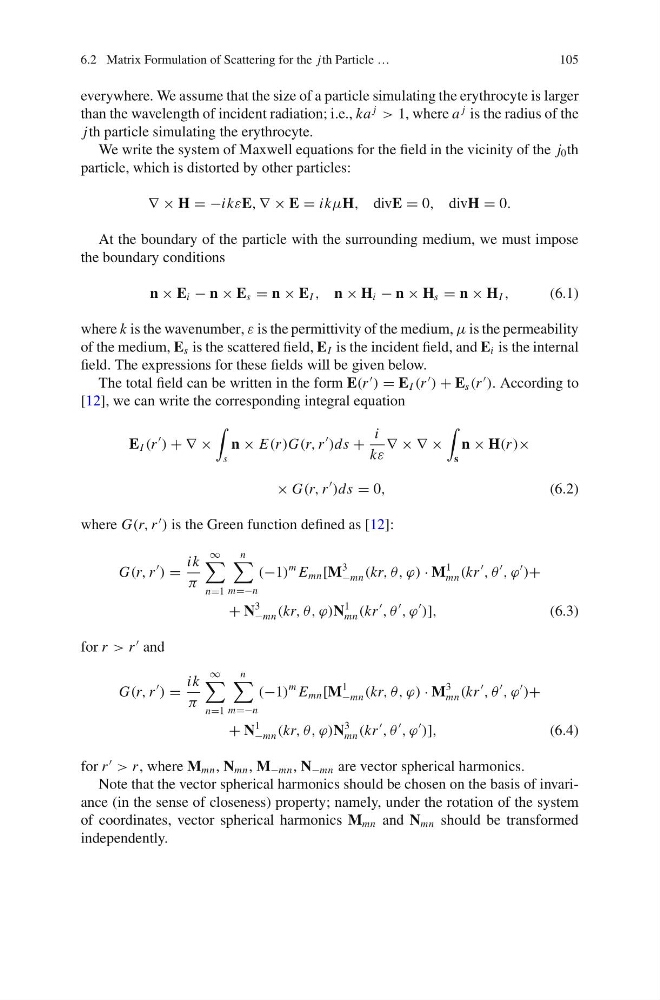
everywhere. We assume that the size of a particle simulating the erythrocyte is larger
than the wavelength of incident radiation; i.e., ka
j
> 1, where a
j is the radius of the
jth particle simulating the erythrocyte.
We write the system of Maxwell equations for the field in the vicinity of the j 0 th
particle, which is distorted by other particles:
∇ × H = −ikεE, ∇ × E = ikμH, divE = 0, divH = 0.
At the boundary of the particle with the surrounding medium, we must impose
the boundary conditions
n × E i − n × E s = n × E I , n × H i − n × H s = n × H I ,
(6.1)
where k is the wavenumber, ε is the permittivity of the medium, μ is the permeability
of the medium, E s is the scattered field, E I is the incident field, and E i is the internal
field. The expressions for these fields will be given below.
The total field can be written in the form E(r
) = E I (r
) + E s (r
). According to
[12], we can write the corresponding integral equation
E I (r
) + ∇ ×
s
n × E(r )G(r, r
)ds +
i
kε
∇ × ∇ ×
s
n × H(r )×
× G(r, r
)ds = 0,
(6.2)
where G(r, r
) is the Green function defined as [12]:
G(r, r
) =
ik
π
∞
n=1
n
m=−n
(−1)
m E mn [M
3
−mn (kr, θ, ϕ) · M
1
mn (kr
, θ
, ϕ
)+
+ N
3
−mn (kr, θ, ϕ)N
1
mn (kr
, θ
, ϕ
)],
(6.3)
for r > r
and
G(r, r
) =
ik
π
∞
n=1
n
m=−n
(−1)
m E mn [M
1
−mn (kr, θ, ϕ) · M
3
mn (kr
, θ
, ϕ
)+
+ N
1
−mn (kr, θ, ϕ)N
3
mn (kr
, θ
, ϕ
)],
(6.4)
for r
> r , where M mn , N mn , M −mn , N −mn are vector spherical harmonics.
Note that the vector spherical harmonics should be chosen on the basis of invariance (in the sense of closeness) property; namely, under the rotation of the system
of coordinates, vector spherical harmonics M mn and N mn should be transformed
independently.
105
everywhere. We assume that the size of a particle simulating the erythrocyte is larger
than the wavelength of incident radiation; i.e., ka
j
> 1, where a
j is the radius of the
jth particle simulating the erythrocyte.
We write the system of Maxwell equations for the field in the vicinity of the j 0 th
particle, which is distorted by other particles:
∇ × H = −ikεE, ∇ × E = ikμH, divE = 0, divH = 0.
At the boundary of the particle with the surrounding medium, we must impose
the boundary conditions
n × E i − n × E s = n × E I , n × H i − n × H s = n × H I ,
(6.1)
where k is the wavenumber, ε is the permittivity of the medium, μ is the permeability
of the medium, E s is the scattered field, E I is the incident field, and E i is the internal
field. The expressions for these fields will be given below.
The total field can be written in the form E(r
) = E I (r
) + E s (r
). According to
[12], we can write the corresponding integral equation
E I (r
) + ∇ ×
s
n × E(r )G(r, r
)ds +
i
kε
∇ × ∇ ×
s
n × H(r )×
× G(r, r
)ds = 0,
(6.2)
where G(r, r
) is the Green function defined as [12]:
G(r, r
) =
ik
π
∞
n=1
n
m=−n
(−1)
m E mn [M
3
−mn (kr, θ, ϕ) · M
1
mn (kr
, θ
, ϕ
)+
+ N
3
−mn (kr, θ, ϕ)N
1
mn (kr
, θ
, ϕ
)],
(6.3)
for r > r
and
G(r, r
) =
ik
π
∞
n=1
n
m=−n
(−1)
m E mn [M
1
−mn (kr, θ, ϕ) · M
3
mn (kr
, θ
, ϕ
)+
+ N
1
−mn (kr, θ, ϕ)N
3
mn (kr
, θ
, ϕ
)],
(6.4)
for r
> r , where M mn , N mn , M −mn , N −mn are vector spherical harmonics.
Note that the vector spherical harmonics should be chosen on the basis of invariance (in the sense of closeness) property; namely, under the rotation of the system
of coordinates, vector spherical harmonics M mn and N mn should be transformed
independently.