

74
M. Congedo
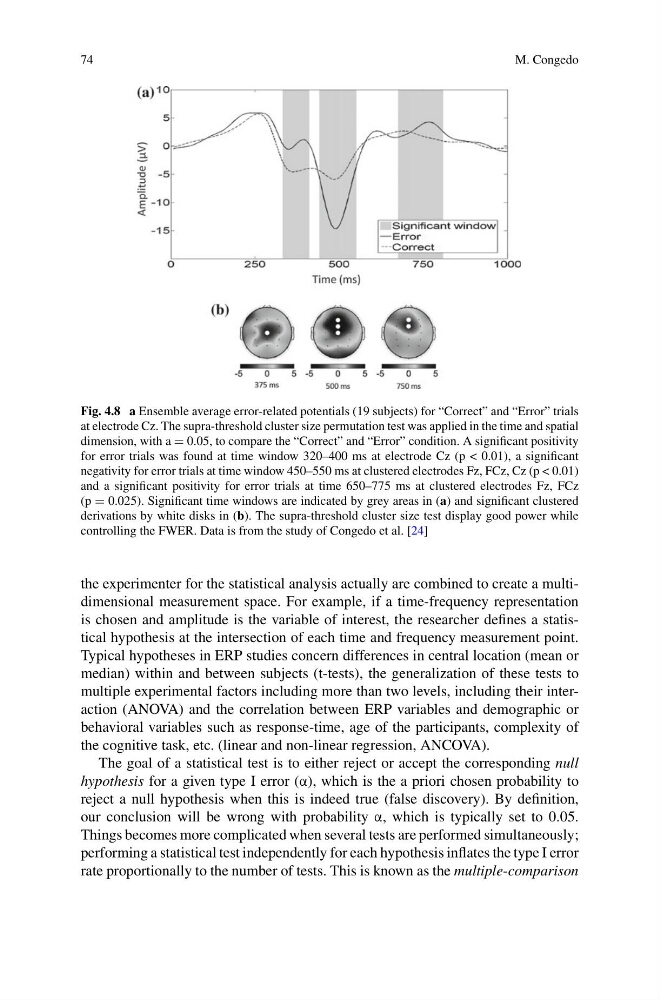
Fig. 4.8 a Ensemble average error-related potentials (19 subjects) for “Correct” and “Error” trials
at electrode Cz. The supra-threshold cluster size permutation test was applied in the time and spatial
dimension, with a 0.05, to compare the “Correct” and “Error” condition. A significant positivity
for error trials was found at time window 320–400 ms at electrode Cz (p < 0.01), a significant
negativity for error trials at time window 450–550 ms at clustered electrodes Fz, FCz, Cz (p < 0.01)
and a significant positivity for error trials at time 650–775 ms at clustered electrodes Fz, FCz
(p 0.025). Significant time windows are indicated by grey areas in (a) and significant clustered
derivations by white disks in (b). The supra-threshold cluster size test display good power while
controlling the FWER. Data is from the study of Congedo et al. [24]
the experimenter for the statistical analysis actually are combined to create a multidimensional measurement space. For example, if a time-frequency representation
is chosen and amplitude is the variable of interest, the researcher defines a statistical hypothesis at the intersection of each time and frequency measurement point.
Typical hypotheses in ERP studies concern differences in central location (mean or
median) within and between subjects (t-tests), the generalization of these tests to
multiple experimental factors including more than two levels, including their interaction (ANOVA) and the correlation between ERP variables and demographic or
behavioral variables such as response-time, age of the participants, complexity of
the cognitive task, etc. (linear and non-linear regression, ANCOVA).
The goal of a statistical test is to either reject or accept the corresponding null
hypothesis for a given type I error (α), which is the a priori chosen probability to
reject a null hypothesis when this is indeed true (false discovery). By definition,
our conclusion will be wrong with probability α, which is typically set to 0.05.
Things becomes more complicated when several tests are performed simultaneously;
performing a statistical test independently for each hypothesis inflates the type I error
rate proportionally to the number of tests. This is known as the multiple-comparison
M. Congedo
Fig. 4.8 a Ensemble average error-related potentials (19 subjects) for “Correct” and “Error” trials
at electrode Cz. The supra-threshold cluster size permutation test was applied in the time and spatial
dimension, with a 0.05, to compare the “Correct” and “Error” condition. A significant positivity
for error trials was found at time window 320–400 ms at electrode Cz (p < 0.01), a significant
negativity for error trials at time window 450–550 ms at clustered electrodes Fz, FCz, Cz (p < 0.01)
and a significant positivity for error trials at time 650–775 ms at clustered electrodes Fz, FCz
(p 0.025). Significant time windows are indicated by grey areas in (a) and significant clustered
derivations by white disks in (b). The supra-threshold cluster size test display good power while
controlling the FWER. Data is from the study of Congedo et al. [24]
the experimenter for the statistical analysis actually are combined to create a multidimensional measurement space. For example, if a time-frequency representation
is chosen and amplitude is the variable of interest, the researcher defines a statistical hypothesis at the intersection of each time and frequency measurement point.
Typical hypotheses in ERP studies concern differences in central location (mean or
median) within and between subjects (t-tests), the generalization of these tests to
multiple experimental factors including more than two levels, including their interaction (ANOVA) and the correlation between ERP variables and demographic or
behavioral variables such as response-time, age of the participants, complexity of
the cognitive task, etc. (linear and non-linear regression, ANCOVA).
The goal of a statistical test is to either reject or accept the corresponding null
hypothesis for a given type I error (α), which is the a priori chosen probability to
reject a null hypothesis when this is indeed true (false discovery). By definition,
our conclusion will be wrong with probability α, which is typically set to 0.05.
Things becomes more complicated when several tests are performed simultaneously;
performing a statistical test independently for each hypothesis inflates the type I error
rate proportionally to the number of tests. This is known as the multiple-comparison