

3 EEG Spectral Analysis
47
(a)
(b)
(c)
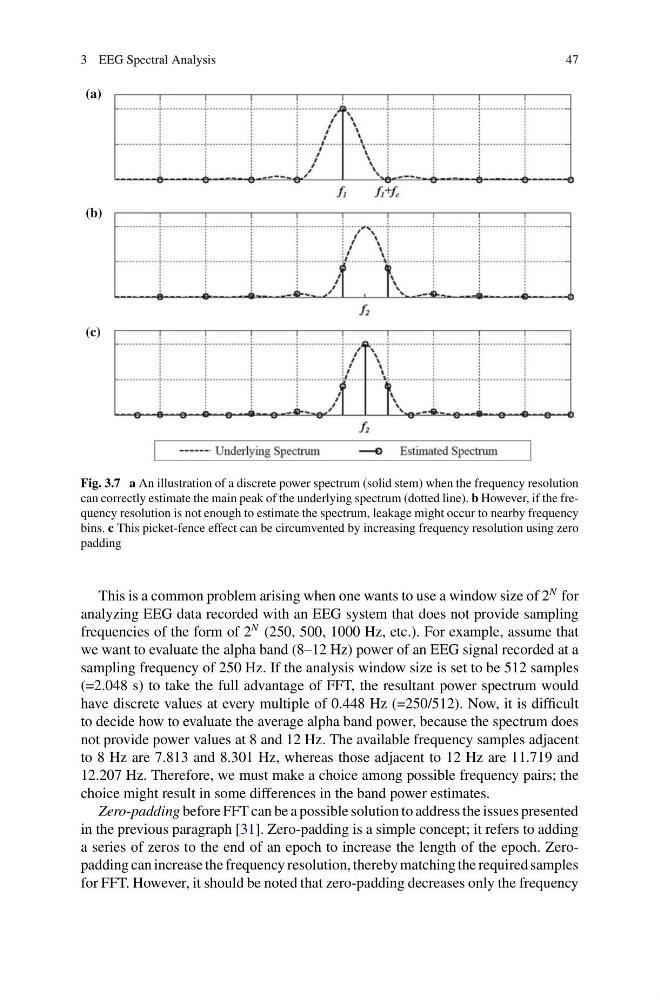
Fig. 3.7 a An illustration of a discrete power spectrum (solid stem) when the frequency resolution
can correctly estimate the main peak of the underlying spectrum (dotted line). b However, if the frequency resolution is not enough to estimate the spectrum, leakage might occur to nearby frequency
bins. c This picket-fence effect can be circumvented by increasing frequency resolution using zero
padding
This is a common problem arising when one wants to use a window size of 2
N for
analyzing EEG data recorded with an EEG system that does not provide sampling
frequencies of the form of 2
N (250, 500, 1000 Hz, etc.). For example, assume that
we want to evaluate the alpha band (8–12 Hz) power of an EEG signal recorded at a
sampling frequency of 250 Hz. If the analysis window size is set to be 512 samples
(=2.048 s) to take the full advantage of FFT, the resultant power spectrum would
have discrete values at every multiple of 0.448 Hz (=250/512). Now, it is difficult
to decide how to evaluate the average alpha band power, because the spectrum does
not provide power values at 8 and 12 Hz. The available frequency samples adjacent
to 8 Hz are 7.813 and 8.301 Hz, whereas those adjacent to 12 Hz are 11.719 and
12.207 Hz. Therefore, we must make a choice among possible frequency pairs; the
choice might result in some differences in the band power estimates.
Zero-padding before FFT can be a possible solution to address the issues presented
in the previous paragraph [31]. Zero-padding is a simple concept; it refers to adding
a series of zeros to the end of an epoch to increase the length of the epoch. Zeropadding can increase the frequency resolution, thereby matching the required samples
for FFT. However, it should be noted that zero-padding decreases only the frequency
47
(a)
(b)
(c)
Fig. 3.7 a An illustration of a discrete power spectrum (solid stem) when the frequency resolution
can correctly estimate the main peak of the underlying spectrum (dotted line). b However, if the frequency resolution is not enough to estimate the spectrum, leakage might occur to nearby frequency
bins. c This picket-fence effect can be circumvented by increasing frequency resolution using zero
padding
This is a common problem arising when one wants to use a window size of 2
N for
analyzing EEG data recorded with an EEG system that does not provide sampling
frequencies of the form of 2
N (250, 500, 1000 Hz, etc.). For example, assume that
we want to evaluate the alpha band (8–12 Hz) power of an EEG signal recorded at a
sampling frequency of 250 Hz. If the analysis window size is set to be 512 samples
(=2.048 s) to take the full advantage of FFT, the resultant power spectrum would
have discrete values at every multiple of 0.448 Hz (=250/512). Now, it is difficult
to decide how to evaluate the average alpha band power, because the spectrum does
not provide power values at 8 and 12 Hz. The available frequency samples adjacent
to 8 Hz are 7.813 and 8.301 Hz, whereas those adjacent to 12 Hz are 11.719 and
12.207 Hz. Therefore, we must make a choice among possible frequency pairs; the
choice might result in some differences in the band power estimates.
Zero-padding before FFT can be a possible solution to address the issues presented
in the previous paragraph [31]. Zero-padding is a simple concept; it refers to adding
a series of zeros to the end of an epoch to increase the length of the epoch. Zeropadding can increase the frequency resolution, thereby matching the required samples
for FFT. However, it should be noted that zero-padding decreases only the frequency