

22
S.-P. Kim
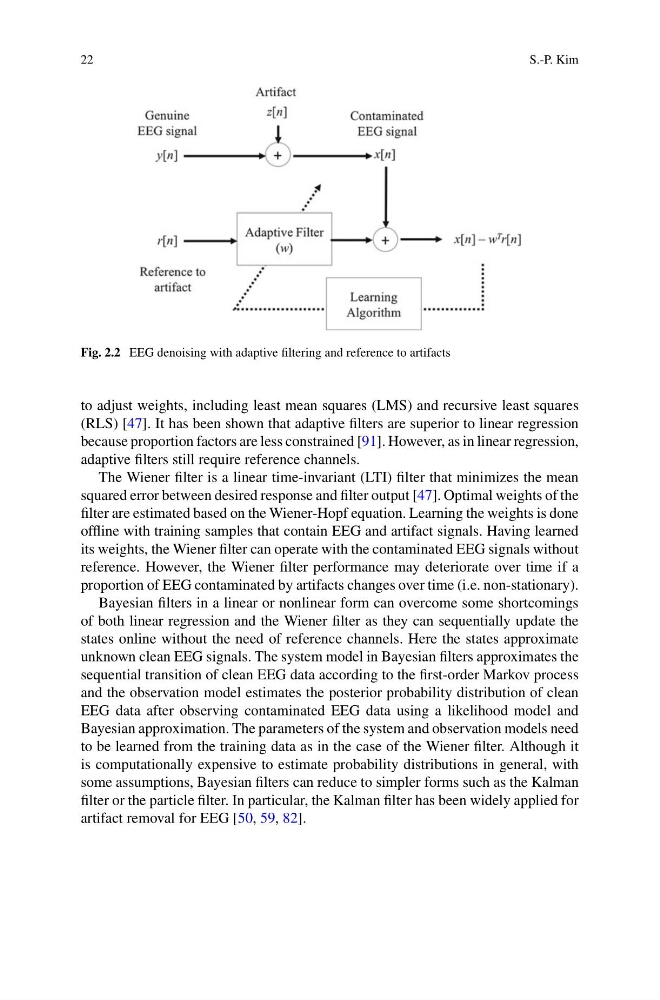
Fig. 2.2 EEG denoising with adaptive filtering and reference to artifacts
to adjust weights, including least mean squares (LMS) and recursive least squares
(RLS) [47]. It has been shown that adaptive filters are superior to linear regression
because proportion factors are less constrained [91]. However, as in linear regression,
adaptive filters still require reference channels.
The Wiener filter is a linear time-invariant (LTI) filter that minimizes the mean
squared error between desired response and filter output [47]. Optimal weights of the
filter are estimated based on the Wiener-Hopf equation. Learning the weights is done
offline with training samples that contain EEG and artifact signals. Having learned
its weights, the Wiener filter can operate with the contaminated EEG signals without
reference. However, the Wiener filter performance may deteriorate over time if a
proportion of EEG contaminated by artifacts changes over time (i.e. non-stationary).
Bayesian filters in a linear or nonlinear form can overcome some shortcomings
of both linear regression and the Wiener filter as they can sequentially update the
states online without the need of reference channels. Here the states approximate
unknown clean EEG signals. The system model in Bayesian filters approximates the
sequential transition of clean EEG data according to the first-order Markov process
and the observation model estimates the posterior probability distribution of clean
EEG data after observing contaminated EEG data using a likelihood model and
Bayesian approximation. The parameters of the system and observation models need
to be learned from the training data as in the case of the Wiener filter. Although it
is computationally expensive to estimate probability distributions in general, with
some assumptions, Bayesian filters can reduce to simpler forms such as the Kalman
filter or the particle filter. In particular, the Kalman filter has been widely applied for
artifact removal for EEG [50, 59, 82].
S.-P. Kim
Fig. 2.2 EEG denoising with adaptive filtering and reference to artifacts
to adjust weights, including least mean squares (LMS) and recursive least squares
(RLS) [47]. It has been shown that adaptive filters are superior to linear regression
because proportion factors are less constrained [91]. However, as in linear regression,
adaptive filters still require reference channels.
The Wiener filter is a linear time-invariant (LTI) filter that minimizes the mean
squared error between desired response and filter output [47]. Optimal weights of the
filter are estimated based on the Wiener-Hopf equation. Learning the weights is done
offline with training samples that contain EEG and artifact signals. Having learned
its weights, the Wiener filter can operate with the contaminated EEG signals without
reference. However, the Wiener filter performance may deteriorate over time if a
proportion of EEG contaminated by artifacts changes over time (i.e. non-stationary).
Bayesian filters in a linear or nonlinear form can overcome some shortcomings
of both linear regression and the Wiener filter as they can sequentially update the
states online without the need of reference channels. Here the states approximate
unknown clean EEG signals. The system model in Bayesian filters approximates the
sequential transition of clean EEG data according to the first-order Markov process
and the observation model estimates the posterior probability distribution of clean
EEG data after observing contaminated EEG data using a likelihood model and
Bayesian approximation. The parameters of the system and observation models need
to be learned from the training data as in the case of the Wiener filter. Although it
is computationally expensive to estimate probability distributions in general, with
some assumptions, Bayesian filters can reduce to simpler forms such as the Kalman
filter or the particle filter. In particular, the Kalman filter has been widely applied for
artifact removal for EEG [50, 59, 82].