

18
S.-P. Kim
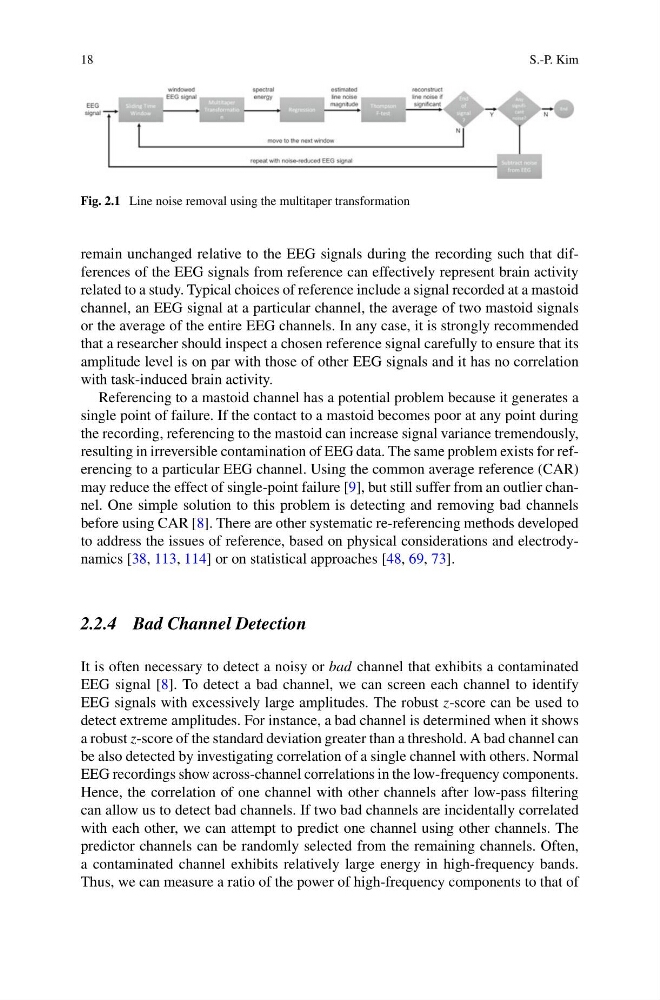
Fig. 2.1 Line noise removal using the multitaper transformation
remain unchanged relative to the EEG signals during the recording such that differences of the EEG signals from reference can effectively represent brain activity
related to a study. Typical choices of reference include a signal recorded at a mastoid
channel, an EEG signal at a particular channel, the average of two mastoid signals
or the average of the entire EEG channels. In any case, it is strongly recommended
that a researcher should inspect a chosen reference signal carefully to ensure that its
amplitude level is on par with those of other EEG signals and it has no correlation
with task-induced brain activity.
Referencing to a mastoid channel has a potential problem because it generates a
single point of failure. If the contact to a mastoid becomes poor at any point during
the recording, referencing to the mastoid can increase signal variance tremendously,
resulting in irreversible contamination of EEG data. The same problem exists for referencing to a particular EEG channel. Using the common average reference (CAR)
may reduce the effect of single-point failure [9], but still suffer from an outlier channel. One simple solution to this problem is detecting and removing bad channels
before using CAR [8]. There are other systematic re-referencing methods developed
to address the issues of reference, based on physical considerations and electrodynamics [38, 113, 114] or on statistical approaches [48, 69, 73].
2.2.4 Bad Channel Detection
It is often necessary to detect a noisy or bad channel that exhibits a contaminated
EEG signal [8]. To detect a bad channel, we can screen each channel to identify
EEG signals with excessively large amplitudes. The robust z-score can be used to
detect extreme amplitudes. For instance, a bad channel is determined when it shows
a robust z-score of the standard deviation greater than a threshold. A bad channel can
be also detected by investigating correlation of a single channel with others. Normal
EEG recordings show across-channel correlations in the low-frequency components.
Hence, the correlation of one channel with other channels after low-pass filtering
can allow us to detect bad channels. If two bad channels are incidentally correlated
with each other, we can attempt to predict one channel using other channels. The
predictor channels can be randomly selected from the remaining channels. Often,
a contaminated channel exhibits relatively large energy in high-frequency bands.
Thus, we can measure a ratio of the power of high-frequency components to that of
S.-P. Kim
Fig. 2.1 Line noise removal using the multitaper transformation
remain unchanged relative to the EEG signals during the recording such that differences of the EEG signals from reference can effectively represent brain activity
related to a study. Typical choices of reference include a signal recorded at a mastoid
channel, an EEG signal at a particular channel, the average of two mastoid signals
or the average of the entire EEG channels. In any case, it is strongly recommended
that a researcher should inspect a chosen reference signal carefully to ensure that its
amplitude level is on par with those of other EEG signals and it has no correlation
with task-induced brain activity.
Referencing to a mastoid channel has a potential problem because it generates a
single point of failure. If the contact to a mastoid becomes poor at any point during
the recording, referencing to the mastoid can increase signal variance tremendously,
resulting in irreversible contamination of EEG data. The same problem exists for referencing to a particular EEG channel. Using the common average reference (CAR)
may reduce the effect of single-point failure [9], but still suffer from an outlier channel. One simple solution to this problem is detecting and removing bad channels
before using CAR [8]. There are other systematic re-referencing methods developed
to address the issues of reference, based on physical considerations and electrodynamics [38, 113, 114] or on statistical approaches [48, 69, 73].
2.2.4 Bad Channel Detection
It is often necessary to detect a noisy or bad channel that exhibits a contaminated
EEG signal [8]. To detect a bad channel, we can screen each channel to identify
EEG signals with excessively large amplitudes. The robust z-score can be used to
detect extreme amplitudes. For instance, a bad channel is determined when it shows
a robust z-score of the standard deviation greater than a threshold. A bad channel can
be also detected by investigating correlation of a single channel with others. Normal
EEG recordings show across-channel correlations in the low-frequency components.
Hence, the correlation of one channel with other channels after low-pass filtering
can allow us to detect bad channels. If two bad channels are incidentally correlated
with each other, we can attempt to predict one channel using other channels. The
predictor channels can be randomly selected from the remaining channels. Often,
a contaminated channel exhibits relatively large energy in high-frequency bands.
Thus, we can measure a ratio of the power of high-frequency components to that of