

9 Computational EEG Analysis for Brain-Computer Interfaces
205
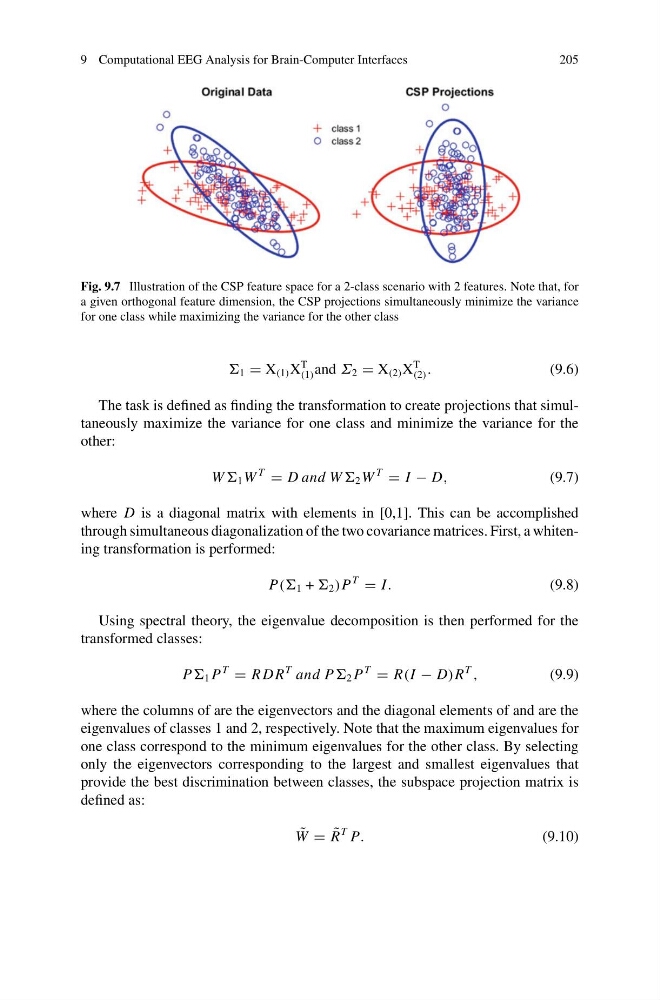
Fig. 9.7 Illustration of the CSP feature space for a 2-class scenario with 2 features. Note that, for
a given orthogonal feature dimension, the CSP projections simultaneously minimize the variance
for one class while maximizing the variance for the other class
1 X (1) X
T
(1) and Σ 2 X (2) X
T
(2) .
(9.6)
The task is defined as finding the transformation to create projections that simultaneously maximize the variance for one class and minimize the variance for the
other:
W 1 W
T
D and W 2 W
T
I − D,
(9.7)
where D is a diagonal matrix with elements in [0,1]. This can be accomplished
through simultaneous diagonalization of the two covariance matrices. First, a whitening transformation is performed:
P( 1 + 2 )P
T
I.
(9.8)
Using spectral theory, the eigenvalue decomposition is then performed for the
transformed classes:
P 1 P
T
R D R
T and P 2 P
T
R(I − D)R
T
,
(9.9)
where the columns of are the eigenvectors and the diagonal elements of and are the
eigenvalues of classes 1 and 2, respectively. Note that the maximum eigenvalues for
one class correspond to the minimum eigenvalues for the other class. By selecting
only the eigenvectors corresponding to the largest and smallest eigenvalues that
provide the best discrimination between classes, the subspace projection matrix is
defined as:
˜
W ˜
R
T P.
(9.10)
205
Fig. 9.7 Illustration of the CSP feature space for a 2-class scenario with 2 features. Note that, for
a given orthogonal feature dimension, the CSP projections simultaneously minimize the variance
for one class while maximizing the variance for the other class
1 X (1) X
T
(1) and Σ 2 X (2) X
T
(2) .
(9.6)
The task is defined as finding the transformation to create projections that simultaneously maximize the variance for one class and minimize the variance for the
other:
W 1 W
T
D and W 2 W
T
I − D,
(9.7)
where D is a diagonal matrix with elements in [0,1]. This can be accomplished
through simultaneous diagonalization of the two covariance matrices. First, a whitening transformation is performed:
P( 1 + 2 )P
T
I.
(9.8)
Using spectral theory, the eigenvalue decomposition is then performed for the
transformed classes:
P 1 P
T
R D R
T and P 2 P
T
R(I − D)R
T
,
(9.9)
where the columns of are the eigenvectors and the diagonal elements of and are the
eigenvalues of classes 1 and 2, respectively. Note that the maximum eigenvalues for
one class correspond to the minimum eigenvalues for the other class. By selecting
only the eigenvectors corresponding to the largest and smallest eigenvalues that
provide the best discrimination between classes, the subspace projection matrix is
defined as:
˜
W ˜
R
T P.
(9.10)