

186
K.-Y. Jung
Table 8.1 Comparison of sensitivity, specificity and accuracy with regard to detecting seizure onset
zone
Intracranial a
Scalp b
Spike (%)
Ripple
(80–250 Hz)
(%)
Fast ripple
(>250 Hz)
(%)
Spike (%)
Gamma
(40–80 Hz)
(%)
Ripple
(>80 Hz)
(%)
Sensitivity 91
91
66
100
82
48
Specificity 30
42
80
30
68
89
Accuracy
44
54
76
43
70
81
a Data from [1]
b Data from [2]
compared with sites contralateral to both seizure onset and hippocampal atrophy.
These findings indicate the strong association between fast ripple and epileptogenic
zone.
Interictal HFOs were observed in neocortical epilepsy with and without lesion in
addition to limbic epilepsy which was firstly reported by Worrell et al. [45]. They
recorded EEG activity using clinical subdural and depth electrodes. They found that
HFOs (60–100 Hz) confined in the contacts of SOZ in all six patients. Thus, HFOs
is identified not only in mesial temporal lobe epilepsy but also commonly observed
in the focal neocortical epilepsy.
It is worth comparing spatiotemporal relationship between interictal HFOs and
IEDs. It has been repeatedly reported that the interictal HFOs were consistent with
the SOZ. HFOs are more frequently identified in the SOZ than outside SOZ [1,
2, 10]. However, HFOs are not limited to the SOZ but usually extended beyond
seizure generating area. HFOs occurred to a large extent independently of spikes
[19]. Although HFOs are found in spiking as well as nonspiking channels, HFOs
generating zones have usually smaller spatial extent than the irritative zones [48].
HFOs often occur with close association with IEDs in terms of temporal relationship. 81% of HFOs occurs with IEDs, mostly superimposed over epileptic spikes
[42], 19% occurred completely independently of spikes in timing and localization.
In another study, 63% of ripple co-occurred with IEDs [2].
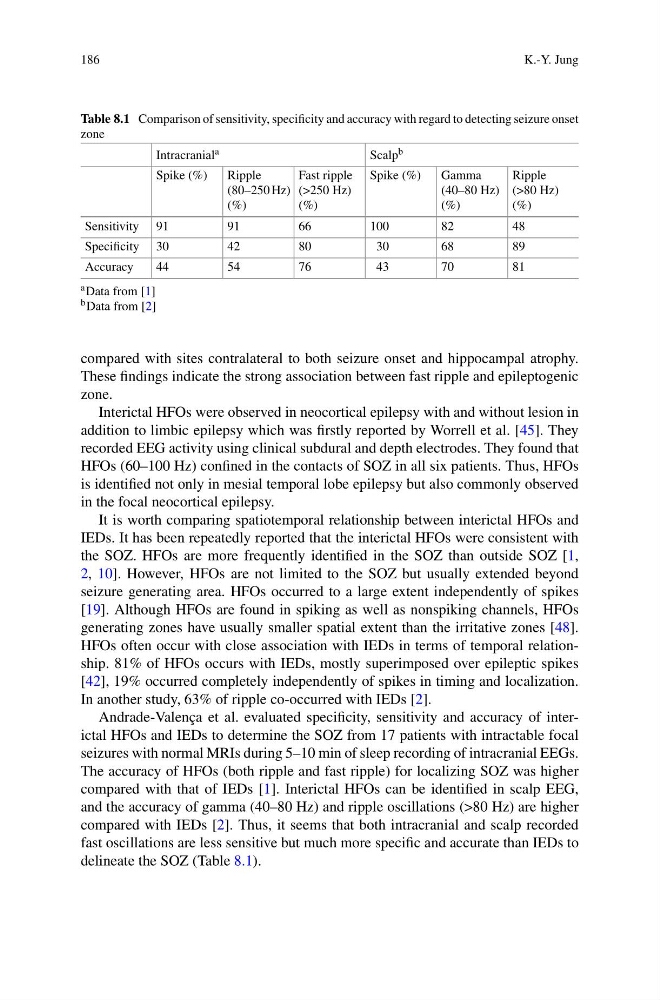
Andrade-Valença et al. evaluated specificity, sensitivity and accuracy of interictal HFOs and IEDs to determine the SOZ from 17 patients with intractable focal
seizures with normal MRIs during 5–10 min of sleep recording of intracranial EEGs.
The accuracy of HFOs (both ripple and fast ripple) for localizing SOZ was higher
compared with that of IEDs [1]. Interictal HFOs can be identified in scalp EEG,
and the accuracy of gamma (40–80 Hz) and ripple oscillations (>80 Hz) are higher
compared with IEDs [2]. Thus, it seems that both intracranial and scalp recorded
fast oscillations are less sensitive but much more specific and accurate than IEDs to
delineate the SOZ (Table 8.1).
K.-Y. Jung
Table 8.1 Comparison of sensitivity, specificity and accuracy with regard to detecting seizure onset
zone
Intracranial a
Scalp b
Spike (%)
Ripple
(80–250 Hz)
(%)
Fast ripple
(>250 Hz)
(%)
Spike (%)
Gamma
(40–80 Hz)
(%)
Ripple
(>80 Hz)
(%)
Sensitivity 91
91
66
100
82
48
Specificity 30
42
80
30
68
89
Accuracy
44
54
76
43
70
81
a Data from [1]
b Data from [2]
compared with sites contralateral to both seizure onset and hippocampal atrophy.
These findings indicate the strong association between fast ripple and epileptogenic
zone.
Interictal HFOs were observed in neocortical epilepsy with and without lesion in
addition to limbic epilepsy which was firstly reported by Worrell et al. [45]. They
recorded EEG activity using clinical subdural and depth electrodes. They found that
HFOs (60–100 Hz) confined in the contacts of SOZ in all six patients. Thus, HFOs
is identified not only in mesial temporal lobe epilepsy but also commonly observed
in the focal neocortical epilepsy.
It is worth comparing spatiotemporal relationship between interictal HFOs and
IEDs. It has been repeatedly reported that the interictal HFOs were consistent with
the SOZ. HFOs are more frequently identified in the SOZ than outside SOZ [1,
2, 10]. However, HFOs are not limited to the SOZ but usually extended beyond
seizure generating area. HFOs occurred to a large extent independently of spikes
[19]. Although HFOs are found in spiking as well as nonspiking channels, HFOs
generating zones have usually smaller spatial extent than the irritative zones [48].
HFOs often occur with close association with IEDs in terms of temporal relationship. 81% of HFOs occurs with IEDs, mostly superimposed over epileptic spikes
[42], 19% occurred completely independently of spikes in timing and localization.
In another study, 63% of ripple co-occurred with IEDs [2].
Andrade-Valença et al. evaluated specificity, sensitivity and accuracy of interictal HFOs and IEDs to determine the SOZ from 17 patients with intractable focal
seizures with normal MRIs during 5–10 min of sleep recording of intracranial EEGs.
The accuracy of HFOs (both ripple and fast ripple) for localizing SOZ was higher
compared with that of IEDs [1]. Interictal HFOs can be identified in scalp EEG,
and the accuracy of gamma (40–80 Hz) and ripple oscillations (>80 Hz) are higher
compared with IEDs [2]. Thus, it seems that both intracranial and scalp recorded
fast oscillations are less sensitive but much more specific and accurate than IEDs to
delineate the SOZ (Table 8.1).