

7 Computational EEG Analysis for the Diagnosis of Psychiatric …
159
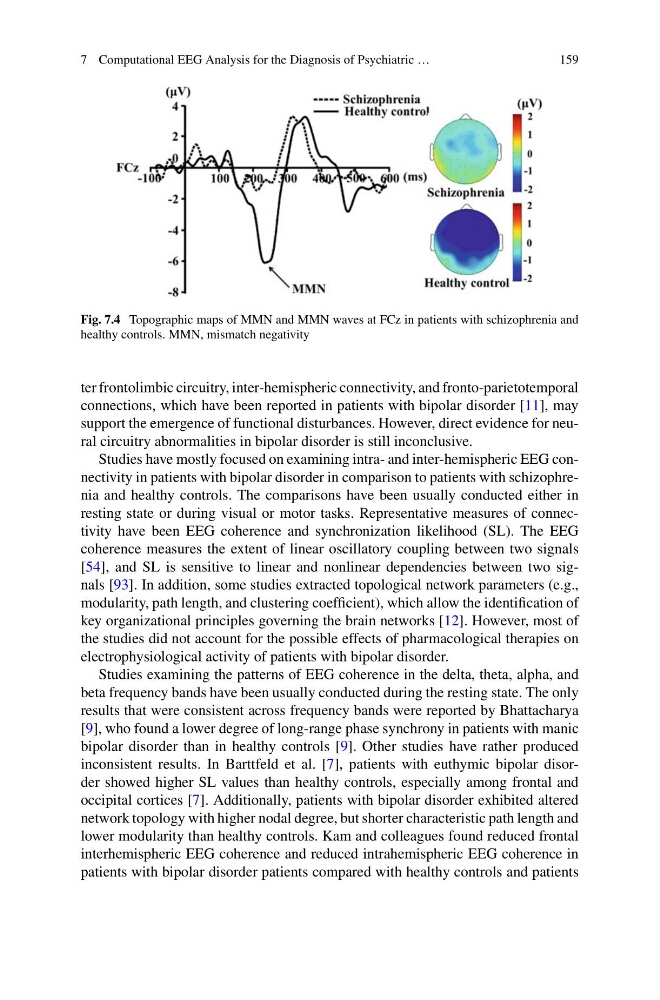
Fig. 7.4 Topographic maps of MMN and MMN waves at FCz in patients with schizophrenia and
healthy controls. MMN, mismatch negativity
ter frontolimbic circuitry, inter-hemispheric connectivity, and fronto-parietotemporal
connections, which have been reported in patients with bipolar disorder [11], may
support the emergence of functional disturbances. However, direct evidence for neural circuitry abnormalities in bipolar disorder is still inconclusive.
Studies have mostly focused on examining intra- and inter-hemispheric EEG connectivity in patients with bipolar disorder in comparison to patients with schizophrenia and healthy controls. The comparisons have been usually conducted either in
resting state or during visual or motor tasks. Representative measures of connectivity have been EEG coherence and synchronization likelihood (SL). The EEG
coherence measures the extent of linear oscillatory coupling between two signals
[54], and SL is sensitive to linear and nonlinear dependencies between two signals [93]. In addition, some studies extracted topological network parameters (e.g.,
modularity, path length, and clustering coefficient), which allow the identification of
key organizational principles governing the brain networks [12]. However, most of
the studies did not account for the possible effects of pharmacological therapies on
electrophysiological activity of patients with bipolar disorder.
Studies examining the patterns of EEG coherence in the delta, theta, alpha, and
beta frequency bands have been usually conducted during the resting state. The only
results that were consistent across frequency bands were reported by Bhattacharya
[9], who found a lower degree of long-range phase synchrony in patients with manic
bipolar disorder than in healthy controls [9]. Other studies have rather produced
inconsistent results. In Barttfeld et al. [7], patients with euthymic bipolar disorder showed higher SL values than healthy controls, especially among frontal and
occipital cortices [7]. Additionally, patients with bipolar disorder exhibited altered
network topology with higher nodal degree, but shorter characteristic path length and
lower modularity than healthy controls. Kam and colleagues found reduced frontal
interhemispheric EEG coherence and reduced intrahemispheric EEG coherence in
patients with bipolar disorder patients compared with healthy controls and patients
159
Fig. 7.4 Topographic maps of MMN and MMN waves at FCz in patients with schizophrenia and
healthy controls. MMN, mismatch negativity
ter frontolimbic circuitry, inter-hemispheric connectivity, and fronto-parietotemporal
connections, which have been reported in patients with bipolar disorder [11], may
support the emergence of functional disturbances. However, direct evidence for neural circuitry abnormalities in bipolar disorder is still inconclusive.
Studies have mostly focused on examining intra- and inter-hemispheric EEG connectivity in patients with bipolar disorder in comparison to patients with schizophrenia and healthy controls. The comparisons have been usually conducted either in
resting state or during visual or motor tasks. Representative measures of connectivity have been EEG coherence and synchronization likelihood (SL). The EEG
coherence measures the extent of linear oscillatory coupling between two signals
[54], and SL is sensitive to linear and nonlinear dependencies between two signals [93]. In addition, some studies extracted topological network parameters (e.g.,
modularity, path length, and clustering coefficient), which allow the identification of
key organizational principles governing the brain networks [12]. However, most of
the studies did not account for the possible effects of pharmacological therapies on
electrophysiological activity of patients with bipolar disorder.
Studies examining the patterns of EEG coherence in the delta, theta, alpha, and
beta frequency bands have been usually conducted during the resting state. The only
results that were consistent across frequency bands were reported by Bhattacharya
[9], who found a lower degree of long-range phase synchrony in patients with manic
bipolar disorder than in healthy controls [9]. Other studies have rather produced
inconsistent results. In Barttfeld et al. [7], patients with euthymic bipolar disorder showed higher SL values than healthy controls, especially among frontal and
occipital cortices [7]. Additionally, patients with bipolar disorder exhibited altered
network topology with higher nodal degree, but shorter characteristic path length and
lower modularity than healthy controls. Kam and colleagues found reduced frontal
interhemispheric EEG coherence and reduced intrahemispheric EEG coherence in
patients with bipolar disorder patients compared with healthy controls and patients