

maintained with radiolabeling. Radiolabeled porphyrins can thus provide a
non-invasive means for deep tumor detection and image-guided PDT.
Hematoporphyrin, one of the most common photosensitizers, has been explored
for radiolabeling.
99m Tc pertechnetate and stannous chloride were used to radiolabel
hematoporphyrin and derivatives and it was thought that the radiolabeling occurs at
the carboxylic chains of the porphyrin. The
99m Tc-labeled species was stable in
biological conditions. Hematoporphyrin labeled with
57
Co and
64 Cu coordinated in
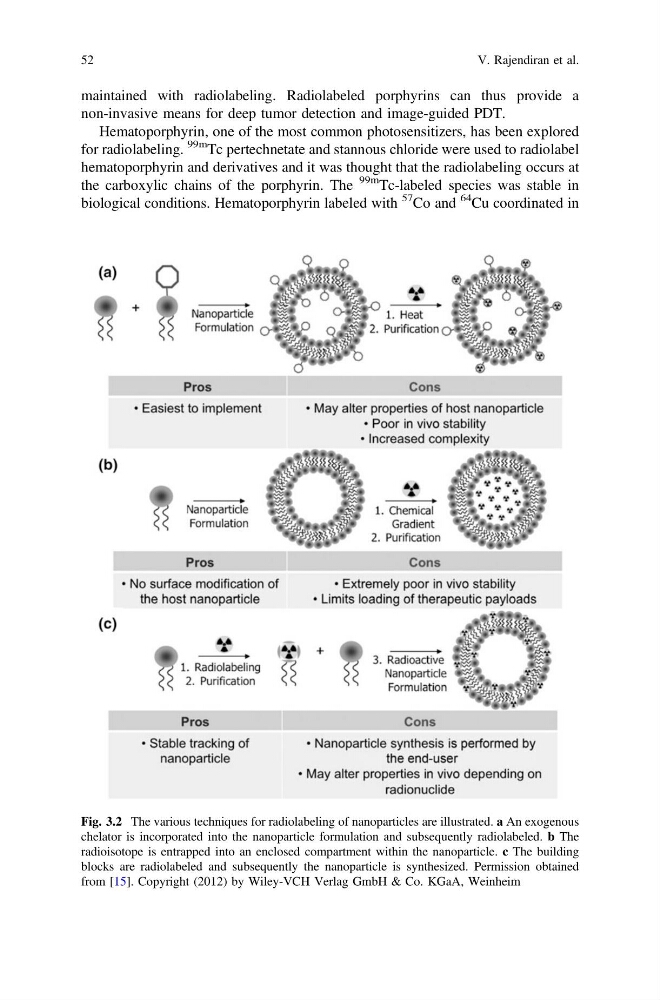
Fig. 3.2 The various techniques for radiolabeling of nanoparticles are illustrated. a An exogenous
chelator is incorporated into the nanoparticle formulation and subsequently radiolabeled. b The
radioisotope is entrapped into an enclosed compartment within the nanoparticle. c The building
blocks are radiolabeled and subsequently the nanoparticle is synthesized. Permission obtained
from [15]. Copyright (2012) by Wiley-VCH Verlag GmbH & Co. KGaA, Weinheim
52
V. Rajendiran et al.
non-invasive means for deep tumor detection and image-guided PDT.
Hematoporphyrin, one of the most common photosensitizers, has been explored
for radiolabeling.
99m Tc pertechnetate and stannous chloride were used to radiolabel
hematoporphyrin and derivatives and it was thought that the radiolabeling occurs at
the carboxylic chains of the porphyrin. The
99m Tc-labeled species was stable in
biological conditions. Hematoporphyrin labeled with
57
Co and
64 Cu coordinated in
Fig. 3.2 The various techniques for radiolabeling of nanoparticles are illustrated. a An exogenous
chelator is incorporated into the nanoparticle formulation and subsequently radiolabeled. b The
radioisotope is entrapped into an enclosed compartment within the nanoparticle. c The building
blocks are radiolabeled and subsequently the nanoparticle is synthesized. Permission obtained
from [15]. Copyright (2012) by Wiley-VCH Verlag GmbH & Co. KGaA, Weinheim
52
V. Rajendiran et al.