

porphura, which means ‘purple’. The basic tetrapyrrole skeleton is found in natural
pigments like hemin, chlorophyll and bacteriochlorophyll. The structure of porphyrin consists of a heterocyclic macrocycle made from four pyrrole subunits
interconnected via methine bridges (=CH–). The simplest form of porphyrin
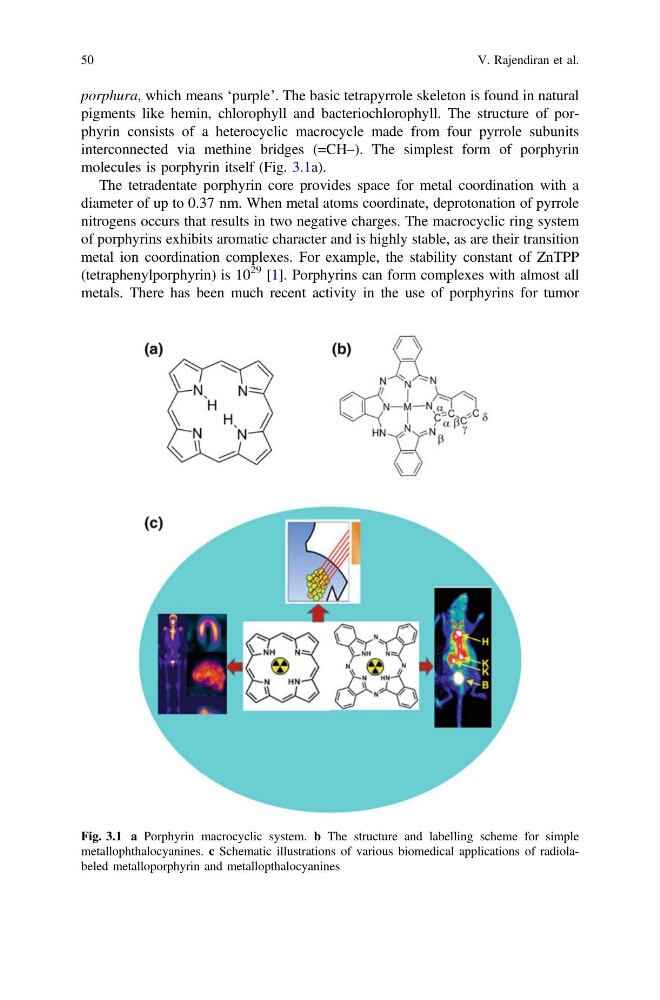
molecules is porphyrin itself (Fig. 3.1a).
The tetradentate porphyrin core provides space for metal coordination with a
diameter of up to 0.37 nm. When metal atoms coordinate, deprotonation of pyrrole
nitrogens occurs that results in two negative charges. The macrocyclic ring system
of porphyrins exhibits aromatic character and is highly stable, as are their transition
metal ion coordination complexes. For example, the stability constant of ZnTPP
(tetraphenylporphyrin) is 10
29 [1]. Porphyrins can form complexes with almost all
metals. There has been much recent activity in the use of porphyrins for tumor
Fig. 3.1 a Porphyrin macrocyclic system. b The structure and labelling scheme for simple
metallophthalocyanines. c Schematic illustrations of various biomedical applications of radiolabeled metalloporphyrin and metallopthalocyanines
50
V. Rajendiran et al.
pigments like hemin, chlorophyll and bacteriochlorophyll. The structure of porphyrin consists of a heterocyclic macrocycle made from four pyrrole subunits
interconnected via methine bridges (=CH–). The simplest form of porphyrin
molecules is porphyrin itself (Fig. 3.1a).
The tetradentate porphyrin core provides space for metal coordination with a
diameter of up to 0.37 nm. When metal atoms coordinate, deprotonation of pyrrole
nitrogens occurs that results in two negative charges. The macrocyclic ring system
of porphyrins exhibits aromatic character and is highly stable, as are their transition
metal ion coordination complexes. For example, the stability constant of ZnTPP
(tetraphenylporphyrin) is 10
29 [1]. Porphyrins can form complexes with almost all
metals. There has been much recent activity in the use of porphyrins for tumor
Fig. 3.1 a Porphyrin macrocyclic system. b The structure and labelling scheme for simple
metallophthalocyanines. c Schematic illustrations of various biomedical applications of radiolabeled metalloporphyrin and metallopthalocyanines
50
V. Rajendiran et al.