

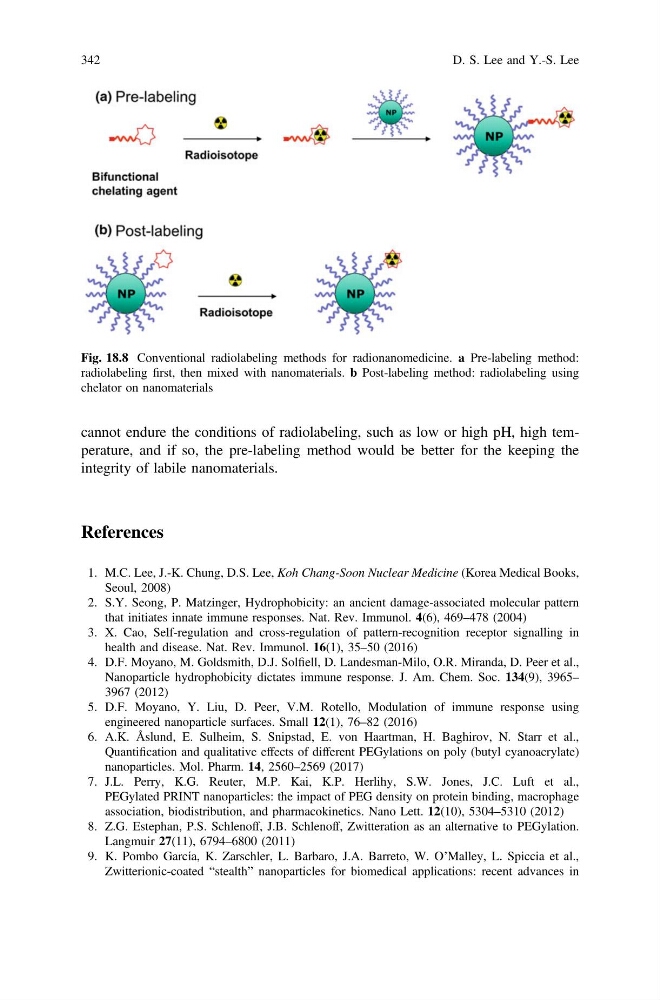
cannot endure the conditions of radiolabeling, such as low or high pH, high temperature, and if so, the pre-labeling method would be better for the keeping the
integrity of labile nanomaterials.
References
1. M.C. Lee, J.-K. Chung, D.S. Lee, Koh Chang-Soon Nuclear Medicine (Korea Medical Books,
Seoul, 2008)
2. S.Y. Seong, P. Matzinger, Hydrophobicity: an ancient damage-associated molecular pattern
that initiates innate immune responses. Nat. Rev. Immunol. 4(6), 469–478 (2004)
3. X. Cao, Self-regulation and cross-regulation of pattern-recognition receptor signalling in
health and disease. Nat. Rev. Immunol. 16(1), 35–50 (2016)
4. D.F. Moyano, M. Goldsmith, D.J. Solfiell, D. Landesman-Milo, O.R. Miranda, D. Peer et al.,
Nanoparticle hydrophobicity dictates immune response. J. Am. Chem. Soc. 134(9), 3965–
3967 (2012)
5. D.F. Moyano, Y. Liu, D. Peer, V.M. Rotello, Modulation of immune response using
engineered nanoparticle surfaces. Small 12(1), 76–82 (2016)
6. A.K. Åslund, E. Sulheim, S. Snipstad, E. von Haartman, H. Baghirov, N. Starr et al.,
Quantification and qualitative effects of different PEGylations on poly (butyl cyanoacrylate)
nanoparticles. Mol. Pharm. 14, 2560–2569 (2017)
7. J.L. Perry, K.G. Reuter, M.P. Kai, K.P. Herlihy, S.W. Jones, J.C. Luft et al.,
PEGylated PRINT nanoparticles: the impact of PEG density on protein binding, macrophage
association, biodistribution, and pharmacokinetics. Nano Lett. 12(10), 5304–5310 (2012)
8. Z.G. Estephan, P.S. Schlenoff, J.B. Schlenoff, Zwitteration as an alternative to PEGylation.
Langmuir 27(11), 6794–6800 (2011)
9. K. Pombo García, K. Zarschler, L. Barbaro, J.A. Barreto, W. O’Malley, L. Spiccia et al.,
Zwitterionic-coated “stealth” nanoparticles for biomedical applications: recent advances in
Fig. 18.8 Conventional radiolabeling methods for radionanomedicine. a Pre-labeling method:
radiolabeling first, then mixed with nanomaterials. b Post-labeling method: radiolabeling using
chelator on nanomaterials
342
D. S. Lee and Y.-S. Lee
integrity of labile nanomaterials.
References
1. M.C. Lee, J.-K. Chung, D.S. Lee, Koh Chang-Soon Nuclear Medicine (Korea Medical Books,
Seoul, 2008)
2. S.Y. Seong, P. Matzinger, Hydrophobicity: an ancient damage-associated molecular pattern
that initiates innate immune responses. Nat. Rev. Immunol. 4(6), 469–478 (2004)
3. X. Cao, Self-regulation and cross-regulation of pattern-recognition receptor signalling in
health and disease. Nat. Rev. Immunol. 16(1), 35–50 (2016)
4. D.F. Moyano, M. Goldsmith, D.J. Solfiell, D. Landesman-Milo, O.R. Miranda, D. Peer et al.,
Nanoparticle hydrophobicity dictates immune response. J. Am. Chem. Soc. 134(9), 3965–
3967 (2012)
5. D.F. Moyano, Y. Liu, D. Peer, V.M. Rotello, Modulation of immune response using
engineered nanoparticle surfaces. Small 12(1), 76–82 (2016)
6. A.K. Åslund, E. Sulheim, S. Snipstad, E. von Haartman, H. Baghirov, N. Starr et al.,
Quantification and qualitative effects of different PEGylations on poly (butyl cyanoacrylate)
nanoparticles. Mol. Pharm. 14, 2560–2569 (2017)
7. J.L. Perry, K.G. Reuter, M.P. Kai, K.P. Herlihy, S.W. Jones, J.C. Luft et al.,
PEGylated PRINT nanoparticles: the impact of PEG density on protein binding, macrophage
association, biodistribution, and pharmacokinetics. Nano Lett. 12(10), 5304–5310 (2012)
8. Z.G. Estephan, P.S. Schlenoff, J.B. Schlenoff, Zwitteration as an alternative to PEGylation.
Langmuir 27(11), 6794–6800 (2011)
9. K. Pombo García, K. Zarschler, L. Barbaro, J.A. Barreto, W. O’Malley, L. Spiccia et al.,
Zwitterionic-coated “stealth” nanoparticles for biomedical applications: recent advances in
Fig. 18.8 Conventional radiolabeling methods for radionanomedicine. a Pre-labeling method:
radiolabeling first, then mixed with nanomaterials. b Post-labeling method: radiolabeling using
chelator on nanomaterials
342
D. S. Lee and Y.-S. Lee