

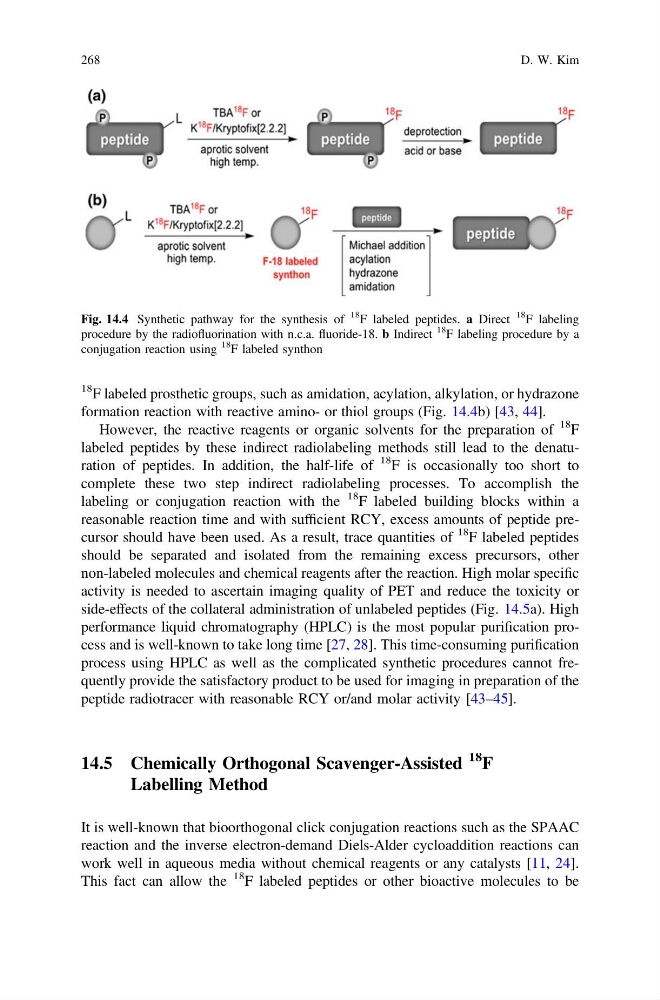
18 F labeled prosthetic groups, such as amidation, acylation, alkylation, or hydrazone
formation reaction with reactive amino- or thiol groups (Fig. 14.4b) [43, 44].
However, the reactive reagents or organic solvents for the preparation of
18 F
labeled peptides by these indirect radiolabeling methods still lead to the denaturation of peptides. In addition, the half-life of
18 F is occasionally too short to
complete these two step indirect radiolabeling processes. To accomplish the
labeling or conjugation reaction with the
18 F labeled building blocks within a
reasonable reaction time and with sufficient RCY, excess amounts of peptide precursor should have been used. As a result, trace quantities of
18 F labeled peptides
should be separated and isolated from the remaining excess precursors, other
non-labeled molecules and chemical reagents after the reaction. High molar specific
activity is needed to ascertain imaging quality of PET and reduce the toxicity or
side-effects of the collateral administration of unlabeled peptides (Fig. 14.5a). High
performance liquid chromatography (HPLC) is the most popular purification process and is well-known to take long time [27, 28]. This time-consuming purification
process using HPLC as well as the complicated synthetic procedures cannot frequently provide the satisfactory product to be used for imaging in preparation of the
peptide radiotracer with reasonable RCY or/and molar activity [43–45].
14.5 Chemically Orthogonal Scavenger-Assisted
18
F
Labelling Method
It is well-known that bioorthogonal click conjugation reactions such as the SPAAC
reaction and the inverse electron-demand Diels-Alder cycloaddition reactions can
work well in aqueous media without chemical reagents or any catalysts [11, 24].
This fact can allow the
18 F labeled peptides or other bioactive molecules to be
Fig. 14.4 Synthetic pathway for the synthesis of
18
F labeled peptides. a Direct
18
F labeling
procedure by the radiofluorination with n.c.a. fluoride-18. b Indirect
18
F labeling procedure by a
conjugation reaction using
18
F labeled synthon
268
D. W. Kim
formation reaction with reactive amino- or thiol groups (Fig. 14.4b) [43, 44].
However, the reactive reagents or organic solvents for the preparation of
18 F
labeled peptides by these indirect radiolabeling methods still lead to the denaturation of peptides. In addition, the half-life of
18 F is occasionally too short to
complete these two step indirect radiolabeling processes. To accomplish the
labeling or conjugation reaction with the
18 F labeled building blocks within a
reasonable reaction time and with sufficient RCY, excess amounts of peptide precursor should have been used. As a result, trace quantities of
18 F labeled peptides
should be separated and isolated from the remaining excess precursors, other
non-labeled molecules and chemical reagents after the reaction. High molar specific
activity is needed to ascertain imaging quality of PET and reduce the toxicity or
side-effects of the collateral administration of unlabeled peptides (Fig. 14.5a). High
performance liquid chromatography (HPLC) is the most popular purification process and is well-known to take long time [27, 28]. This time-consuming purification
process using HPLC as well as the complicated synthetic procedures cannot frequently provide the satisfactory product to be used for imaging in preparation of the
peptide radiotracer with reasonable RCY or/and molar activity [43–45].
14.5 Chemically Orthogonal Scavenger-Assisted
18
F
Labelling Method
It is well-known that bioorthogonal click conjugation reactions such as the SPAAC
reaction and the inverse electron-demand Diels-Alder cycloaddition reactions can
work well in aqueous media without chemical reagents or any catalysts [11, 24].
This fact can allow the
18 F labeled peptides or other bioactive molecules to be
Fig. 14.4 Synthetic pathway for the synthesis of
18
F labeled peptides. a Direct
18
F labeling
procedure by the radiofluorination with n.c.a. fluoride-18. b Indirect
18
F labeling procedure by a
conjugation reaction using
18
F labeled synthon
268
D. W. Kim