

13.1 Click Chemistry
The concept of ‘click chemistry’ was introduced in 2001 by Kolb et al. who
identified a variety of chemical reactions which have a specific set of advantageous
properties in common [1]. Specifically, the reactions which fall under this umbrella
term must be: (i) modular, (ii) wide in scope, (iii) very high yielding, (iv) incapable
of generating offensive by-products, and (v) stereospecific. From a practical perspective, click chemistry reactions must be capable of proceeding efficiently in
ambient reaction conditions (e.g. not requiring precautions against oxygen) and
involve easily accessible chemical precursors. In addition, these reactions must be
able to take place either in the absence of solvent or in a solvent which is benign
and/or easily removed. Lastly, it is also important that the desired product is easily
isolated from the reaction mixture.
13.1.1 The Huisgen 1,3-Dipolar Cycloaddition
While several reaction types abide by these highly specific criteria, one reaction in
particular has gained prominence across many sub-disciplines of chemistry (including the field of radiochemistry), namely the Huisgen 1,3-dipolar cycloaddition
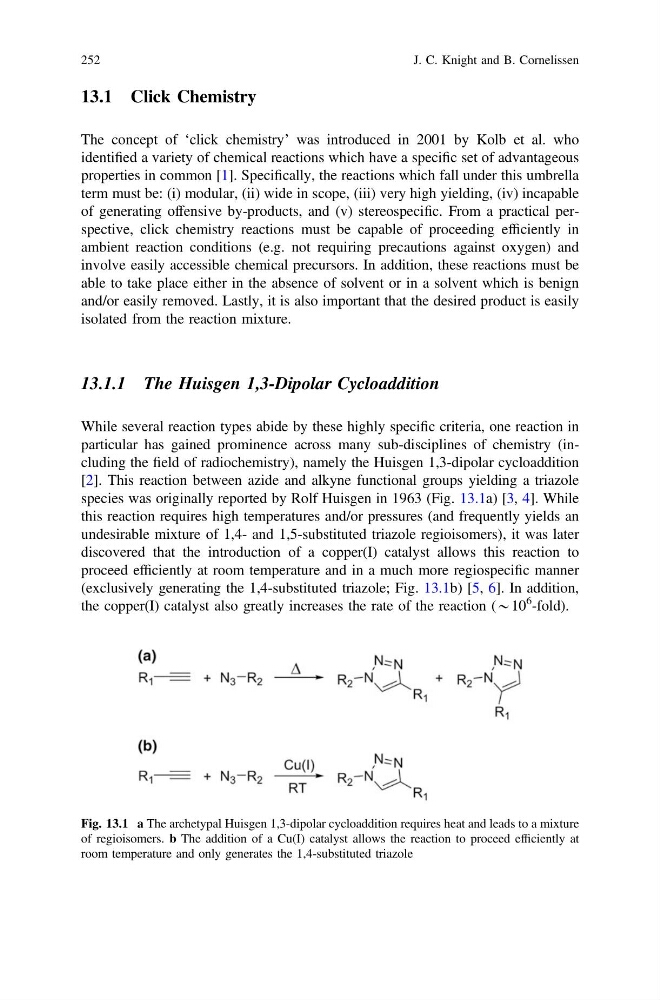
[2]. This reaction between azide and alkyne functional groups yielding a triazole
species was originally reported by Rolf Huisgen in 1963 (Fig. 13.1a) [3, 4]. While
this reaction requires high temperatures and/or pressures (and frequently yields an
undesirable mixture of 1,4- and 1,5-substituted triazole regioisomers), it was later
discovered that the introduction of a copper(I) catalyst allows this reaction to
proceed efficiently at room temperature and in a much more regiospecific manner
(exclusively generating the 1,4-substituted triazole; Fig. 13.1b) [5, 6]. In addition,
the copper(I) catalyst also greatly increases the rate of the reaction (*10
6 -fold).
Fig. 13.1 a The archetypal Huisgen 1,3-dipolar cycloaddition requires heat and leads to a mixture
of regioisomers. b The addition of a Cu(I) catalyst allows the reaction to proceed efficiently at
room temperature and only generates the 1,4-substituted triazole
252
J. C. Knight and B. Cornelissen
The concept of ‘click chemistry’ was introduced in 2001 by Kolb et al. who
identified a variety of chemical reactions which have a specific set of advantageous
properties in common [1]. Specifically, the reactions which fall under this umbrella
term must be: (i) modular, (ii) wide in scope, (iii) very high yielding, (iv) incapable
of generating offensive by-products, and (v) stereospecific. From a practical perspective, click chemistry reactions must be capable of proceeding efficiently in
ambient reaction conditions (e.g. not requiring precautions against oxygen) and
involve easily accessible chemical precursors. In addition, these reactions must be
able to take place either in the absence of solvent or in a solvent which is benign
and/or easily removed. Lastly, it is also important that the desired product is easily
isolated from the reaction mixture.
13.1.1 The Huisgen 1,3-Dipolar Cycloaddition
While several reaction types abide by these highly specific criteria, one reaction in
particular has gained prominence across many sub-disciplines of chemistry (including the field of radiochemistry), namely the Huisgen 1,3-dipolar cycloaddition
[2]. This reaction between azide and alkyne functional groups yielding a triazole
species was originally reported by Rolf Huisgen in 1963 (Fig. 13.1a) [3, 4]. While
this reaction requires high temperatures and/or pressures (and frequently yields an
undesirable mixture of 1,4- and 1,5-substituted triazole regioisomers), it was later
discovered that the introduction of a copper(I) catalyst allows this reaction to
proceed efficiently at room temperature and in a much more regiospecific manner
(exclusively generating the 1,4-substituted triazole; Fig. 13.1b) [5, 6]. In addition,
the copper(I) catalyst also greatly increases the rate of the reaction (*10
6 -fold).
Fig. 13.1 a The archetypal Huisgen 1,3-dipolar cycloaddition requires heat and leads to a mixture
of regioisomers. b The addition of a Cu(I) catalyst allows the reaction to proceed efficiently at
room temperature and only generates the 1,4-substituted triazole
252
J. C. Knight and B. Cornelissen