

macromolecules. Nowadays, by the help of the great contribution of scientists on
drug development, for selection of target disease and disease-targeting molecules,
one can simply search on the internet or database to find enough candidate molecules to choose a proper disease-targeting molecule for each disease. Small molecules including low molecular-weight chemicals, carbohydrates, nucleic acids, or
small peptides have good potential as a disease targeting molecule on
nanomaterials.
Arginine-glycine-aspartate (RGD) peptide targets the integrin a v b 3 , which is an
ideal vascular target protein considering its high expression on endothelial cells of
newly formed vessels in correlation with disease progression [20]. The RGD
peptide has been the most widely used as modification or the surface of nanomaterials, either for therapy or drug delivery. This is because integrin a v b 3 expression
was high on U87MG cells, and it was easy to get this cell line and to establish
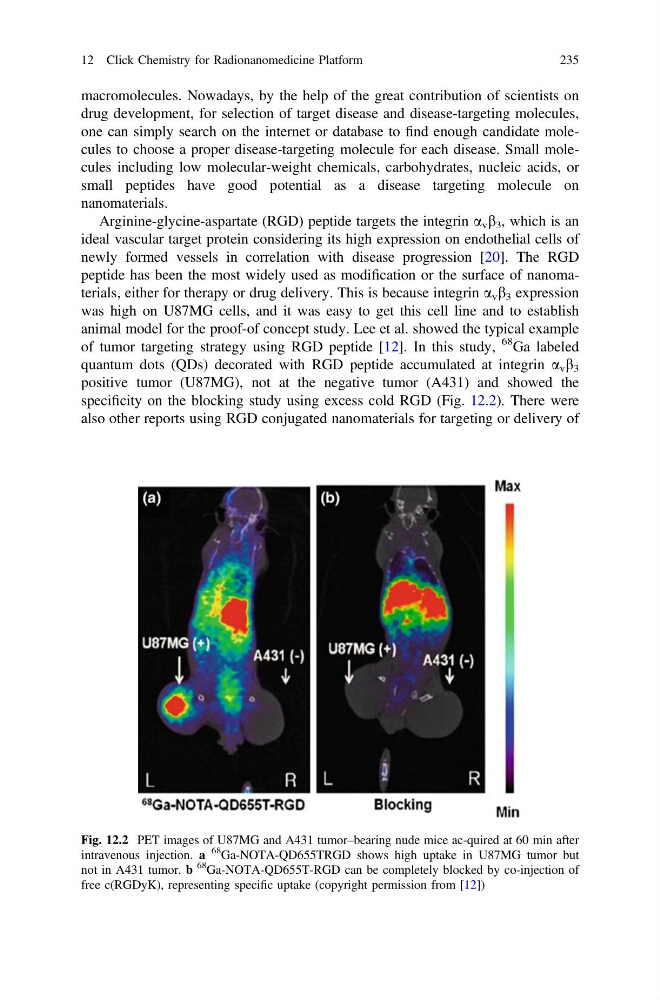
animal model for the proof-of concept study. Lee et al. showed the typical example
of tumor targeting strategy using RGD peptide [12]. In this study,
68 Ga labeled
quantum dots (QDs) decorated with RGD peptide accumulated at integrin a v b 3
positive tumor (U87MG), not at the negative tumor (A431) and showed the
specificity on the blocking study using excess cold RGD (Fig. 12.2). There were
also other reports using RGD conjugated nanomaterials for targeting or delivery of
Fig. 12.2 PET images of U87MG and A431 tumor–bearing nude mice ac-quired at 60 min after
intravenous injection. a
68
Ga-NOTA-QD655TRGD shows high uptake in U87MG tumor but
not in A431 tumor. b
68
Ga-NOTA-QD655T-RGD can be completely blocked by co-injection of
free c(RGDyK), representing specific uptake (copyright permission from [12])
12 Click Chemistry for Radionanomedicine Platform
235
drug development, for selection of target disease and disease-targeting molecules,
one can simply search on the internet or database to find enough candidate molecules to choose a proper disease-targeting molecule for each disease. Small molecules including low molecular-weight chemicals, carbohydrates, nucleic acids, or
small peptides have good potential as a disease targeting molecule on
nanomaterials.
Arginine-glycine-aspartate (RGD) peptide targets the integrin a v b 3 , which is an
ideal vascular target protein considering its high expression on endothelial cells of
newly formed vessels in correlation with disease progression [20]. The RGD
peptide has been the most widely used as modification or the surface of nanomaterials, either for therapy or drug delivery. This is because integrin a v b 3 expression
was high on U87MG cells, and it was easy to get this cell line and to establish
animal model for the proof-of concept study. Lee et al. showed the typical example
of tumor targeting strategy using RGD peptide [12]. In this study,
68 Ga labeled
quantum dots (QDs) decorated with RGD peptide accumulated at integrin a v b 3
positive tumor (U87MG), not at the negative tumor (A431) and showed the
specificity on the blocking study using excess cold RGD (Fig. 12.2). There were
also other reports using RGD conjugated nanomaterials for targeting or delivery of
Fig. 12.2 PET images of U87MG and A431 tumor–bearing nude mice ac-quired at 60 min after
intravenous injection. a
68
Ga-NOTA-QD655TRGD shows high uptake in U87MG tumor but
not in A431 tumor. b
68
Ga-NOTA-QD655T-RGD can be completely blocked by co-injection of
free c(RGDyK), representing specific uptake (copyright permission from [12])
12 Click Chemistry for Radionanomedicine Platform
235