

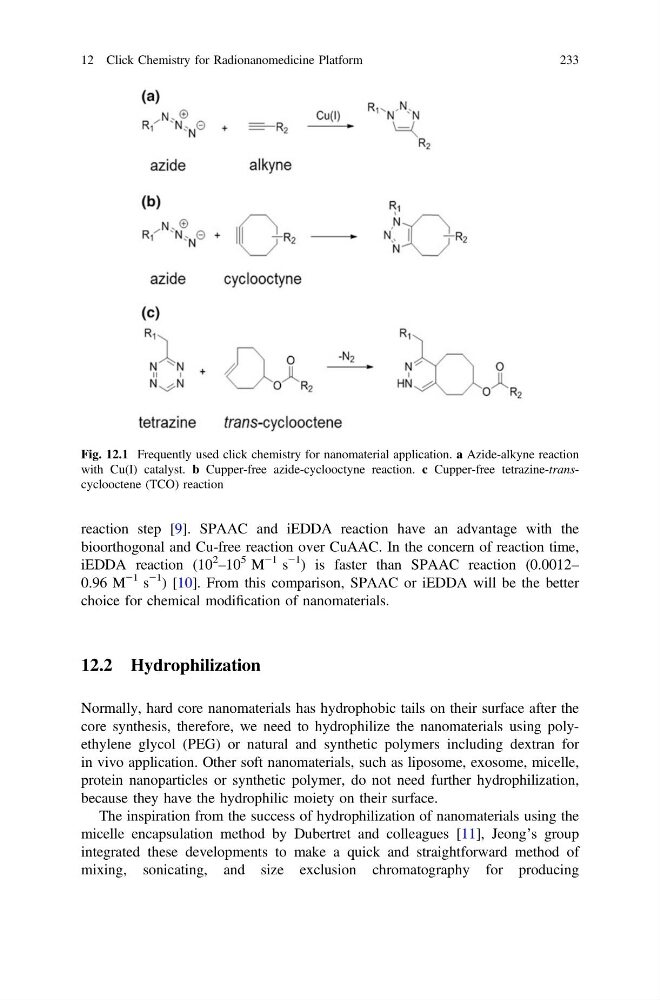
reaction step [9]. SPAAC and iEDDA reaction have an advantage with the
bioorthogonal and Cu-free reaction over CuAAC. In the concern of reaction time,
iEDDA reaction (10
2
–10
5 M
−1 s
−1 ) is faster than SPAAC reaction (0.0012–
0.96 M
−1 s
−1 ) [10]. From this comparison, SPAAC or iEDDA will be the better
choice for chemical modification of nanomaterials.
12.2 Hydrophilization
Normally, hard core nanomaterials has hydrophobic tails on their surface after the
core synthesis, therefore, we need to hydrophilize the nanomaterials using polyethylene glycol (PEG) or natural and synthetic polymers including dextran for
in vivo application. Other soft nanomaterials, such as liposome, exosome, micelle,
protein nanoparticles or synthetic polymer, do not need further hydrophilization,
because they have the hydrophilic moiety on their surface.
The inspiration from the success of hydrophilization of nanomaterials using the
micelle encapsulation method by Dubertret and colleagues [11], Jeong’s group
integrated these developments to make a quick and straightforward method of
mixing, sonicating, and size exclusion chromatography for producing
Fig. 12.1 Frequently used click chemistry for nanomaterial application. a Azide-alkyne reaction
with Cu(I) catalyst. b Cupper-free azide-cyclooctyne reaction. c Cupper-free tetrazine-transcyclooctene (TCO) reaction
12 Click Chemistry for Radionanomedicine Platform
233
bioorthogonal and Cu-free reaction over CuAAC. In the concern of reaction time,
iEDDA reaction (10
2
–10
5 M
−1 s
−1 ) is faster than SPAAC reaction (0.0012–
0.96 M
−1 s
−1 ) [10]. From this comparison, SPAAC or iEDDA will be the better
choice for chemical modification of nanomaterials.
12.2 Hydrophilization
Normally, hard core nanomaterials has hydrophobic tails on their surface after the
core synthesis, therefore, we need to hydrophilize the nanomaterials using polyethylene glycol (PEG) or natural and synthetic polymers including dextran for
in vivo application. Other soft nanomaterials, such as liposome, exosome, micelle,
protein nanoparticles or synthetic polymer, do not need further hydrophilization,
because they have the hydrophilic moiety on their surface.
The inspiration from the success of hydrophilization of nanomaterials using the
micelle encapsulation method by Dubertret and colleagues [11], Jeong’s group
integrated these developments to make a quick and straightforward method of
mixing, sonicating, and size exclusion chromatography for producing
Fig. 12.1 Frequently used click chemistry for nanomaterial application. a Azide-alkyne reaction
with Cu(I) catalyst. b Cupper-free azide-cyclooctyne reaction. c Cupper-free tetrazine-transcyclooctene (TCO) reaction
12 Click Chemistry for Radionanomedicine Platform
233