

versatile tools for surface engineering of those nanomaterials and prepared them for
further imaging/therapy applications [84, 85]. Also, as discussed previously, ligand
exchange (e.g. OA is replaced by PAA [86] or polyphosphoric acid capping [87])
was frequently adopted for further incorporation of stabilizing/functionalizing
molecules. Surface-decorating molecules (e.g. mPEG-grafted poly(L-lysine) [88])
can also be added during the synthetic route to save the extra ligand exchange
procedures, and interestingly, it was shown that this method did not bestow
advantageous properties to the radionanomaterial, while the overall synthesis yield
was considerably lower than the ligand exchange method [88]. Similar to what we
have discussed for graphene materials, sometimes disease-targeting molecules (e.g.
folate) can be simultaneously used as surface functionalization agent for metal
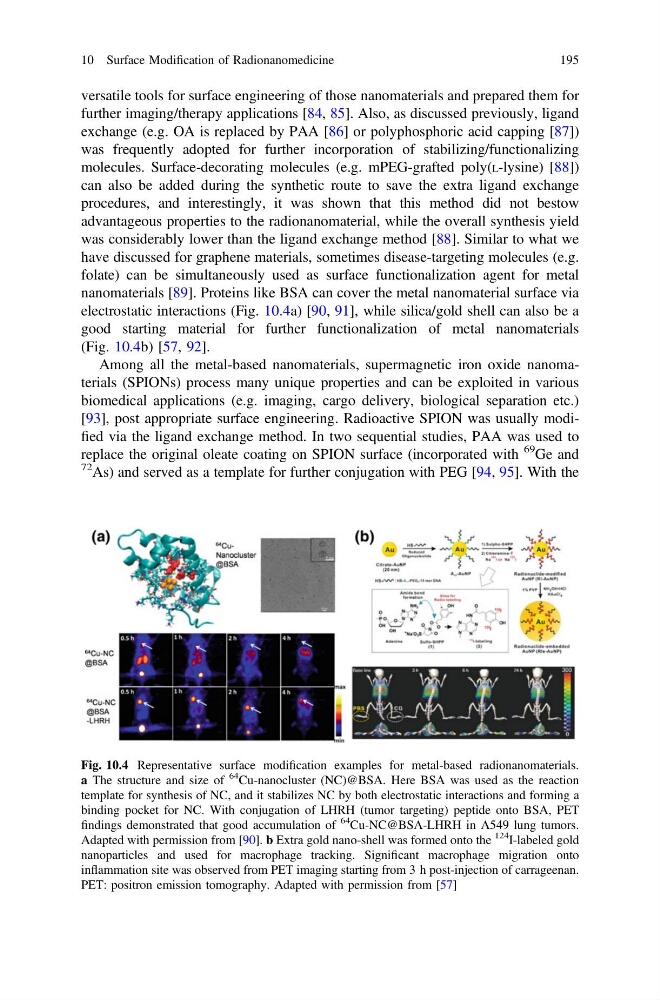
nanomaterials [89]. Proteins like BSA can cover the metal nanomaterial surface via
electrostatic interactions (Fig. 10.4a) [90, 91], while silica/gold shell can also be a
good starting material for further functionalization of metal nanomaterials
(Fig. 10.4b) [57, 92].
Among all the metal-based nanomaterials, supermagnetic iron oxide nanomaterials (SPIONs) process many unique properties and can be exploited in various
biomedical applications (e.g. imaging, cargo delivery, biological separation etc.)
[93], post appropriate surface engineering. Radioactive SPION was usually modified via the ligand exchange method. In two sequential studies, PAA was used to
replace the original oleate coating on SPION surface (incorporated with
69 Ge and
72 As) and served as a template for further conjugation with PEG [94, 95]. With the
Fig. 10.4 Representative surface modification examples for metal-based radionanomaterials.
a The structure and size of
64 Cu-nanocluster (NC)@BSA. Here BSA was used as the reaction
template for synthesis of NC, and it stabilizes NC by both electrostatic interactions and forming a
binding pocket for NC. With conjugation of LHRH (tumor targeting) peptide onto BSA, PET
findings demonstrated that good accumulation of
64
Cu-NC@BSA-LHRH in A549 lung tumors.
Adapted with permission from [90]. b Extra gold nano-shell was formed onto the
124
I-labeled gold
nanoparticles and used for macrophage tracking. Significant macrophage migration onto
inflammation site was observed from PET imaging starting from 3 h post-injection of carrageenan.
PET: positron emission tomography. Adapted with permission from [57]
10 Surface Modification of Radionanomedicine
195
further imaging/therapy applications [84, 85]. Also, as discussed previously, ligand
exchange (e.g. OA is replaced by PAA [86] or polyphosphoric acid capping [87])
was frequently adopted for further incorporation of stabilizing/functionalizing
molecules. Surface-decorating molecules (e.g. mPEG-grafted poly(L-lysine) [88])
can also be added during the synthetic route to save the extra ligand exchange
procedures, and interestingly, it was shown that this method did not bestow
advantageous properties to the radionanomaterial, while the overall synthesis yield
was considerably lower than the ligand exchange method [88]. Similar to what we
have discussed for graphene materials, sometimes disease-targeting molecules (e.g.
folate) can be simultaneously used as surface functionalization agent for metal
nanomaterials [89]. Proteins like BSA can cover the metal nanomaterial surface via
electrostatic interactions (Fig. 10.4a) [90, 91], while silica/gold shell can also be a
good starting material for further functionalization of metal nanomaterials
(Fig. 10.4b) [57, 92].
Among all the metal-based nanomaterials, supermagnetic iron oxide nanomaterials (SPIONs) process many unique properties and can be exploited in various
biomedical applications (e.g. imaging, cargo delivery, biological separation etc.)
[93], post appropriate surface engineering. Radioactive SPION was usually modified via the ligand exchange method. In two sequential studies, PAA was used to
replace the original oleate coating on SPION surface (incorporated with
69 Ge and
72 As) and served as a template for further conjugation with PEG [94, 95]. With the
Fig. 10.4 Representative surface modification examples for metal-based radionanomaterials.
a The structure and size of
64 Cu-nanocluster (NC)@BSA. Here BSA was used as the reaction
template for synthesis of NC, and it stabilizes NC by both electrostatic interactions and forming a
binding pocket for NC. With conjugation of LHRH (tumor targeting) peptide onto BSA, PET
findings demonstrated that good accumulation of
64
Cu-NC@BSA-LHRH in A549 lung tumors.
Adapted with permission from [90]. b Extra gold nano-shell was formed onto the
124
I-labeled gold
nanoparticles and used for macrophage tracking. Significant macrophage migration onto
inflammation site was observed from PET imaging starting from 3 h post-injection of carrageenan.
PET: positron emission tomography. Adapted with permission from [57]
10 Surface Modification of Radionanomedicine
195