

in the spleen). Further studies incorporated PEG (react with surface amine) to
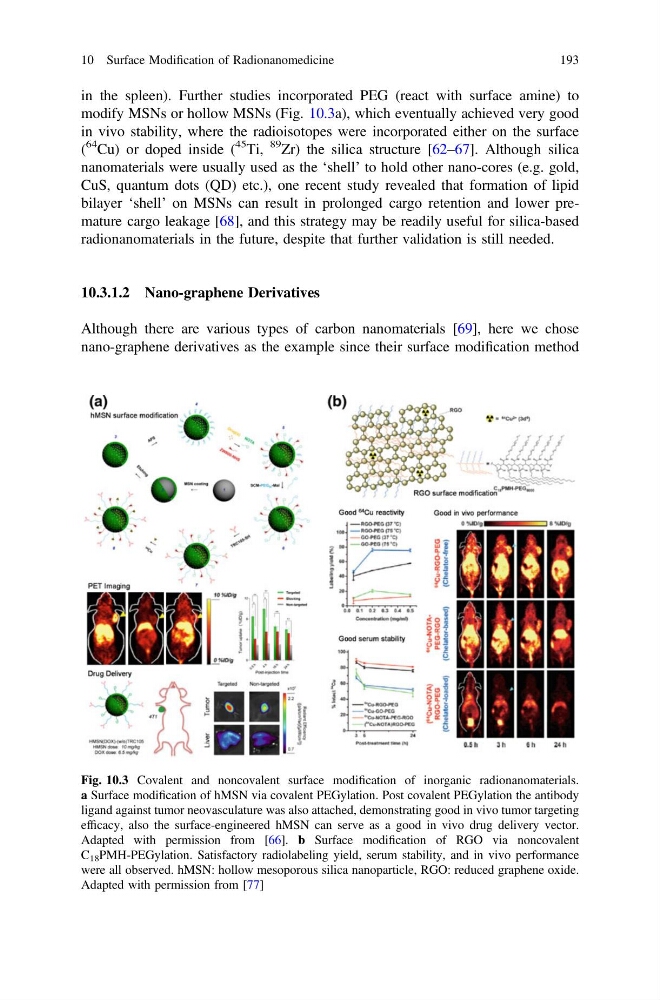
modify MSNs or hollow MSNs (Fig. 10.3a), which eventually achieved very good
in vivo stability, where the radioisotopes were incorporated either on the surface
(
64 Cu) or doped inside (
45 Ti,
89 Zr) the silica structure [62–67]. Although silica
nanomaterials were usually used as the ‘shell’ to hold other nano-cores (e.g. gold,
CuS, quantum dots (QD) etc.), one recent study revealed that formation of lipid
bilayer ‘shell’ on MSNs can result in prolonged cargo retention and lower premature cargo leakage [68], and this strategy may be readily useful for silica-based
radionanomaterials in the future, despite that further validation is still needed.
10.3.1.2 Nano-graphene Derivatives
Although there are various types of carbon nanomaterials [69], here we chose
nano-graphene derivatives as the example since their surface modification method
Fig. 10.3 Covalent and noncovalent surface modification of inorganic radionanomaterials.
a Surface modification of hMSN via covalent PEGylation. Post covalent PEGylation the antibody
ligand against tumor neovasculature was also attached, demonstrating good in vivo tumor targeting
efficacy, also the surface-engineered hMSN can serve as a good in vivo drug delivery vector.
Adapted with permission from [66]. b Surface modification of RGO via noncovalent
C 18 PMH-PEGylation. Satisfactory radiolabeling yield, serum stability, and in vivo performance
were all observed. hMSN: hollow mesoporous silica nanoparticle, RGO: reduced graphene oxide.
Adapted with permission from [77]
10 Surface Modification of Radionanomedicine
193
modify MSNs or hollow MSNs (Fig. 10.3a), which eventually achieved very good
in vivo stability, where the radioisotopes were incorporated either on the surface
(
64 Cu) or doped inside (
45 Ti,
89 Zr) the silica structure [62–67]. Although silica
nanomaterials were usually used as the ‘shell’ to hold other nano-cores (e.g. gold,
CuS, quantum dots (QD) etc.), one recent study revealed that formation of lipid
bilayer ‘shell’ on MSNs can result in prolonged cargo retention and lower premature cargo leakage [68], and this strategy may be readily useful for silica-based
radionanomaterials in the future, despite that further validation is still needed.
10.3.1.2 Nano-graphene Derivatives
Although there are various types of carbon nanomaterials [69], here we chose
nano-graphene derivatives as the example since their surface modification method
Fig. 10.3 Covalent and noncovalent surface modification of inorganic radionanomaterials.
a Surface modification of hMSN via covalent PEGylation. Post covalent PEGylation the antibody
ligand against tumor neovasculature was also attached, demonstrating good in vivo tumor targeting
efficacy, also the surface-engineered hMSN can serve as a good in vivo drug delivery vector.
Adapted with permission from [66]. b Surface modification of RGO via noncovalent
C 18 PMH-PEGylation. Satisfactory radiolabeling yield, serum stability, and in vivo performance
were all observed. hMSN: hollow mesoporous silica nanoparticle, RGO: reduced graphene oxide.
Adapted with permission from [77]
10 Surface Modification of Radionanomedicine
193