

8.2 Variability of Biodistribution of EVs
8.2.1 Challenging in Tissue Targeting: Tropism of EVs
One of the important features of EVs that raise the promises for their application as
drug carriers and therapeutics is their tissue-homing characteristics. Because of
various surface proteins of EVs which can interact with recipient cells, EVs have
initially received great attention for tissue-targeting endogenous nanomaterials [5].
Initial pilot studies which aimed at regenerative therapeutics as EVs showed that
mesenchymal stem cell-derived EVs had therapeutic effects on myocardial ischemic
tissue injuries or renal tissue loss by tissue homing effect of EVs [18, 29–33].
Moreover, tumor-derived EVs were reported to be accumulated in the lymph nodes
which suggested pre-metastatic behavior [34] implying EVs’ tropism that could be
applied to tissue targeting.
Unfortunately, this tissue targeting capacity and in vivo distribution of EVs is
highly affected by the physiological state of EVs as well as their extraction and
administration methods [35]. So far, many studies using various imaging techniques
reported too much variability regarding in vivo distribution of EVs. As those
studies used different cell type-derived EVs as well as different techniques for
acquisition of EVs, the in vivo distribution results should have been so variable.
This variety of in vivo biodistribution are determined by technical, intrinsic and
biological factors of EVs. The factors that have impact on biodistribution are
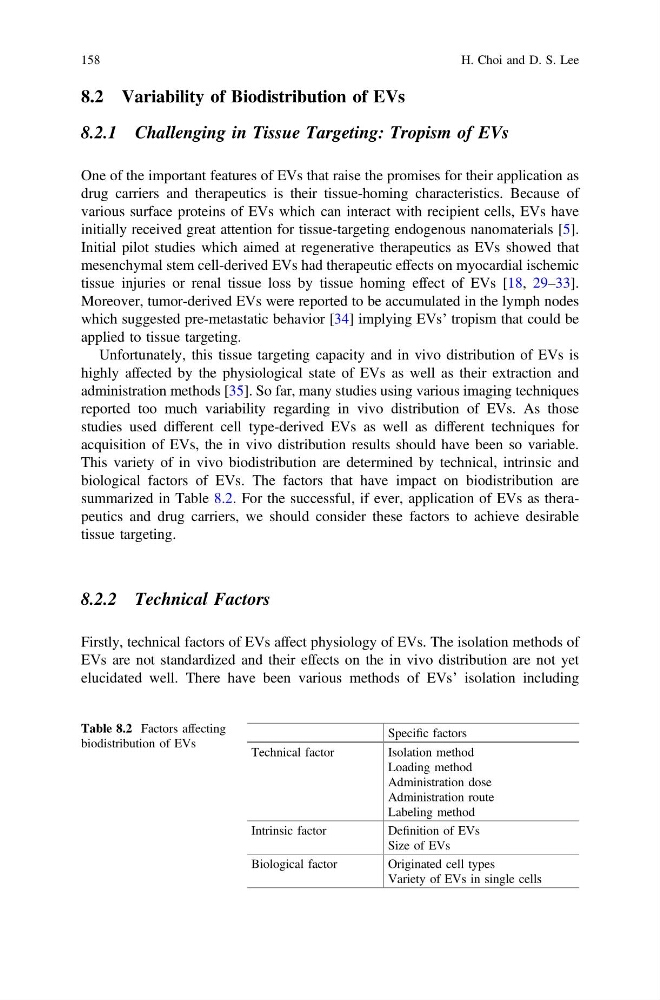
summarized in Table 8.2. For the successful, if ever, application of EVs as therapeutics and drug carriers, we should consider these factors to achieve desirable
tissue targeting.
8.2.2 Technical Factors
Firstly, technical factors of EVs affect physiology of EVs. The isolation methods of
EVs are not standardized and their effects on the in vivo distribution are not yet
elucidated well. There have been various methods of EVs’ isolation including
Table 8.2 Factors affecting
biodistribution of EVs
Specific factors
Technical factor
Isolation method
Loading method
Administration dose
Administration route
Labeling method
Intrinsic factor
Definition of EVs
Size of EVs
Biological factor
Originated cell types
Variety of EVs in single cells
158
H. Choi and D. S. Lee
8.2.1 Challenging in Tissue Targeting: Tropism of EVs
One of the important features of EVs that raise the promises for their application as
drug carriers and therapeutics is their tissue-homing characteristics. Because of
various surface proteins of EVs which can interact with recipient cells, EVs have
initially received great attention for tissue-targeting endogenous nanomaterials [5].
Initial pilot studies which aimed at regenerative therapeutics as EVs showed that
mesenchymal stem cell-derived EVs had therapeutic effects on myocardial ischemic
tissue injuries or renal tissue loss by tissue homing effect of EVs [18, 29–33].
Moreover, tumor-derived EVs were reported to be accumulated in the lymph nodes
which suggested pre-metastatic behavior [34] implying EVs’ tropism that could be
applied to tissue targeting.
Unfortunately, this tissue targeting capacity and in vivo distribution of EVs is
highly affected by the physiological state of EVs as well as their extraction and
administration methods [35]. So far, many studies using various imaging techniques
reported too much variability regarding in vivo distribution of EVs. As those
studies used different cell type-derived EVs as well as different techniques for
acquisition of EVs, the in vivo distribution results should have been so variable.
This variety of in vivo biodistribution are determined by technical, intrinsic and
biological factors of EVs. The factors that have impact on biodistribution are
summarized in Table 8.2. For the successful, if ever, application of EVs as therapeutics and drug carriers, we should consider these factors to achieve desirable
tissue targeting.
8.2.2 Technical Factors
Firstly, technical factors of EVs affect physiology of EVs. The isolation methods of
EVs are not standardized and their effects on the in vivo distribution are not yet
elucidated well. There have been various methods of EVs’ isolation including
Table 8.2 Factors affecting
biodistribution of EVs
Specific factors
Technical factor
Isolation method
Loading method
Administration dose
Administration route
Labeling method
Intrinsic factor
Definition of EVs
Size of EVs
Biological factor
Originated cell types
Variety of EVs in single cells
158
H. Choi and D. S. Lee