

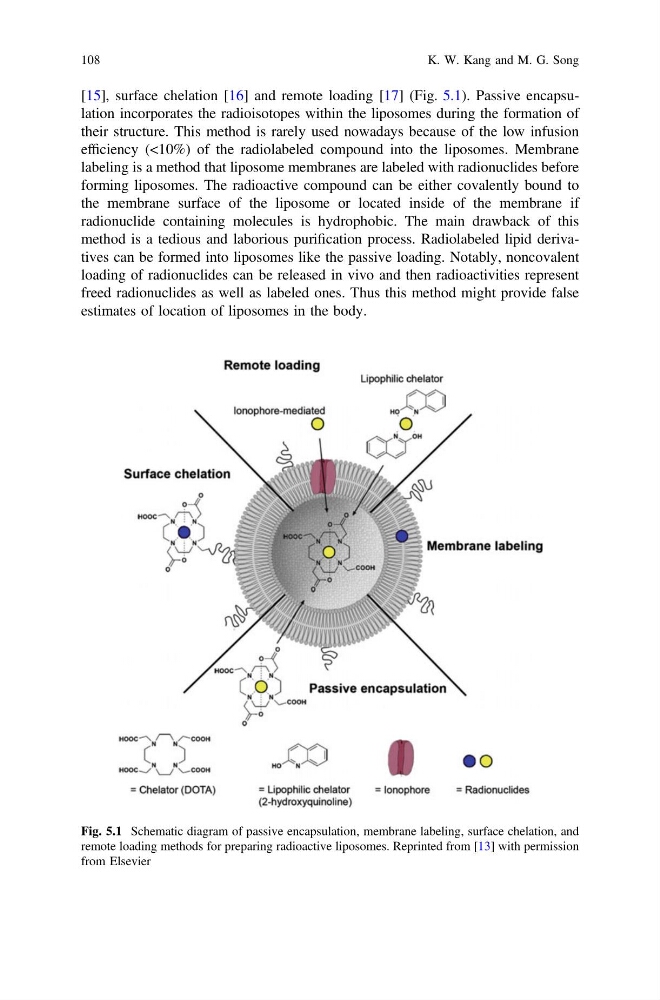
[15], surface chelation [16] and remote loading [17] (Fig. 5.1). Passive encapsulation incorporates the radioisotopes within the liposomes during the formation of
their structure. This method is rarely used nowadays because of the low infusion
efficiency (<10%) of the radiolabeled compound into the liposomes. Membrane
labeling is a method that liposome membranes are labeled with radionuclides before
forming liposomes. The radioactive compound can be either covalently bound to
the membrane surface of the liposome or located inside of the membrane if
radionuclide containing molecules is hydrophobic. The main drawback of this
method is a tedious and laborious purification process. Radiolabeled lipid derivatives can be formed into liposomes like the passive loading. Notably, noncovalent
loading of radionuclides can be released in vivo and then radioactivities represent
freed radionuclides as well as labeled ones. Thus this method might provide false
estimates of location of liposomes in the body.
Fig. 5.1 Schematic diagram of passive encapsulation, membrane labeling, surface chelation, and
remote loading methods for preparing radioactive liposomes. Reprinted from [13] with permission
from Elsevier
108
K. W. Kang and M. G. Song
their structure. This method is rarely used nowadays because of the low infusion
efficiency (<10%) of the radiolabeled compound into the liposomes. Membrane
labeling is a method that liposome membranes are labeled with radionuclides before
forming liposomes. The radioactive compound can be either covalently bound to
the membrane surface of the liposome or located inside of the membrane if
radionuclide containing molecules is hydrophobic. The main drawback of this
method is a tedious and laborious purification process. Radiolabeled lipid derivatives can be formed into liposomes like the passive loading. Notably, noncovalent
loading of radionuclides can be released in vivo and then radioactivities represent
freed radionuclides as well as labeled ones. Thus this method might provide false
estimates of location of liposomes in the body.
Fig. 5.1 Schematic diagram of passive encapsulation, membrane labeling, surface chelation, and
remote loading methods for preparing radioactive liposomes. Reprinted from [13] with permission
from Elsevier
108
K. W. Kang and M. G. Song