

In addition to aforementioned covalent modifications, non-covalent methods
have also been frequently employed to incorporate different molecules on
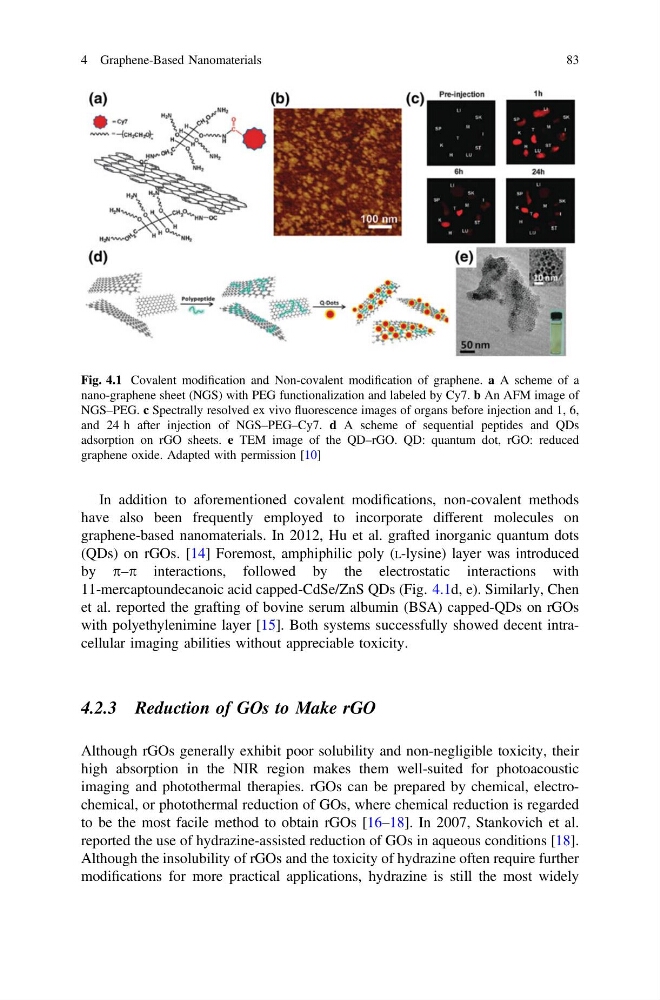
graphene-based nanomaterials. In 2012, Hu et al. grafted inorganic quantum dots
(QDs) on rGOs. [14] Foremost, amphiphilic poly (L-lysine) layer was introduced
by p–p interactions, followed by the electrostatic interactions with
11-mercaptoundecanoic acid capped-CdSe/ZnS QDs (Fig. 4.1d, e). Similarly, Chen
et al. reported the grafting of bovine serum albumin (BSA) capped-QDs on rGOs
with polyethylenimine layer [15]. Both systems successfully showed decent intracellular imaging abilities without appreciable toxicity.
4.2.3 Reduction of GOs to Make rGO
Although rGOs generally exhibit poor solubility and non-negligible toxicity, their
high absorption in the NIR region makes them well-suited for photoacoustic
imaging and photothermal therapies. rGOs can be prepared by chemical, electrochemical, or photothermal reduction of GOs, where chemical reduction is regarded
to be the most facile method to obtain rGOs [16–18]. In 2007, Stankovich et al.
reported the use of hydrazine-assisted reduction of GOs in aqueous conditions [18].
Although the insolubility of rGOs and the toxicity of hydrazine often require further
modifications for more practical applications, hydrazine is still the most widely
Fig. 4.1 Covalent modification and Non-covalent modification of graphene. a A scheme of a
nano-graphene sheet (NGS) with PEG functionalization and labeled by Cy7. b An AFM image of
NGS–PEG. c Spectrally resolved ex vivo fluorescence images of organs before injection and 1, 6,
and 24 h after injection of NGS–PEG–Cy7. d A scheme of sequential peptides and QDs
adsorption on rGO sheets. e TEM image of the QD–rGO. QD: quantum dot, rGO: reduced
graphene oxide. Adapted with permission [10]
4 Graphene-Based Nanomaterials
83
have also been frequently employed to incorporate different molecules on
graphene-based nanomaterials. In 2012, Hu et al. grafted inorganic quantum dots
(QDs) on rGOs. [14] Foremost, amphiphilic poly (L-lysine) layer was introduced
by p–p interactions, followed by the electrostatic interactions with
11-mercaptoundecanoic acid capped-CdSe/ZnS QDs (Fig. 4.1d, e). Similarly, Chen
et al. reported the grafting of bovine serum albumin (BSA) capped-QDs on rGOs
with polyethylenimine layer [15]. Both systems successfully showed decent intracellular imaging abilities without appreciable toxicity.
4.2.3 Reduction of GOs to Make rGO
Although rGOs generally exhibit poor solubility and non-negligible toxicity, their
high absorption in the NIR region makes them well-suited for photoacoustic
imaging and photothermal therapies. rGOs can be prepared by chemical, electrochemical, or photothermal reduction of GOs, where chemical reduction is regarded
to be the most facile method to obtain rGOs [16–18]. In 2007, Stankovich et al.
reported the use of hydrazine-assisted reduction of GOs in aqueous conditions [18].
Although the insolubility of rGOs and the toxicity of hydrazine often require further
modifications for more practical applications, hydrazine is still the most widely
Fig. 4.1 Covalent modification and Non-covalent modification of graphene. a A scheme of a
nano-graphene sheet (NGS) with PEG functionalization and labeled by Cy7. b An AFM image of
NGS–PEG. c Spectrally resolved ex vivo fluorescence images of organs before injection and 1, 6,
and 24 h after injection of NGS–PEG–Cy7. d A scheme of sequential peptides and QDs
adsorption on rGO sheets. e TEM image of the QD–rGO. QD: quantum dot, rGO: reduced
graphene oxide. Adapted with permission [10]
4 Graphene-Based Nanomaterials
83