

Curriculum Vitae
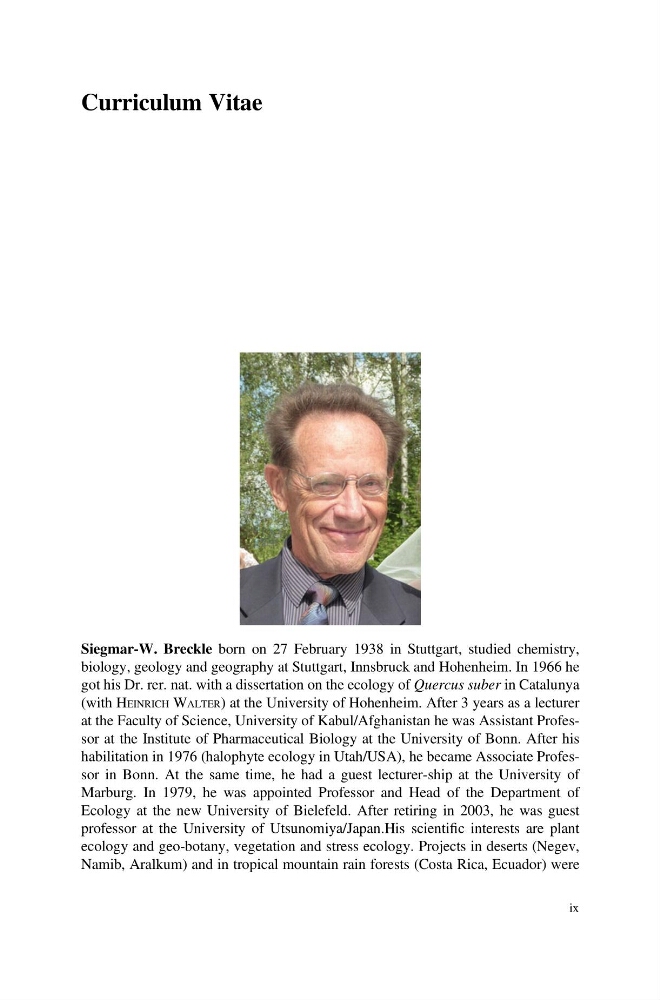
Siegmar-W. Breckle born on 27 February 1938 in Stuttgart, studied chemistry,
biology, geology and geography at Stuttgart, Innsbruck and Hohenheim. In 1966 he
got his Dr. rer. nat. with a dissertation on the ecology of Quercus suber in Catalunya
(with HEINRICH WALTER) at the University of Hohenheim. After 3 years as a lecturer
at the Faculty of Science, University of Kabul/Afghanistan he was Assistant Professor at the Institute of Pharmaceutical Biology at the University of Bonn. After his
habilitation in 1976 (halophyte ecology in Utah/USA), he became Associate Professor in Bonn. At the same time, he had a guest lecturer-ship at the University of
Marburg. In 1979, he was appointed Professor and Head of the Department of
Ecology at the new University of Bielefeld. After retiring in 2003, he was guest
professor at the University of Utsunomiya/Japan.His scientific interests are plant
ecology and geo-botany, vegetation and stress ecology. Projects in deserts (Negev,
Namib, Aralkum) and in tropical mountain rain forests (Costa Rica, Ecuador) were
ix
Siegmar-W. Breckle born on 27 February 1938 in Stuttgart, studied chemistry,
biology, geology and geography at Stuttgart, Innsbruck and Hohenheim. In 1966 he
got his Dr. rer. nat. with a dissertation on the ecology of Quercus suber in Catalunya
(with HEINRICH WALTER) at the University of Hohenheim. After 3 years as a lecturer
at the Faculty of Science, University of Kabul/Afghanistan he was Assistant Professor at the Institute of Pharmaceutical Biology at the University of Bonn. After his
habilitation in 1976 (halophyte ecology in Utah/USA), he became Associate Professor in Bonn. At the same time, he had a guest lecturer-ship at the University of
Marburg. In 1979, he was appointed Professor and Head of the Department of
Ecology at the new University of Bielefeld. After retiring in 2003, he was guest
professor at the University of Utsunomiya/Japan.His scientific interests are plant
ecology and geo-botany, vegetation and stress ecology. Projects in deserts (Negev,
Namib, Aralkum) and in tropical mountain rain forests (Costa Rica, Ecuador) were
ix