

became valuable historical documents. How were we to use them? By developing a
“snowball system”, after 2005 we were able to use photographs from many colleagues all over the world. This was the starting point for collecting photos for an
illustrated flora. An easy-to-use botanical field guide was, for a long time, much
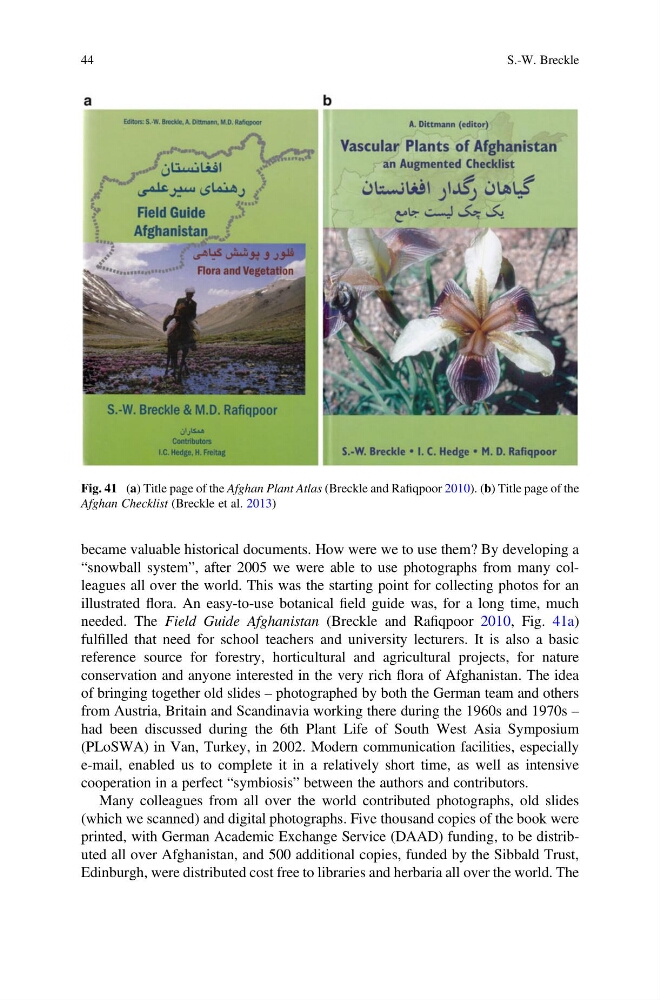
needed. The Field Guide Afghanistan (Breckle and Rafiqpoor 2010, Fig. 41a)
fulfilled that need for school teachers and university lecturers. It is also a basic
reference source for forestry, horticultural and agricultural projects, for nature
conservation and anyone interested in the very rich flora of Afghanistan. The idea
of bringing together old slides – photographed by both the German team and others
from Austria, Britain and Scandinavia working there during the 1960s and 1970s –
had been discussed during the 6th Plant Life of South West Asia Symposium
(PLoSWA) in Van, Turkey, in 2002. Modern communication facilities, especially
e-mail, enabled us to complete it in a relatively short time, as well as intensive
cooperation in a perfect “symbiosis” between the authors and contributors.
Many colleagues from all over the world contributed photographs, old slides
(which we scanned) and digital photographs. Five thousand copies of the book were
printed, with German Academic Exchange Service (DAAD) funding, to be distributed all over Afghanistan, and 500 additional copies, funded by the Sibbald Trust,
Edinburgh, were distributed cost free to libraries and herbaria all over the world. The
Fig. 41 (a) Title page of the Afghan Plant Atlas (Breckle and Rafiqpoor 2010). (b) Title page of the
Afghan Checklist (Breckle et al. 2013)
44
S.-W. Breckle
“snowball system”, after 2005 we were able to use photographs from many colleagues all over the world. This was the starting point for collecting photos for an
illustrated flora. An easy-to-use botanical field guide was, for a long time, much
needed. The Field Guide Afghanistan (Breckle and Rafiqpoor 2010, Fig. 41a)
fulfilled that need for school teachers and university lecturers. It is also a basic
reference source for forestry, horticultural and agricultural projects, for nature
conservation and anyone interested in the very rich flora of Afghanistan. The idea
of bringing together old slides – photographed by both the German team and others
from Austria, Britain and Scandinavia working there during the 1960s and 1970s –
had been discussed during the 6th Plant Life of South West Asia Symposium
(PLoSWA) in Van, Turkey, in 2002. Modern communication facilities, especially
e-mail, enabled us to complete it in a relatively short time, as well as intensive
cooperation in a perfect “symbiosis” between the authors and contributors.
Many colleagues from all over the world contributed photographs, old slides
(which we scanned) and digital photographs. Five thousand copies of the book were
printed, with German Academic Exchange Service (DAAD) funding, to be distributed all over Afghanistan, and 500 additional copies, funded by the Sibbald Trust,
Edinburgh, were distributed cost free to libraries and herbaria all over the world. The
Fig. 41 (a) Title page of the Afghan Plant Atlas (Breckle and Rafiqpoor 2010). (b) Title page of the
Afghan Checklist (Breckle et al. 2013)
44
S.-W. Breckle