

Reserva Biológica San Francisco (RBSF) adjacent to the Podocarpus National Park.
On the opposite side of the valley, the forests were cleared about 30 years ago for
pine plantations and pastures. Thus, this whole valley – being a hotspot of biodiversity (see Sect. 7.1) – offers great opportunities for comparative studies.
The succession is apparently very dynamic and different in each place, especially
in southern Ecuador. There, the long open and steep landslides (Fig. 30b) revealed
orchids and ferns as members of the first successional stages (Gross 1998), together
with annuals, certainly favoured by their small diaspores. This is rather similar to
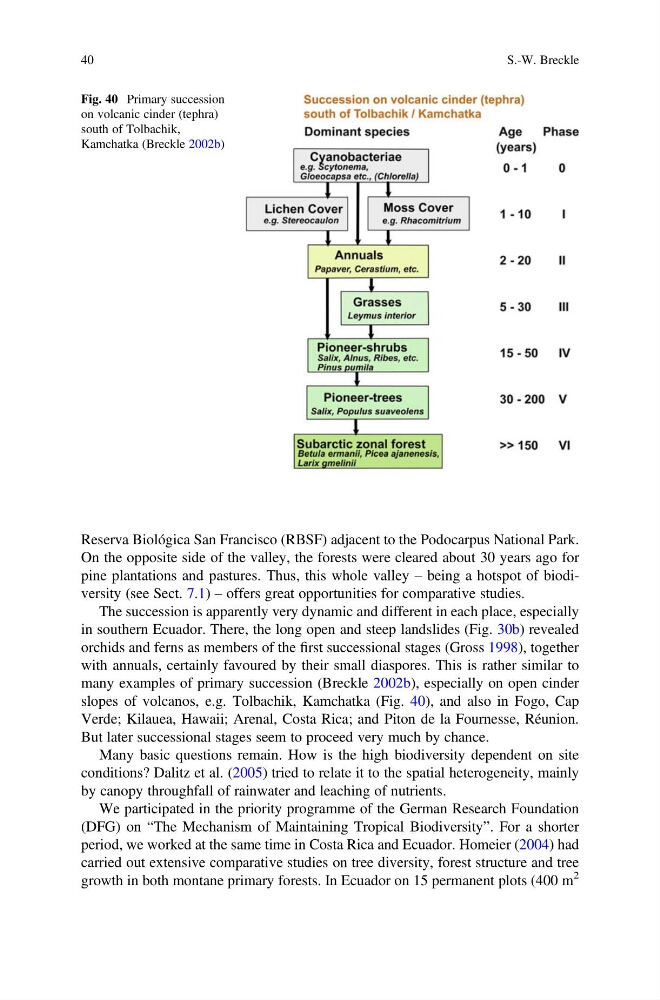
many examples of primary succession (Breckle 2002b), especially on open cinder
slopes of volcanos, e.g. Tolbachik, Kamchatka (Fig. 40), and also in Fogo, Cap
Verde; Kilauea, Hawaii; Arenal, Costa Rica; and Piton de la Fournesse, Réunion.
But later successional stages seem to proceed very much by chance.
Many basic questions remain. How is the high biodiversity dependent on site
conditions? Dalitz et al. (2005) tried to relate it to the spatial heterogeneity, mainly
by canopy throughfall of rainwater and leaching of nutrients.
We participated in the priority programme of the German Research Foundation
(DFG) on “The Mechanism of Maintaining Tropical Biodiversity”. For a shorter
period, we worked at the same time in Costa Rica and Ecuador. Homeier (2004) had
carried out extensive comparative studies on tree diversity, forest structure and tree
growth in both montane primary forests. In Ecuador on 15 permanent plots (400 m
2
Fig. 40 Primary succession
on volcanic cinder (tephra)
south of Tolbachik,
Kamchatka (Breckle 2002b)
40
S.-W. Breckle
On the opposite side of the valley, the forests were cleared about 30 years ago for
pine plantations and pastures. Thus, this whole valley – being a hotspot of biodiversity (see Sect. 7.1) – offers great opportunities for comparative studies.
The succession is apparently very dynamic and different in each place, especially
in southern Ecuador. There, the long open and steep landslides (Fig. 30b) revealed
orchids and ferns as members of the first successional stages (Gross 1998), together
with annuals, certainly favoured by their small diaspores. This is rather similar to
many examples of primary succession (Breckle 2002b), especially on open cinder
slopes of volcanos, e.g. Tolbachik, Kamchatka (Fig. 40), and also in Fogo, Cap
Verde; Kilauea, Hawaii; Arenal, Costa Rica; and Piton de la Fournesse, Réunion.
But later successional stages seem to proceed very much by chance.
Many basic questions remain. How is the high biodiversity dependent on site
conditions? Dalitz et al. (2005) tried to relate it to the spatial heterogeneity, mainly
by canopy throughfall of rainwater and leaching of nutrients.
We participated in the priority programme of the German Research Foundation
(DFG) on “The Mechanism of Maintaining Tropical Biodiversity”. For a shorter
period, we worked at the same time in Costa Rica and Ecuador. Homeier (2004) had
carried out extensive comparative studies on tree diversity, forest structure and tree
growth in both montane primary forests. In Ecuador on 15 permanent plots (400 m
2
Fig. 40 Primary succession
on volcanic cinder (tephra)
south of Tolbachik,
Kamchatka (Breckle 2002b)
40
S.-W. Breckle