

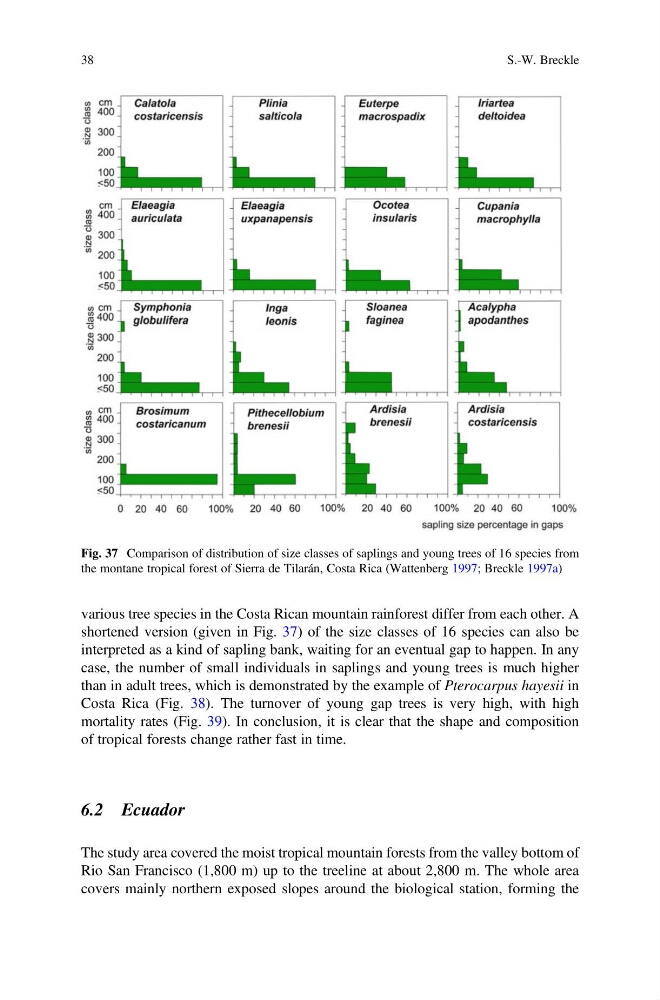
various tree species in the Costa Rican mountain rainforest differ from each other. A
shortened version (given in Fig. 37) of the size classes of 16 species can also be
interpreted as a kind of sapling bank, waiting for an eventual gap to happen. In any
case, the number of small individuals in saplings and young trees is much higher
than in adult trees, which is demonstrated by the example of Pterocarpus hayesii in
Costa Rica (Fig. 38). The turnover of young gap trees is very high, with high
mortality rates (Fig. 39). In conclusion, it is clear that the shape and composition
of tropical forests change rather fast in time.
6.2 Ecuador
The study area covered the moist tropical mountain forests from the valley bottom of
Rio San Francisco (1,800 m) up to the treeline at about 2,800 m. The whole area
covers mainly northern exposed slopes around the biological station, forming the
Fig. 37 Comparison of distribution of size classes of saplings and young trees of 16 species from
the montane tropical forest of Sierra de Tilarán, Costa Rica (Wattenberg 1997; Breckle 1997a)
38
S.-W. Breckle
shortened version (given in Fig. 37) of the size classes of 16 species can also be
interpreted as a kind of sapling bank, waiting for an eventual gap to happen. In any
case, the number of small individuals in saplings and young trees is much higher
than in adult trees, which is demonstrated by the example of Pterocarpus hayesii in
Costa Rica (Fig. 38). The turnover of young gap trees is very high, with high
mortality rates (Fig. 39). In conclusion, it is clear that the shape and composition
of tropical forests change rather fast in time.
6.2 Ecuador
The study area covered the moist tropical mountain forests from the valley bottom of
Rio San Francisco (1,800 m) up to the treeline at about 2,800 m. The whole area
covers mainly northern exposed slopes around the biological station, forming the
Fig. 37 Comparison of distribution of size classes of saplings and young trees of 16 species from
the montane tropical forest of Sierra de Tilarán, Costa Rica (Wattenberg 1997; Breckle 1997a)
38
S.-W. Breckle