

Gap dynamics play an important role in the future stand structure (Fig. 29). Gaps
are the result of natural disturbances in forests, ranging from large branches breaking
off, to a tree dying then falling over and bringing its roots to the surface of the
ground, to landslides bringing down groups of trees. In the premontane tropical
rainforests of the Sierra de Tilarán, the slopes are very steep; thus tree falls and small
landslides are common; the same is also true in Ecuador (see Fig. 30b). Because of
the range of causes, gaps have a wide range of sizes, including small and large gaps.
Gaps allow an increase in light as well as changes in moisture and wind levels,
leading to differences in microclimate conditions compared with those below the
closed canopy, which are generally cooler and more shaded. Thus, gaps are more or
less a special site with altered conditions (Fig. 29); these smaller or bigger islands
can be the reason for a dynamic mosaic canopy structure. Gaps provide the ideal
location and conditions for rapid plant reproduction and growth (Fig. 39)
(Wattenberg 1996).
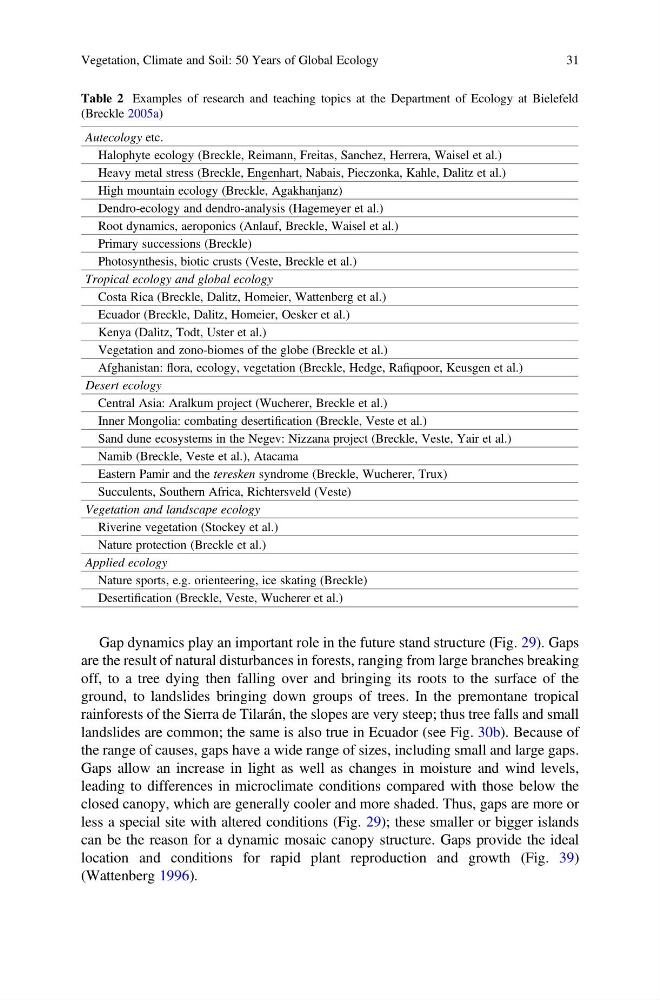
Table 2 Examples of research and teaching topics at the Department of Ecology at Bielefeld
(Breckle 2005a)
Autecology etc.
Halophyte ecology (Breckle, Reimann, Freitas, Sanchez, Herrera, Waisel et al.)
Heavy metal stress (Breckle, Engenhart, Nabais, Pieczonka, Kahle, Dalitz et al.)
High mountain ecology (Breckle, Agakhanjanz)
Dendro-ecology and dendro-analysis (Hagemeyer et al.)
Root dynamics, aeroponics (Anlauf, Breckle, Waisel et al.)
Primary successions (Breckle)
Photosynthesis, biotic crusts (Veste, Breckle et al.)
Tropical ecology and global ecology
Costa Rica (Breckle, Dalitz, Homeier, Wattenberg et al.)
Ecuador (Breckle, Dalitz, Homeier, Oesker et al.)
Kenya (Dalitz, Todt, Uster et al.)
Vegetation and zono-biomes of the globe (Breckle et al.)
Afghanistan: flora, ecology, vegetation (Breckle, Hedge, Rafiqpoor, Keusgen et al.)
Desert ecology
Central Asia: Aralkum project (Wucherer, Breckle et al.)
Inner Mongolia: combating desertification (Breckle, Veste et al.)
Sand dune ecosystems in the Negev: Nizzana project (Breckle, Veste, Yair et al.)
Namib (Breckle, Veste et al.), Atacama
Eastern Pamir and the teresken syndrome (Breckle, Wucherer, Trux)
Succulents, Southern Africa, Richtersveld (Veste)
Vegetation and landscape ecology
Riverine vegetation (Stockey et al.)
Nature protection (Breckle et al.)
Applied ecology
Nature sports, e.g. orienteering, ice skating (Breckle)
Desertification (Breckle, Veste, Wucherer et al.)
Vegetation, Climate and Soil: 50 Years of Global Ecology
31
are the result of natural disturbances in forests, ranging from large branches breaking
off, to a tree dying then falling over and bringing its roots to the surface of the
ground, to landslides bringing down groups of trees. In the premontane tropical
rainforests of the Sierra de Tilarán, the slopes are very steep; thus tree falls and small
landslides are common; the same is also true in Ecuador (see Fig. 30b). Because of
the range of causes, gaps have a wide range of sizes, including small and large gaps.
Gaps allow an increase in light as well as changes in moisture and wind levels,
leading to differences in microclimate conditions compared with those below the
closed canopy, which are generally cooler and more shaded. Thus, gaps are more or
less a special site with altered conditions (Fig. 29); these smaller or bigger islands
can be the reason for a dynamic mosaic canopy structure. Gaps provide the ideal
location and conditions for rapid plant reproduction and growth (Fig. 39)
(Wattenberg 1996).
Table 2 Examples of research and teaching topics at the Department of Ecology at Bielefeld
(Breckle 2005a)
Autecology etc.
Halophyte ecology (Breckle, Reimann, Freitas, Sanchez, Herrera, Waisel et al.)
Heavy metal stress (Breckle, Engenhart, Nabais, Pieczonka, Kahle, Dalitz et al.)
High mountain ecology (Breckle, Agakhanjanz)
Dendro-ecology and dendro-analysis (Hagemeyer et al.)
Root dynamics, aeroponics (Anlauf, Breckle, Waisel et al.)
Primary successions (Breckle)
Photosynthesis, biotic crusts (Veste, Breckle et al.)
Tropical ecology and global ecology
Costa Rica (Breckle, Dalitz, Homeier, Wattenberg et al.)
Ecuador (Breckle, Dalitz, Homeier, Oesker et al.)
Kenya (Dalitz, Todt, Uster et al.)
Vegetation and zono-biomes of the globe (Breckle et al.)
Afghanistan: flora, ecology, vegetation (Breckle, Hedge, Rafiqpoor, Keusgen et al.)
Desert ecology
Central Asia: Aralkum project (Wucherer, Breckle et al.)
Inner Mongolia: combating desertification (Breckle, Veste et al.)
Sand dune ecosystems in the Negev: Nizzana project (Breckle, Veste, Yair et al.)
Namib (Breckle, Veste et al.), Atacama
Eastern Pamir and the teresken syndrome (Breckle, Wucherer, Trux)
Succulents, Southern Africa, Richtersveld (Veste)
Vegetation and landscape ecology
Riverine vegetation (Stockey et al.)
Nature protection (Breckle et al.)
Applied ecology
Nature sports, e.g. orienteering, ice skating (Breckle)
Desertification (Breckle, Veste, Wucherer et al.)
Vegetation, Climate and Soil: 50 Years of Global Ecology
31