

2011), affecting soil microbial activity, ectomycorrhizal community as well as water,
carbon and nutrient cycling due to higher soil water reserves (Hansen et al. 2013;
Parts et al. 2013; Kukumägi et al. 2014).
3.1 Free Air Humidity Manipulation (FAHM)
Free Air Humidity Manipulation (FAHM) infrastructure was established in a former
agricultural field in 2006–2007 to study the effects of artificially decreased VPD on
northern forest ecosystems. The experimental site is located at Rõka in the Järvselja
Experimental Forest District in south-eastern Estonia (58
14
0 N, 27
18
0 E, altitude
40–48 m) (Fig. 1). Estonia lies in between the temperate continental and maritime
climate zones, and the vegetation belongs to the boreo-nemoral zone. The soil type
in the experimental site is endogleyic planosol (Hansen et al. 2013). Average
temperature is 17
C and À6.7
C in July and January, respectively. The growing
season lasts around 180 days from mid-April to October.
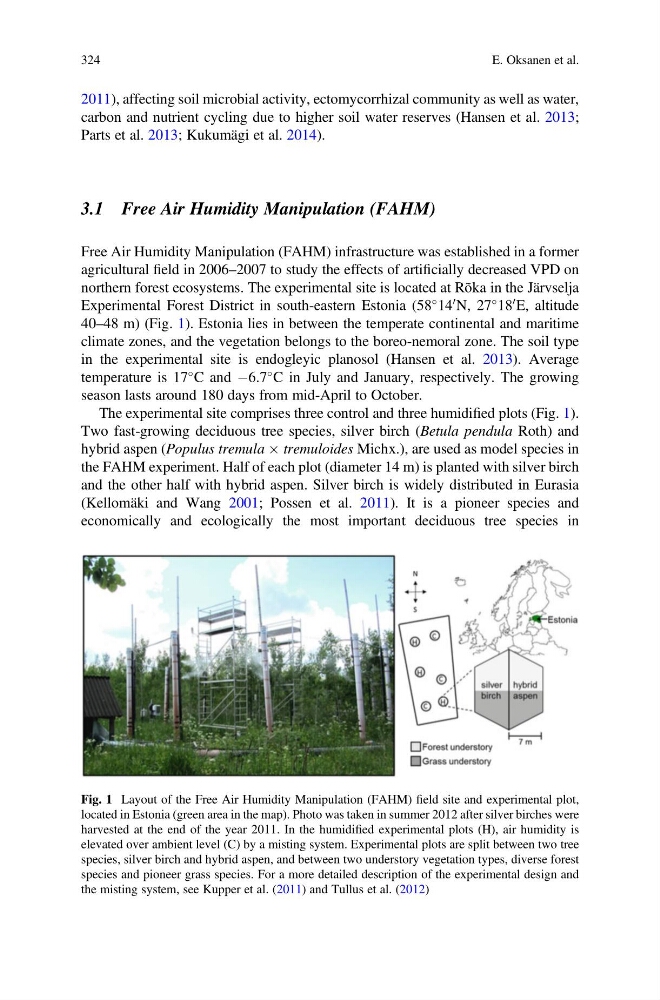
The experimental site comprises three control and three humidified plots (Fig. 1).
Two fast-growing deciduous tree species, silver birch (Betula pendula Roth) and
hybrid aspen (Populus tremula  tremuloides Michx.), are used as model species in
the FAHM experiment. Half of each plot (diameter 14 m) is planted with silver birch
and the other half with hybrid aspen. Silver birch is widely distributed in Eurasia
(Kellomäki and Wang 2001; Possen et al. 2011). It is a pioneer species and
economically and ecologically the most important deciduous tree species in
Fig. 1 Layout of the Free Air Humidity Manipulation (FAHM) field site and experimental plot,
located in Estonia (green area in the map). Photo was taken in summer 2012 after silver birches were
harvested at the end of the year 2011. In the humidified experimental plots (H), air humidity is
elevated over ambient level (C) by a misting system. Experimental plots are split between two tree
species, silver birch and hybrid aspen, and between two understory vegetation types, diverse forest
species and pioneer grass species. For a more detailed description of the experimental design and
the misting system, see Kupper et al. (2011) and Tullus et al. (2012)
324
E. Oksanen et al.
carbon and nutrient cycling due to higher soil water reserves (Hansen et al. 2013;
Parts et al. 2013; Kukumägi et al. 2014).
3.1 Free Air Humidity Manipulation (FAHM)
Free Air Humidity Manipulation (FAHM) infrastructure was established in a former
agricultural field in 2006–2007 to study the effects of artificially decreased VPD on
northern forest ecosystems. The experimental site is located at Rõka in the Järvselja
Experimental Forest District in south-eastern Estonia (58
14
0 N, 27
18
0 E, altitude
40–48 m) (Fig. 1). Estonia lies in between the temperate continental and maritime
climate zones, and the vegetation belongs to the boreo-nemoral zone. The soil type
in the experimental site is endogleyic planosol (Hansen et al. 2013). Average
temperature is 17
C and À6.7
C in July and January, respectively. The growing
season lasts around 180 days from mid-April to October.
The experimental site comprises three control and three humidified plots (Fig. 1).
Two fast-growing deciduous tree species, silver birch (Betula pendula Roth) and
hybrid aspen (Populus tremula  tremuloides Michx.), are used as model species in
the FAHM experiment. Half of each plot (diameter 14 m) is planted with silver birch
and the other half with hybrid aspen. Silver birch is widely distributed in Eurasia
(Kellomäki and Wang 2001; Possen et al. 2011). It is a pioneer species and
economically and ecologically the most important deciduous tree species in
Fig. 1 Layout of the Free Air Humidity Manipulation (FAHM) field site and experimental plot,
located in Estonia (green area in the map). Photo was taken in summer 2012 after silver birches were
harvested at the end of the year 2011. In the humidified experimental plots (H), air humidity is
elevated over ambient level (C) by a misting system. Experimental plots are split between two tree
species, silver birch and hybrid aspen, and between two understory vegetation types, diverse forest
species and pioneer grass species. For a more detailed description of the experimental design and
the misting system, see Kupper et al. (2011) and Tullus et al. (2012)
324
E. Oksanen et al.