

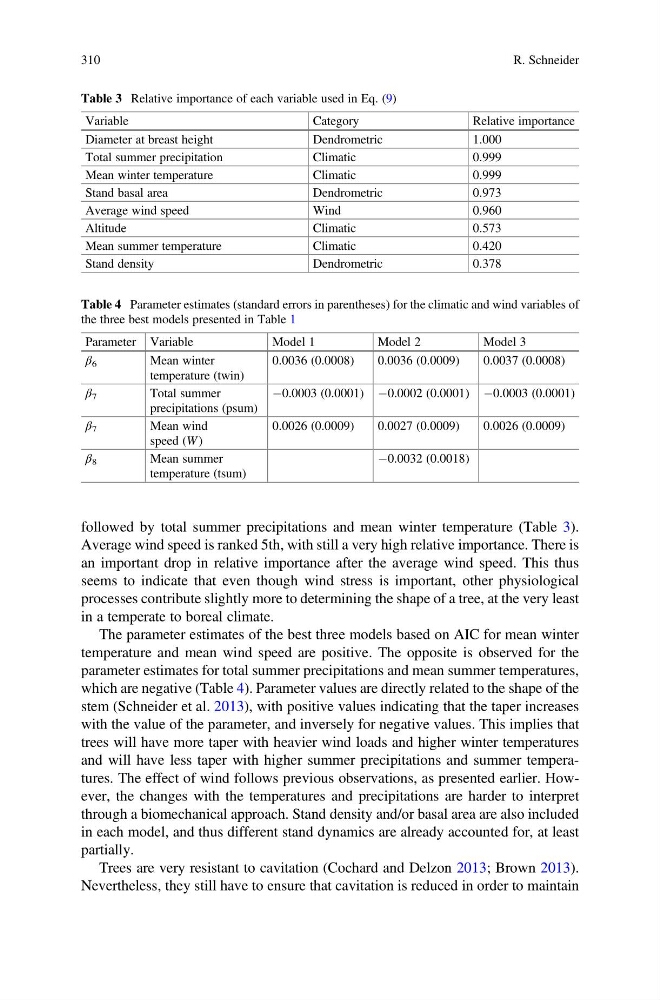
followed by total summer precipitations and mean winter temperature (Table 3).
Average wind speed is ranked 5th, with still a very high relative importance. There is
an important drop in relative importance after the average wind speed. This thus
seems to indicate that even though wind stress is important, other physiological
processes contribute slightly more to determining the shape of a tree, at the very least
in a temperate to boreal climate.
The parameter estimates of the best three models based on AIC for mean winter
temperature and mean wind speed are positive. The opposite is observed for the
parameter estimates for total summer precipitations and mean summer temperatures,
which are negative (Table 4). Parameter values are directly related to the shape of the
stem (Schneider et al. 2013), with positive values indicating that the taper increases
with the value of the parameter, and inversely for negative values. This implies that
trees will have more taper with heavier wind loads and higher winter temperatures
and will have less taper with higher summer precipitations and summer temperatures. The effect of wind follows previous observations, as presented earlier. However, the changes with the temperatures and precipitations are harder to interpret
through a biomechanical approach. Stand density and/or basal area are also included
in each model, and thus different stand dynamics are already accounted for, at least
partially.
Trees are very resistant to cavitation (Cochard and Delzon 2013; Brown 2013).
Nevertheless, they still have to ensure that cavitation is reduced in order to maintain
Table 3 Relative importance of each variable used in Eq. (9)
Variable
Category
Relative importance
Diameter at breast height
Dendrometric
1.000
Total summer precipitation
Climatic
0.999
Mean winter temperature
Climatic
0.999
Stand basal area
Dendrometric
0.973
Average wind speed
Wind
0.960
Altitude
Climatic
0.573
Mean summer temperature
Climatic
0.420
Stand density
Dendrometric
0.378
Table 4 Parameter estimates (standard errors in parentheses) for the climatic and wind variables of
the three best models presented in Table 1
Parameter Variable
Model 1
Model 2
Model 3
β 6
Mean winter
temperature (twin)
0.0036 (0.0008)
0.0036 (0.0009)
0.0037 (0.0008)
β 7
Total summer
precipitations (psum)
À0.0003 (0.0001) À0.0002 (0.0001) À0.0003 (0.0001)
β 7
Mean wind
speed (W )
0.0026 (0.0009)
0.0027 (0.0009)
0.0026 (0.0009)
β 8
Mean summer
temperature (tsum)
À0.0032 (0.0018)
310
R. Schneider
Average wind speed is ranked 5th, with still a very high relative importance. There is
an important drop in relative importance after the average wind speed. This thus
seems to indicate that even though wind stress is important, other physiological
processes contribute slightly more to determining the shape of a tree, at the very least
in a temperate to boreal climate.
The parameter estimates of the best three models based on AIC for mean winter
temperature and mean wind speed are positive. The opposite is observed for the
parameter estimates for total summer precipitations and mean summer temperatures,
which are negative (Table 4). Parameter values are directly related to the shape of the
stem (Schneider et al. 2013), with positive values indicating that the taper increases
with the value of the parameter, and inversely for negative values. This implies that
trees will have more taper with heavier wind loads and higher winter temperatures
and will have less taper with higher summer precipitations and summer temperatures. The effect of wind follows previous observations, as presented earlier. However, the changes with the temperatures and precipitations are harder to interpret
through a biomechanical approach. Stand density and/or basal area are also included
in each model, and thus different stand dynamics are already accounted for, at least
partially.
Trees are very resistant to cavitation (Cochard and Delzon 2013; Brown 2013).
Nevertheless, they still have to ensure that cavitation is reduced in order to maintain
Table 3 Relative importance of each variable used in Eq. (9)
Variable
Category
Relative importance
Diameter at breast height
Dendrometric
1.000
Total summer precipitation
Climatic
0.999
Mean winter temperature
Climatic
0.999
Stand basal area
Dendrometric
0.973
Average wind speed
Wind
0.960
Altitude
Climatic
0.573
Mean summer temperature
Climatic
0.420
Stand density
Dendrometric
0.378
Table 4 Parameter estimates (standard errors in parentheses) for the climatic and wind variables of
the three best models presented in Table 1
Parameter Variable
Model 1
Model 2
Model 3
β 6
Mean winter
temperature (twin)
0.0036 (0.0008)
0.0036 (0.0009)
0.0037 (0.0008)
β 7
Total summer
precipitations (psum)
À0.0003 (0.0001) À0.0002 (0.0001) À0.0003 (0.0001)
β 7
Mean wind
speed (W )
0.0026 (0.0009)
0.0027 (0.0009)
0.0026 (0.0009)
β 8
Mean summer
temperature (tsum)
À0.0032 (0.0018)
310
R. Schneider