

stem of the tree. It must ensure mechanical stability such that the tree does not buckle
under its own weight or through stresses imposed by wind or snow. The stem must
also transport metabolites produced in the leaves to the other parts of the tree, and
water and nutrients from the roots up.
This review will start by exploring empirical methods to quantify changes in stem
form (Sect. 3). The underlying hypothesis of the hydraulic (Sect. 4.1) and biomechanical (Sect. 4.2) theories will then be explored, followed by a review of previously published and new results on the effects of climatic variables on the shape of
forest trees (Sect. 5).
2 Data Description
In several Sects. 3.1 and 4, data on balsam fir (Abies balsamea) is used and described
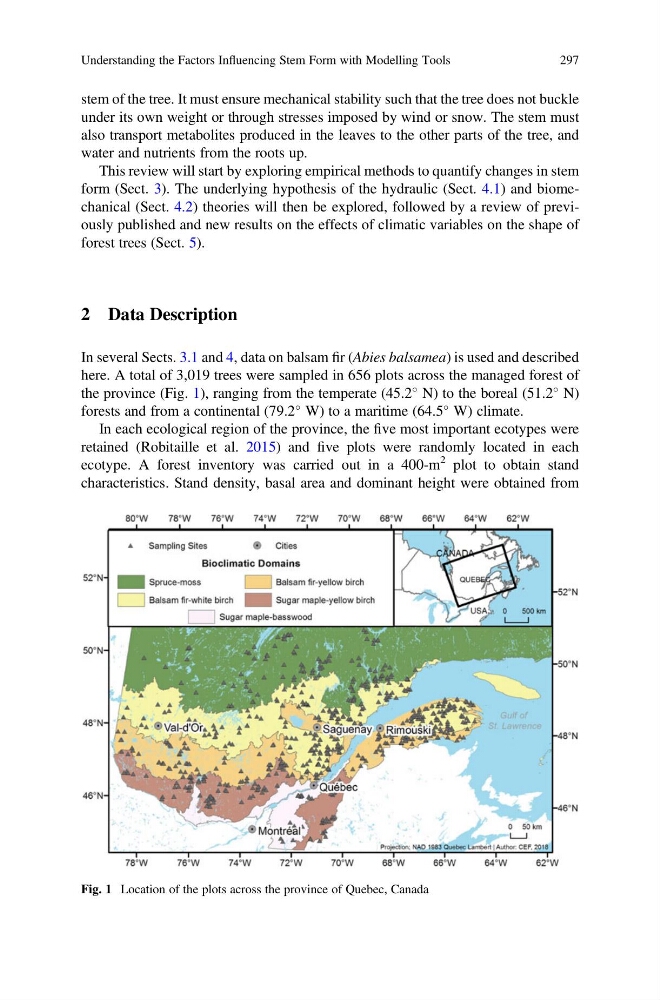
here. A total of 3,019 trees were sampled in 656 plots across the managed forest of
the province (Fig. 1), ranging from the temperate (45.2
N) to the boreal (51.2
N)
forests and from a continental (79.2
W) to a maritime (64.5
W) climate.
In each ecological region of the province, the five most important ecotypes were
retained (Robitaille et al. 2015) and five plots were randomly located in each
ecotype. A forest inventory was carried out in a 400-m
2 plot to obtain stand
characteristics. Stand density, basal area and dominant height were obtained from
Fig. 1 Location of the plots across the province of Quebec, Canada
Understanding the Factors Influencing Stem Form with Modelling Tools
297
under its own weight or through stresses imposed by wind or snow. The stem must
also transport metabolites produced in the leaves to the other parts of the tree, and
water and nutrients from the roots up.
This review will start by exploring empirical methods to quantify changes in stem
form (Sect. 3). The underlying hypothesis of the hydraulic (Sect. 4.1) and biomechanical (Sect. 4.2) theories will then be explored, followed by a review of previously published and new results on the effects of climatic variables on the shape of
forest trees (Sect. 5).
2 Data Description
In several Sects. 3.1 and 4, data on balsam fir (Abies balsamea) is used and described
here. A total of 3,019 trees were sampled in 656 plots across the managed forest of
the province (Fig. 1), ranging from the temperate (45.2
N) to the boreal (51.2
N)
forests and from a continental (79.2
W) to a maritime (64.5
W) climate.
In each ecological region of the province, the five most important ecotypes were
retained (Robitaille et al. 2015) and five plots were randomly located in each
ecotype. A forest inventory was carried out in a 400-m
2 plot to obtain stand
characteristics. Stand density, basal area and dominant height were obtained from
Fig. 1 Location of the plots across the province of Quebec, Canada
Understanding the Factors Influencing Stem Form with Modelling Tools
297