

Leblanc et al. 2008). Ultra performance liquid chromatography (UPLC) analyses of
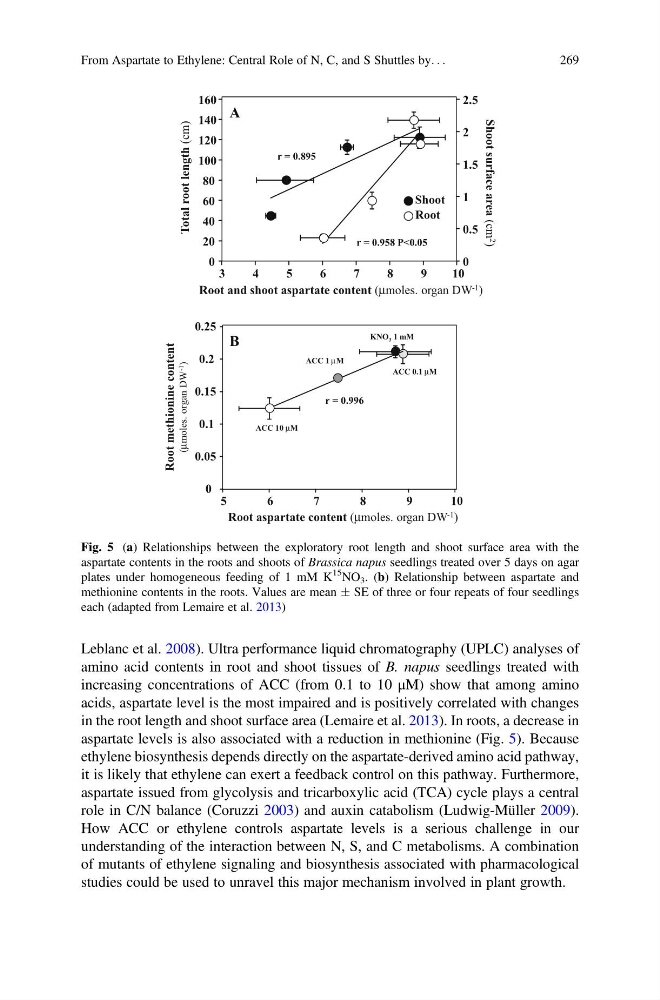
amino acid contents in root and shoot tissues of B. napus seedlings treated with
increasing concentrations of ACC (from 0.1 to 10 μM) show that among amino
acids, aspartate level is the most impaired and is positively correlated with changes
in the root length and shoot surface area (Lemaire et al. 2013). In roots, a decrease in
aspartate levels is also associated with a reduction in methionine (Fig. 5). Because
ethylene biosynthesis depends directly on the aspartate-derived amino acid pathway,
it is likely that ethylene can exert a feedback control on this pathway. Furthermore,
aspartate issued from glycolysis and tricarboxylic acid (TCA) cycle plays a central
role in C/N balance (Coruzzi 2003) and auxin catabolism (Ludwig-Müller 2009).
How ACC or ethylene controls aspartate levels is a serious challenge in our
understanding of the interaction between N, S, and C metabolisms. A combination
of mutants of ethylene signaling and biosynthesis associated with pharmacological
studies could be used to unravel this major mechanism involved in plant growth.
r = 0.996
0
0.05
0.1
0.15
0.2
0.25
5
6
7
8
9
1 0
Root methionine
content
( moles. organ DW -1
)
Root aspartate content ( moles. organ DW -1 )
B
r = 0.958 P<0.05
r = 0.895
0
0.5
1
1.5
2
2.5
0
20
40
60
80
100
120
140
160
3
4
5
6
7
8
9
10
Root and shoot aspartate content ( moles. organ DW -1 )
Total root length (cm)
Shoot surface area (cm 2 )
Root
Shoot
A
ACC 10 M
ACC 1 M
ACC 0.1 M
KNO 3 1 mM
μ
μ
μ
μ
μ
μ
Fig. 5 (a) Relationships between the exploratory root length and shoot surface area with the
aspartate contents in the roots and shoots of Brassica napus seedlings treated over 5 days on agar
plates under homogeneous feeding of 1 mM K
15
NO 3 . (b) Relationship between aspartate and
methionine contents in the roots. Values are mean Æ SE of three or four repeats of four seedlings
each (adapted from Lemaire et al. 2013)
From Aspartate to Ethylene: Central Role of N, C, and S Shuttles by. . .
269
amino acid contents in root and shoot tissues of B. napus seedlings treated with
increasing concentrations of ACC (from 0.1 to 10 μM) show that among amino
acids, aspartate level is the most impaired and is positively correlated with changes
in the root length and shoot surface area (Lemaire et al. 2013). In roots, a decrease in
aspartate levels is also associated with a reduction in methionine (Fig. 5). Because
ethylene biosynthesis depends directly on the aspartate-derived amino acid pathway,
it is likely that ethylene can exert a feedback control on this pathway. Furthermore,
aspartate issued from glycolysis and tricarboxylic acid (TCA) cycle plays a central
role in C/N balance (Coruzzi 2003) and auxin catabolism (Ludwig-Müller 2009).
How ACC or ethylene controls aspartate levels is a serious challenge in our
understanding of the interaction between N, S, and C metabolisms. A combination
of mutants of ethylene signaling and biosynthesis associated with pharmacological
studies could be used to unravel this major mechanism involved in plant growth.
r = 0.996
0
0.05
0.1
0.15
0.2
0.25
5
6
7
8
9
1 0
Root methionine
content
( moles. organ DW -1
)
Root aspartate content ( moles. organ DW -1 )
B
r = 0.958 P<0.05
r = 0.895
0
0.5
1
1.5
2
2.5
0
20
40
60
80
100
120
140
160
3
4
5
6
7
8
9
10
Root and shoot aspartate content ( moles. organ DW -1 )
Total root length (cm)
Shoot surface area (cm 2 )
Root
Shoot
A
ACC 10 M
ACC 1 M
ACC 0.1 M
KNO 3 1 mM
μ
μ
μ
μ
μ
μ
Fig. 5 (a) Relationships between the exploratory root length and shoot surface area with the
aspartate contents in the roots and shoots of Brassica napus seedlings treated over 5 days on agar
plates under homogeneous feeding of 1 mM K
15
NO 3 . (b) Relationship between aspartate and
methionine contents in the roots. Values are mean Æ SE of three or four repeats of four seedlings
each (adapted from Lemaire et al. 2013)
From Aspartate to Ethylene: Central Role of N, C, and S Shuttles by. . .
269