

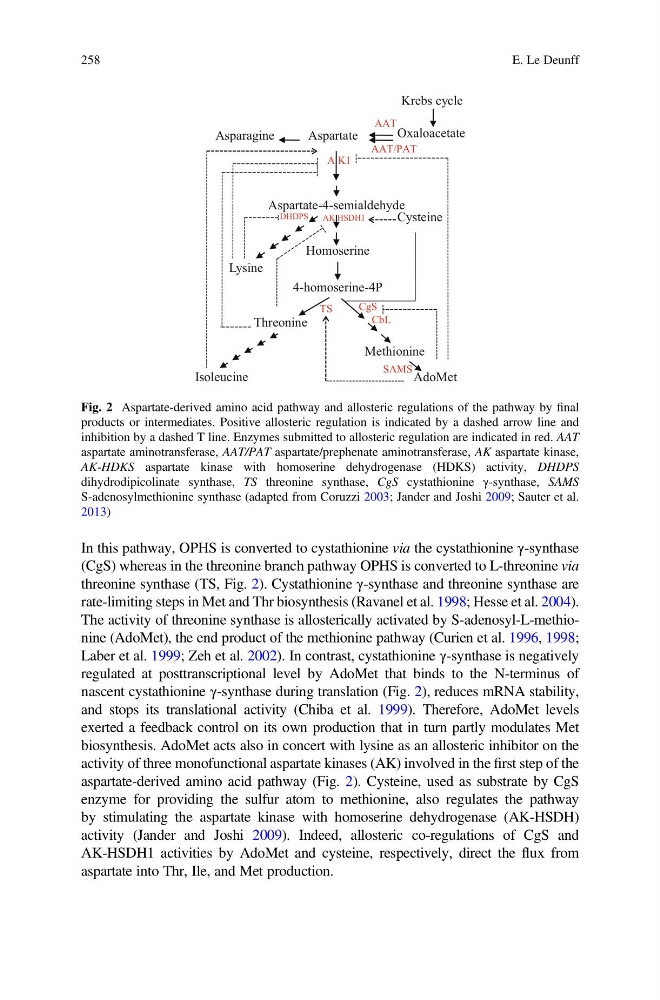
In this pathway, OPHS is converted to cystathionine via the cystathionine γ-synthase
(CgS) whereas in the threonine branch pathway OPHS is converted to L-threonine via
threonine synthase (TS, Fig. 2). Cystathionine γ-synthase and threonine synthase are
rate-limiting steps in Met and Thr biosynthesis (Ravanel et al. 1998; Hesse et al. 2004).
The activity of threonine synthase is allosterically activated by S-adenosyl-L-methionine (AdoMet), the end product of the methionine pathway (Curien et al. 1996, 1998;
Laber et al. 1999; Zeh et al. 2002). In contrast, cystathionine γ-synthase is negatively
regulated at posttranscriptional level by AdoMet that binds to the N-terminus of
nascent cystathionine γ-synthase during translation (Fig. 2), reduces mRNA stability,
and stops its translational activity (Chiba et al. 1999). Therefore, AdoMet levels
exerted a feedback control on its own production that in turn partly modulates Met
biosynthesis. AdoMet acts also in concert with lysine as an allosteric inhibitor on the
activity of three monofunctional aspartate kinases (AK) involved in the first step of the
aspartate-derived amino acid pathway (Fig. 2). Cysteine, used as substrate by CgS
enzyme for providing the sulfur atom to methionine, also regulates the pathway
by stimulating the aspartate kinase with homoserine dehydrogenase (AK-HSDH)
activity (Jander and Joshi 2009). Indeed, allosteric co-regulations of CgS and
AK-HSDH1 activities by AdoMet and cysteine, respectively, direct the flux from
aspartate into Thr, Ile, and Met production.
Aspartate
Asparagine
Homoserine
Threonine
Methionine
4-homoserine-4P
Lysine
Isoleucine
AdoMet
Aspartate-4-semialdehyde
A K1
Oxaloacetate
AAT
DHDPS
CgS
Krebs cycle
AAT/PAT
Cysteine
AK HSDH1
SAMS
TS
CbL
Fig. 2 Aspartate-derived amino acid pathway and allosteric regulations of the pathway by final
products or intermediates. Positive allosteric regulation is indicated by a dashed arrow line and
inhibition by a dashed T line. Enzymes submitted to allosteric regulation are indicated in red. AAT
aspartate aminotransferase, AAT/PAT aspartate/prephenate aminotransferase, AK aspartate kinase,
AK-HDKS aspartate kinase with homoserine dehydrogenase (HDKS) activity, DHDPS
dihydrodipicolinate synthase, TS threonine synthase, CgS cystathionine γ-synthase, SAMS
S-adenosylmethionine synthase (adapted from Coruzzi 2003; Jander and Joshi 2009; Sauter et al.
2013)
258
E. Le Deunff
(CgS) whereas in the threonine branch pathway OPHS is converted to L-threonine via
threonine synthase (TS, Fig. 2). Cystathionine γ-synthase and threonine synthase are
rate-limiting steps in Met and Thr biosynthesis (Ravanel et al. 1998; Hesse et al. 2004).
The activity of threonine synthase is allosterically activated by S-adenosyl-L-methionine (AdoMet), the end product of the methionine pathway (Curien et al. 1996, 1998;
Laber et al. 1999; Zeh et al. 2002). In contrast, cystathionine γ-synthase is negatively
regulated at posttranscriptional level by AdoMet that binds to the N-terminus of
nascent cystathionine γ-synthase during translation (Fig. 2), reduces mRNA stability,
and stops its translational activity (Chiba et al. 1999). Therefore, AdoMet levels
exerted a feedback control on its own production that in turn partly modulates Met
biosynthesis. AdoMet acts also in concert with lysine as an allosteric inhibitor on the
activity of three monofunctional aspartate kinases (AK) involved in the first step of the
aspartate-derived amino acid pathway (Fig. 2). Cysteine, used as substrate by CgS
enzyme for providing the sulfur atom to methionine, also regulates the pathway
by stimulating the aspartate kinase with homoserine dehydrogenase (AK-HSDH)
activity (Jander and Joshi 2009). Indeed, allosteric co-regulations of CgS and
AK-HSDH1 activities by AdoMet and cysteine, respectively, direct the flux from
aspartate into Thr, Ile, and Met production.
Aspartate
Asparagine
Homoserine
Threonine
Methionine
4-homoserine-4P
Lysine
Isoleucine
AdoMet
Aspartate-4-semialdehyde
A K1
Oxaloacetate
AAT
DHDPS
CgS
Krebs cycle
AAT/PAT
Cysteine
AK HSDH1
SAMS
TS
CbL
Fig. 2 Aspartate-derived amino acid pathway and allosteric regulations of the pathway by final
products or intermediates. Positive allosteric regulation is indicated by a dashed arrow line and
inhibition by a dashed T line. Enzymes submitted to allosteric regulation are indicated in red. AAT
aspartate aminotransferase, AAT/PAT aspartate/prephenate aminotransferase, AK aspartate kinase,
AK-HDKS aspartate kinase with homoserine dehydrogenase (HDKS) activity, DHDPS
dihydrodipicolinate synthase, TS threonine synthase, CgS cystathionine γ-synthase, SAMS
S-adenosylmethionine synthase (adapted from Coruzzi 2003; Jander and Joshi 2009; Sauter et al.
2013)
258
E. Le Deunff