

corresponding alcohol (Perkins et al. 2015). There are different types of 2-Cys PRX,
the one found to be a target of NTRC belongs to the typical form, which is a
homodimer each of the monomers containing two catalytically active Cys residues,
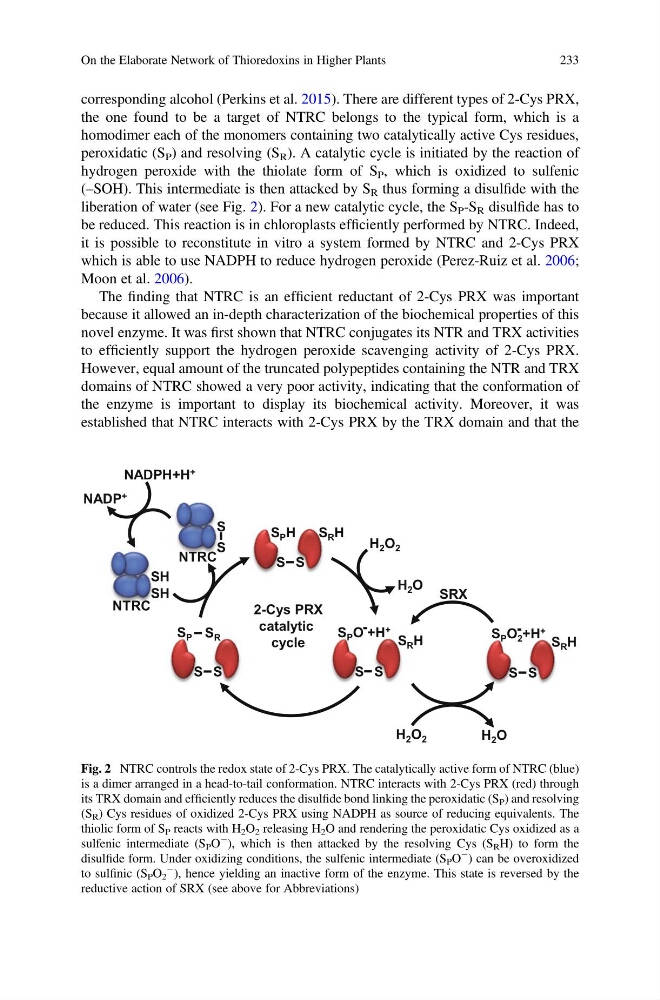
peroxidatic (S P ) and resolving (S R ). A catalytic cycle is initiated by the reaction of
hydrogen peroxide with the thiolate form of S P , which is oxidized to sulfenic
(–SOH). This intermediate is then attacked by S R thus forming a disulfide with the
liberation of water (see Fig. 2). For a new catalytic cycle, the S P -S R disulfide has to
be reduced. This reaction is in chloroplasts efficiently performed by NTRC. Indeed,
it is possible to reconstitute in vitro a system formed by NTRC and 2-Cys PRX
which is able to use NADPH to reduce hydrogen peroxide (Perez-Ruiz et al. 2006;
Moon et al. 2006).
The finding that NTRC is an efficient reductant of 2-Cys PRX was important
because it allowed an in-depth characterization of the biochemical properties of this
novel enzyme. It was first shown that NTRC conjugates its NTR and TRX activities
to efficiently support the hydrogen peroxide scavenging activity of 2-Cys PRX.
However, equal amount of the truncated polypeptides containing the NTR and TRX
domains of NTRC showed a very poor activity, indicating that the conformation of
the enzyme is important to display its biochemical activity. Moreover, it was
established that NTRC interacts with 2-Cys PRX by the TRX domain and that the
NTRC
S S
S P O +H +
S R H
S P S R
S S
S P H
S R H
S S
H 2 O 2
H 2 O
SH
SH
S
S
NADPH+H +
NADP +
NTRC
2-Cys PRX
catalytic
cycle
S P O 2 +H +
S S
S R H
SRX
H 2 O 2
H 2 O
Fig. 2 NTRC controls the redox state of 2-Cys PRX. The catalytically active form of NTRC (blue)
is a dimer arranged in a head-to-tail conformation. NTRC interacts with 2-Cys PRX (red) through
its TRX domain and efficiently reduces the disulfide bond linking the peroxidatic (S P ) and resolving
(S R ) Cys residues of oxidized 2-Cys PRX using NADPH as source of reducing equivalents. The
thiolic form of S P reacts with H 2 O 2 releasing H 2 O and rendering the peroxidatic Cys oxidized as a
sulfenic intermediate (S P O
À ), which is then attacked by the resolving Cys (S R H) to form the
disulfide form. Under oxidizing conditions, the sulfenic intermediate (S P O
À
) can be overoxidized
to sulfinic (S P O 2
À
), hence yielding an inactive form of the enzyme. This state is reversed by the
reductive action of SRX (see above for Abbreviations)
On the Elaborate Network of Thioredoxins in Higher Plants
233
the one found to be a target of NTRC belongs to the typical form, which is a
homodimer each of the monomers containing two catalytically active Cys residues,
peroxidatic (S P ) and resolving (S R ). A catalytic cycle is initiated by the reaction of
hydrogen peroxide with the thiolate form of S P , which is oxidized to sulfenic
(–SOH). This intermediate is then attacked by S R thus forming a disulfide with the
liberation of water (see Fig. 2). For a new catalytic cycle, the S P -S R disulfide has to
be reduced. This reaction is in chloroplasts efficiently performed by NTRC. Indeed,
it is possible to reconstitute in vitro a system formed by NTRC and 2-Cys PRX
which is able to use NADPH to reduce hydrogen peroxide (Perez-Ruiz et al. 2006;
Moon et al. 2006).
The finding that NTRC is an efficient reductant of 2-Cys PRX was important
because it allowed an in-depth characterization of the biochemical properties of this
novel enzyme. It was first shown that NTRC conjugates its NTR and TRX activities
to efficiently support the hydrogen peroxide scavenging activity of 2-Cys PRX.
However, equal amount of the truncated polypeptides containing the NTR and TRX
domains of NTRC showed a very poor activity, indicating that the conformation of
the enzyme is important to display its biochemical activity. Moreover, it was
established that NTRC interacts with 2-Cys PRX by the TRX domain and that the
NTRC
S S
S P O +H +
S R H
S P S R
S S
S P H
S R H
S S
H 2 O 2
H 2 O
SH
SH
S
S
NADPH+H +
NADP +
NTRC
2-Cys PRX
catalytic
cycle
S P O 2 +H +
S S
S R H
SRX
H 2 O 2
H 2 O
Fig. 2 NTRC controls the redox state of 2-Cys PRX. The catalytically active form of NTRC (blue)
is a dimer arranged in a head-to-tail conformation. NTRC interacts with 2-Cys PRX (red) through
its TRX domain and efficiently reduces the disulfide bond linking the peroxidatic (S P ) and resolving
(S R ) Cys residues of oxidized 2-Cys PRX using NADPH as source of reducing equivalents. The
thiolic form of S P reacts with H 2 O 2 releasing H 2 O and rendering the peroxidatic Cys oxidized as a
sulfenic intermediate (S P O
À ), which is then attacked by the resolving Cys (S R H) to form the
disulfide form. Under oxidizing conditions, the sulfenic intermediate (S P O
À
) can be overoxidized
to sulfinic (S P O 2
À
), hence yielding an inactive form of the enzyme. This state is reversed by the
reductive action of SRX (see above for Abbreviations)
On the Elaborate Network of Thioredoxins in Higher Plants
233