

conserved Cys and are suggested to be of eukaryotic origin based on their high
homology with cytosolic TRX, while all other plastidial TRX are considered to have
prokaryotic ancestors (Sahrawy et al. 1996; Schürmann and Buchanan 2008).
Tissue-specific gene expression analyses revealed different patterns of expression
for each of the single TRX isoforms in Arabidopsis (Bohrer et al. 2012; Belin et al.
2015). TRXm3, y1, and z were almost not detectable in green tissues, while TRXf1,
m1, m2, m4, and x were expressed at high levels. In comparison to leaves, roots
contained overall low plastidial TRX transcript abundance; however, TRXm2
displayed the highest expression values.
The source of reducing power for TRX reduction differs between plastids and
other compartments (Meyer et al. 2012; Geigenberger et al. 2017). While in plastids
the delivery of reducing power to TRX depends on reduced FDX, TRX in other
compartments rely on NADPH and are reduced via NTR of which Arabidopsis
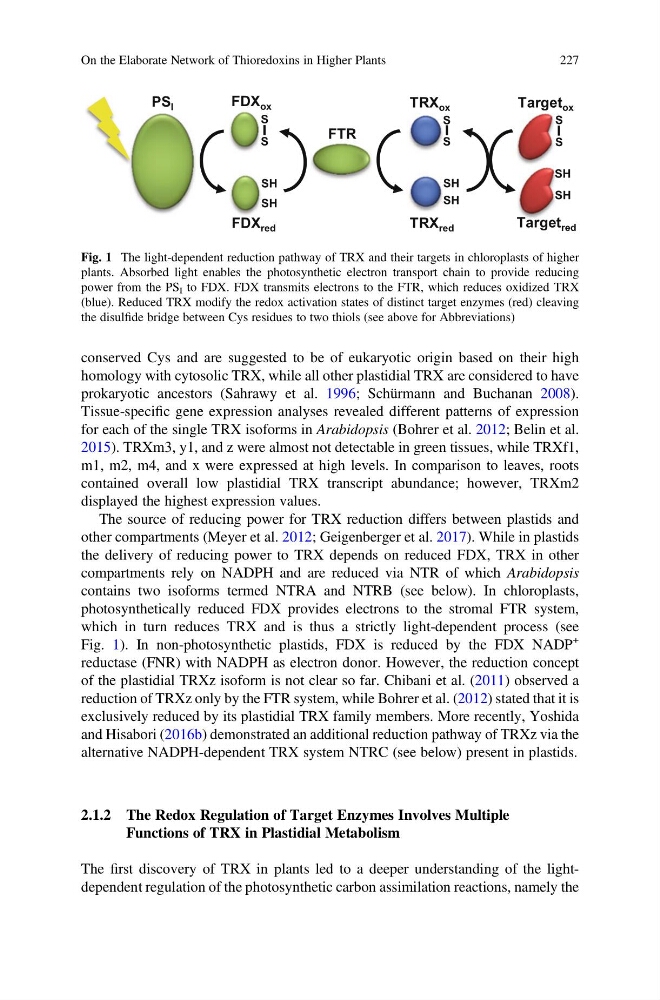
contains two isoforms termed NTRA and NTRB (see below). In chloroplasts,
photosynthetically reduced FDX provides electrons to the stromal FTR system,
which in turn reduces TRX and is thus a strictly light-dependent process (see
Fig. 1). In non-photosynthetic plastids, FDX is reduced by the FDX NADP
+
reductase (FNR) with NADPH as electron donor. However, the reduction concept
of the plastidial TRXz isoform is not clear so far. Chibani et al. (2011) observed a
reduction of TRXz only by the FTR system, while Bohrer et al. (2012) stated that it is
exclusively reduced by its plastidial TRX family members. More recently, Yoshida
and Hisabori (2016b) demonstrated an additional reduction pathway of TRXz via the
alternative NADPH-dependent TRX system NTRC (see below) present in plastids.
2.1.2 The Redox Regulation of Target Enzymes Involves Multiple
Functions of TRX in Plastidial Metabolism
The first discovery of TRX in plants led to a deeper understanding of the lightdependent regulation of the photosynthetic carbon assimilation reactions, namely the
S
S
SH
SH
PS I
FDX ox
FDX red
TRX ox
TRX red
SH
SH
S
S
FTR
S
S
Target red
Target ox
SH
SH
Fig. 1 The light-dependent reduction pathway of TRX and their targets in chloroplasts of higher
plants. Absorbed light enables the photosynthetic electron transport chain to provide reducing
power from the PS I to FDX. FDX transmits electrons to the FTR, which reduces oxidized TRX
(blue). Reduced TRX modify the redox activation states of distinct target enzymes (red) cleaving
the disulfide bridge between Cys residues to two thiols (see above for Abbreviations)
On the Elaborate Network of Thioredoxins in Higher Plants
227
homology with cytosolic TRX, while all other plastidial TRX are considered to have
prokaryotic ancestors (Sahrawy et al. 1996; Schürmann and Buchanan 2008).
Tissue-specific gene expression analyses revealed different patterns of expression
for each of the single TRX isoforms in Arabidopsis (Bohrer et al. 2012; Belin et al.
2015). TRXm3, y1, and z were almost not detectable in green tissues, while TRXf1,
m1, m2, m4, and x were expressed at high levels. In comparison to leaves, roots
contained overall low plastidial TRX transcript abundance; however, TRXm2
displayed the highest expression values.
The source of reducing power for TRX reduction differs between plastids and
other compartments (Meyer et al. 2012; Geigenberger et al. 2017). While in plastids
the delivery of reducing power to TRX depends on reduced FDX, TRX in other
compartments rely on NADPH and are reduced via NTR of which Arabidopsis
contains two isoforms termed NTRA and NTRB (see below). In chloroplasts,
photosynthetically reduced FDX provides electrons to the stromal FTR system,
which in turn reduces TRX and is thus a strictly light-dependent process (see
Fig. 1). In non-photosynthetic plastids, FDX is reduced by the FDX NADP
+
reductase (FNR) with NADPH as electron donor. However, the reduction concept
of the plastidial TRXz isoform is not clear so far. Chibani et al. (2011) observed a
reduction of TRXz only by the FTR system, while Bohrer et al. (2012) stated that it is
exclusively reduced by its plastidial TRX family members. More recently, Yoshida
and Hisabori (2016b) demonstrated an additional reduction pathway of TRXz via the
alternative NADPH-dependent TRX system NTRC (see below) present in plastids.
2.1.2 The Redox Regulation of Target Enzymes Involves Multiple
Functions of TRX in Plastidial Metabolism
The first discovery of TRX in plants led to a deeper understanding of the lightdependent regulation of the photosynthetic carbon assimilation reactions, namely the
S
S
SH
SH
PS I
FDX ox
FDX red
TRX ox
TRX red
SH
SH
S
S
FTR
S
S
Target red
Target ox
SH
SH
Fig. 1 The light-dependent reduction pathway of TRX and their targets in chloroplasts of higher
plants. Absorbed light enables the photosynthetic electron transport chain to provide reducing
power from the PS I to FDX. FDX transmits electrons to the FTR, which reduces oxidized TRX
(blue). Reduced TRX modify the redox activation states of distinct target enzymes (red) cleaving
the disulfide bridge between Cys residues to two thiols (see above for Abbreviations)
On the Elaborate Network of Thioredoxins in Higher Plants
227