

All these NAC proteins involved in the biosynthesis of secondary cell wall
(SCW) have been grouped as VNS (VND, NST/SND, SBM) subfamily (Ohtani
et al. 2011; Xu et al. 2014; Pascual et al. 2017). Interestingly, the studies published
so far show that there is no correlation between the number of VNS genes present in
each species and the size of its genome or the abundance of lignified tissues (Zhu
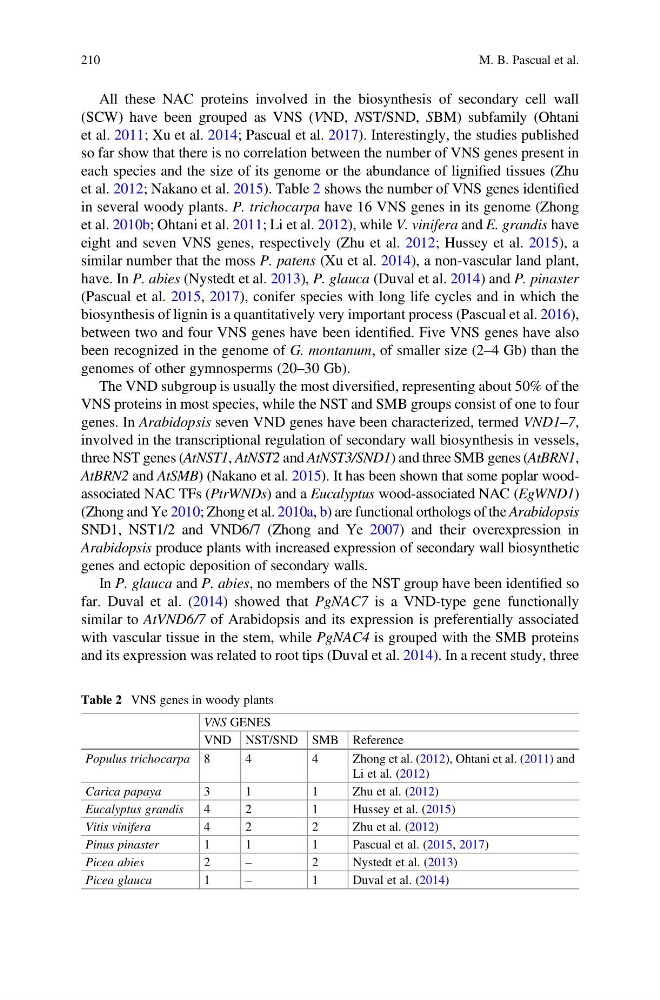
et al. 2012; Nakano et al. 2015). Table 2 shows the number of VNS genes identified
in several woody plants. P. trichocarpa have 16 VNS genes in its genome (Zhong
et al. 2010b; Ohtani et al. 2011; Li et al. 2012), while V. vinifera and E. grandis have
eight and seven VNS genes, respectively (Zhu et al. 2012; Hussey et al. 2015), a
similar number that the moss P. patens (Xu et al. 2014), a non-vascular land plant,
have. In P. abies (Nystedt et al. 2013), P. glauca (Duval et al. 2014) and P. pinaster
(Pascual et al. 2015, 2017), conifer species with long life cycles and in which the
biosynthesis of lignin is a quantitatively very important process (Pascual et al. 2016),
between two and four VNS genes have been identified. Five VNS genes have also
been recognized in the genome of G. montanum, of smaller size (2–4 Gb) than the
genomes of other gymnosperms (20–30 Gb).
The VND subgroup is usually the most diversified, representing about 50% of the
VNS proteins in most species, while the NST and SMB groups consist of one to four
genes. In Arabidopsis seven VND genes have been characterized, termed VND1–7,
involved in the transcriptional regulation of secondary wall biosynthesis in vessels,
three NST genes (AtNST1, AtNST2 and AtNST3/SND1) and three SMB genes (AtBRN1,
AtBRN2 and AtSMB) (Nakano et al. 2015). It has been shown that some poplar woodassociated NAC TFs (PtrWNDs) and a Eucalyptus wood-associated NAC (EgWND1)
(Zhong and Ye 2010; Zhong et al. 2010a, b) are functional orthologs of the Arabidopsis
SND1, NST1/2 and VND6/7 (Zhong and Ye 2007) and their overexpression in
Arabidopsis produce plants with increased expression of secondary wall biosynthetic
genes and ectopic deposition of secondary walls.
In P. glauca and P. abies, no members of the NST group have been identified so
far. Duval et al. (2014) showed that PgNAC7 is a VND-type gene functionally
similar to AtVND6/7 of Arabidopsis and its expression is preferentially associated
with vascular tissue in the stem, while PgNAC4 is grouped with the SMB proteins
and its expression was related to root tips (Duval et al. 2014). In a recent study, three
Table 2 VNS genes in woody plants
VNS GENES
VND NST/SND SMB Reference
Populus trichocarpa 8
4
4
Zhong et al. (2012), Ohtani et al. (2011) and
Li et al. (2012)
Carica papaya
3
1
1
Zhu et al. (2012)
Eucalyptus grandis
4
2
1
Hussey et al. (2015)
Vitis vinifera
4
2
2
Zhu et al. (2012)
Pinus pinaster
1
1
1
Pascual et al. (2015, 2017)
Picea abies
2
–
2
Nystedt et al. (2013)
Picea glauca
1
–
1
Duval et al. (2014)
210
M. B. Pascual et al.
(SCW) have been grouped as VNS (VND, NST/SND, SBM) subfamily (Ohtani
et al. 2011; Xu et al. 2014; Pascual et al. 2017). Interestingly, the studies published
so far show that there is no correlation between the number of VNS genes present in
each species and the size of its genome or the abundance of lignified tissues (Zhu
et al. 2012; Nakano et al. 2015). Table 2 shows the number of VNS genes identified
in several woody plants. P. trichocarpa have 16 VNS genes in its genome (Zhong
et al. 2010b; Ohtani et al. 2011; Li et al. 2012), while V. vinifera and E. grandis have
eight and seven VNS genes, respectively (Zhu et al. 2012; Hussey et al. 2015), a
similar number that the moss P. patens (Xu et al. 2014), a non-vascular land plant,
have. In P. abies (Nystedt et al. 2013), P. glauca (Duval et al. 2014) and P. pinaster
(Pascual et al. 2015, 2017), conifer species with long life cycles and in which the
biosynthesis of lignin is a quantitatively very important process (Pascual et al. 2016),
between two and four VNS genes have been identified. Five VNS genes have also
been recognized in the genome of G. montanum, of smaller size (2–4 Gb) than the
genomes of other gymnosperms (20–30 Gb).
The VND subgroup is usually the most diversified, representing about 50% of the
VNS proteins in most species, while the NST and SMB groups consist of one to four
genes. In Arabidopsis seven VND genes have been characterized, termed VND1–7,
involved in the transcriptional regulation of secondary wall biosynthesis in vessels,
three NST genes (AtNST1, AtNST2 and AtNST3/SND1) and three SMB genes (AtBRN1,
AtBRN2 and AtSMB) (Nakano et al. 2015). It has been shown that some poplar woodassociated NAC TFs (PtrWNDs) and a Eucalyptus wood-associated NAC (EgWND1)
(Zhong and Ye 2010; Zhong et al. 2010a, b) are functional orthologs of the Arabidopsis
SND1, NST1/2 and VND6/7 (Zhong and Ye 2007) and their overexpression in
Arabidopsis produce plants with increased expression of secondary wall biosynthetic
genes and ectopic deposition of secondary walls.
In P. glauca and P. abies, no members of the NST group have been identified so
far. Duval et al. (2014) showed that PgNAC7 is a VND-type gene functionally
similar to AtVND6/7 of Arabidopsis and its expression is preferentially associated
with vascular tissue in the stem, while PgNAC4 is grouped with the SMB proteins
and its expression was related to root tips (Duval et al. 2014). In a recent study, three
Table 2 VNS genes in woody plants
VNS GENES
VND NST/SND SMB Reference
Populus trichocarpa 8
4
4
Zhong et al. (2012), Ohtani et al. (2011) and
Li et al. (2012)
Carica papaya
3
1
1
Zhu et al. (2012)
Eucalyptus grandis
4
2
1
Hussey et al. (2015)
Vitis vinifera
4
2
2
Zhu et al. (2012)
Pinus pinaster
1
1
1
Pascual et al. (2015, 2017)
Picea abies
2
–
2
Nystedt et al. (2013)
Picea glauca
1
–
1
Duval et al. (2014)
210
M. B. Pascual et al.