

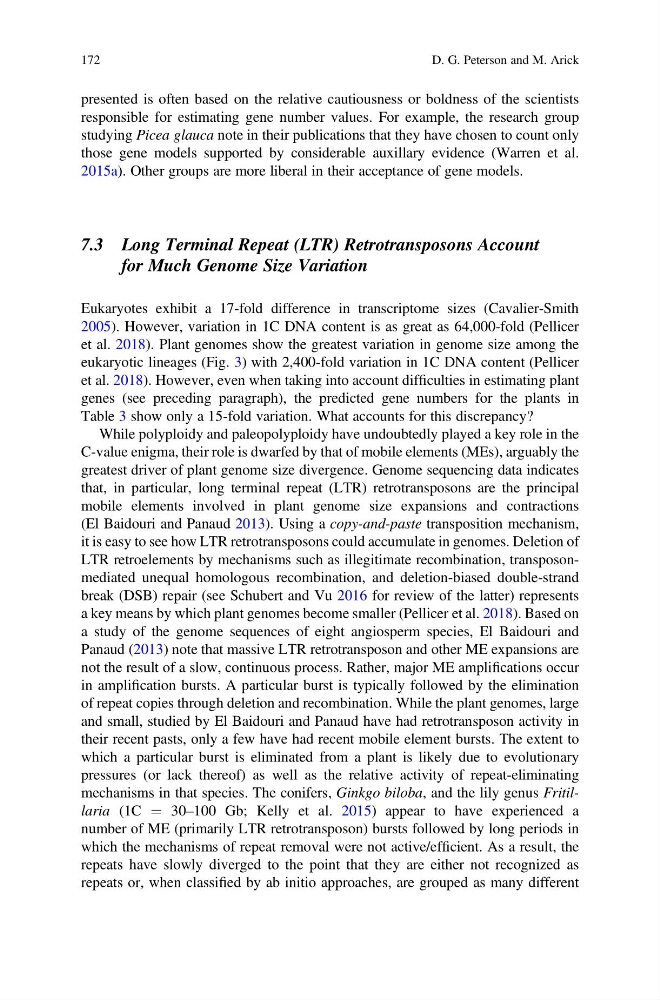
presented is often based on the relative cautiousness or boldness of the scientists
responsible for estimating gene number values. For example, the research group
studying Picea glauca note in their publications that they have chosen to count only
those gene models supported by considerable auxillary evidence (Warren et al.
2015a). Other groups are more liberal in their acceptance of gene models.
7.3 Long Terminal Repeat (LTR) Retrotransposons Account
for Much Genome Size Variation
Eukaryotes exhibit a 17-fold difference in transcriptome sizes (Cavalier-Smith
2005). However, variation in 1C DNA content is as great as 64,000-fold (Pellicer
et al. 2018). Plant genomes show the greatest variation in genome size among the
eukaryotic lineages (Fig. 3) with 2,400-fold variation in 1C DNA content (Pellicer
et al. 2018). However, even when taking into account difficulties in estimating plant
genes (see preceding paragraph), the predicted gene numbers for the plants in
Table 3 show only a 15-fold variation. What accounts for this discrepancy?
While polyploidy and paleopolyploidy have undoubtedly played a key role in the
C-value enigma, their role is dwarfed by that of mobile elements (MEs), arguably the
greatest driver of plant genome size divergence. Genome sequencing data indicates
that, in particular, long terminal repeat (LTR) retrotransposons are the principal
mobile elements involved in plant genome size expansions and contractions
(El Baidouri and Panaud 2013). Using a copy-and-paste transposition mechanism,
it is easy to see how LTR retrotransposons could accumulate in genomes. Deletion of
LTR retroelements by mechanisms such as illegitimate recombination, transposonmediated unequal homologous recombination, and deletion-biased double-strand
break (DSB) repair (see Schubert and Vu 2016 for review of the latter) represents
a key means by which plant genomes become smaller (Pellicer et al. 2018). Based on
a study of the genome sequences of eight angiosperm species, El Baidouri and
Panaud (2013) note that massive LTR retrotransposon and other ME expansions are
not the result of a slow, continuous process. Rather, major ME amplifications occur
in amplification bursts. A particular burst is typically followed by the elimination
of repeat copies through deletion and recombination. While the plant genomes, large
and small, studied by El Baidouri and Panaud have had retrotransposon activity in
their recent pasts, only a few have had recent mobile element bursts. The extent to
which a particular burst is eliminated from a plant is likely due to evolutionary
pressures (or lack thereof) as well as the relative activity of repeat-eliminating
mechanisms in that species. The conifers, Ginkgo biloba, and the lily genus Fritillaria (1C ¼ 30–100 Gb; Kelly et al. 2015) appear to have experienced a
number of ME (primarily LTR retrotransposon) bursts followed by long periods in
which the mechanisms of repeat removal were not active/efficient. As a result, the
repeats have slowly diverged to the point that they are either not recognized as
repeats or, when classified by ab initio approaches, are grouped as many different
172
D. G. Peterson and M. Arick
responsible for estimating gene number values. For example, the research group
studying Picea glauca note in their publications that they have chosen to count only
those gene models supported by considerable auxillary evidence (Warren et al.
2015a). Other groups are more liberal in their acceptance of gene models.
7.3 Long Terminal Repeat (LTR) Retrotransposons Account
for Much Genome Size Variation
Eukaryotes exhibit a 17-fold difference in transcriptome sizes (Cavalier-Smith
2005). However, variation in 1C DNA content is as great as 64,000-fold (Pellicer
et al. 2018). Plant genomes show the greatest variation in genome size among the
eukaryotic lineages (Fig. 3) with 2,400-fold variation in 1C DNA content (Pellicer
et al. 2018). However, even when taking into account difficulties in estimating plant
genes (see preceding paragraph), the predicted gene numbers for the plants in
Table 3 show only a 15-fold variation. What accounts for this discrepancy?
While polyploidy and paleopolyploidy have undoubtedly played a key role in the
C-value enigma, their role is dwarfed by that of mobile elements (MEs), arguably the
greatest driver of plant genome size divergence. Genome sequencing data indicates
that, in particular, long terminal repeat (LTR) retrotransposons are the principal
mobile elements involved in plant genome size expansions and contractions
(El Baidouri and Panaud 2013). Using a copy-and-paste transposition mechanism,
it is easy to see how LTR retrotransposons could accumulate in genomes. Deletion of
LTR retroelements by mechanisms such as illegitimate recombination, transposonmediated unequal homologous recombination, and deletion-biased double-strand
break (DSB) repair (see Schubert and Vu 2016 for review of the latter) represents
a key means by which plant genomes become smaller (Pellicer et al. 2018). Based on
a study of the genome sequences of eight angiosperm species, El Baidouri and
Panaud (2013) note that massive LTR retrotransposon and other ME expansions are
not the result of a slow, continuous process. Rather, major ME amplifications occur
in amplification bursts. A particular burst is typically followed by the elimination
of repeat copies through deletion and recombination. While the plant genomes, large
and small, studied by El Baidouri and Panaud have had retrotransposon activity in
their recent pasts, only a few have had recent mobile element bursts. The extent to
which a particular burst is eliminated from a plant is likely due to evolutionary
pressures (or lack thereof) as well as the relative activity of repeat-eliminating
mechanisms in that species. The conifers, Ginkgo biloba, and the lily genus Fritillaria (1C ¼ 30–100 Gb; Kelly et al. 2015) appear to have experienced a
number of ME (primarily LTR retrotransposon) bursts followed by long periods in
which the mechanisms of repeat removal were not active/efficient. As a result, the
repeats have slowly diverged to the point that they are either not recognized as
repeats or, when classified by ab initio approaches, are grouped as many different
172
D. G. Peterson and M. Arick