

commercial success. In other words, it is a fact that benefits derived from PMP are
now well highlighted; still regulatory agencies need to cooperate with developers to
ensure that there is strict regulatory oversight of these products, in order to gain trust,
confidence and support of the public, concerned stakeholders and investors and then
progress on the marketplace.
Responsibility in science and technology is a hot topic among policy-makers,
researchers and innovators in Europe. Thanks to concerted efforts, in recent years,
more people now understand changes that the European research and development
system is going through. More citizens are involved in science through public
engagement exercises. Biology and society scientists have established collaborations. Users are leading innovation. Open access trends are changing the publishing
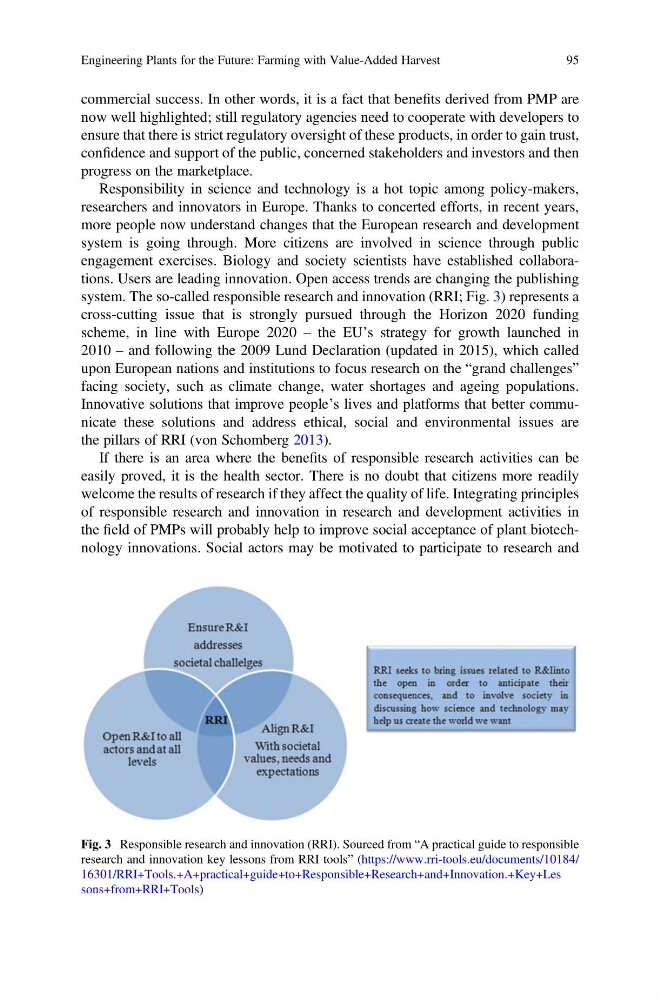
system. The so-called responsible research and innovation (RRI; Fig. 3) represents a
cross-cutting issue that is strongly pursued through the Horizon 2020 funding
scheme, in line with Europe 2020 – the EU’s strategy for growth launched in
2010 – and following the 2009 Lund Declaration (updated in 2015), which called
upon European nations and institutions to focus research on the “grand challenges”
facing society, such as climate change, water shortages and ageing populations.
Innovative solutions that improve people’s lives and platforms that better communicate these solutions and address ethical, social and environmental issues are
the pillars of RRI (von Schomberg 2013).
If there is an area where the benefits of responsible research activities can be
easily proved, it is the health sector. There is no doubt that citizens more readily
welcome the results of research if they affect the quality of life. Integrating principles
of responsible research and innovation in research and development activities in
the field of PMPs will probably help to improve social acceptance of plant biotechnology innovations. Social actors may be motivated to participate to research and
Fig. 3 Responsible research and innovation (RRI). Sourced from “A practical guide to responsible
research and innovation key lessons from RRI tools” (https://www.rri-tools.eu/documents/10184/
16301/RRI+Tools.+A+practical+guide+to+Responsible+Research+and+Innovation.+Key+Les
sons+from+RRI+Tools)
Engineering Plants for the Future: Farming with Value-Added Harvest
95
now well highlighted; still regulatory agencies need to cooperate with developers to
ensure that there is strict regulatory oversight of these products, in order to gain trust,
confidence and support of the public, concerned stakeholders and investors and then
progress on the marketplace.
Responsibility in science and technology is a hot topic among policy-makers,
researchers and innovators in Europe. Thanks to concerted efforts, in recent years,
more people now understand changes that the European research and development
system is going through. More citizens are involved in science through public
engagement exercises. Biology and society scientists have established collaborations. Users are leading innovation. Open access trends are changing the publishing
system. The so-called responsible research and innovation (RRI; Fig. 3) represents a
cross-cutting issue that is strongly pursued through the Horizon 2020 funding
scheme, in line with Europe 2020 – the EU’s strategy for growth launched in
2010 – and following the 2009 Lund Declaration (updated in 2015), which called
upon European nations and institutions to focus research on the “grand challenges”
facing society, such as climate change, water shortages and ageing populations.
Innovative solutions that improve people’s lives and platforms that better communicate these solutions and address ethical, social and environmental issues are
the pillars of RRI (von Schomberg 2013).
If there is an area where the benefits of responsible research activities can be
easily proved, it is the health sector. There is no doubt that citizens more readily
welcome the results of research if they affect the quality of life. Integrating principles
of responsible research and innovation in research and development activities in
the field of PMPs will probably help to improve social acceptance of plant biotechnology innovations. Social actors may be motivated to participate to research and
Fig. 3 Responsible research and innovation (RRI). Sourced from “A practical guide to responsible
research and innovation key lessons from RRI tools” (https://www.rri-tools.eu/documents/10184/
16301/RRI+Tools.+A+practical+guide+to+Responsible+Research+and+Innovation.+Key+Les
sons+from+RRI+Tools)
Engineering Plants for the Future: Farming with Value-Added Harvest
95