

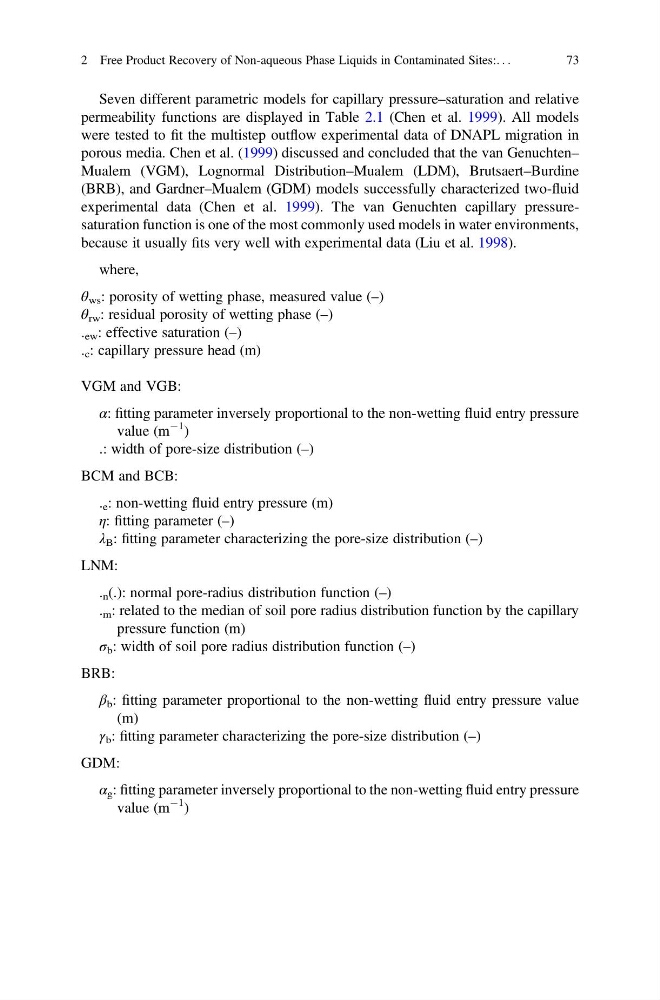
Seven different parametric models for capillary pressure–saturation and relative
permeability functions are displayed in Table 2.1 (Chen et al. 1999). All models
were tested to fit the multistep outflow experimental data of DNAPL migration in
porous media. Chen et al. (1999) discussed and concluded that the van Genuchten–
Mualem (VGM), Lognormal Distribution–Mualem (LDM), Brutsaert–Burdine
(BRB), and Gardner–Mualem (GDM) models successfully characterized two-fluid
experimental data (Chen et al. 1999). The van Genuchten capillary pressuresaturation function is one of the most commonly used models in water environments,
because it usually fits very well with experimental data (Liu et al. 1998).
where,
θ ws : porosity of wetting phase, measured value (–)
θ rw : residual porosity of wetting phase (–)
. ew : effective saturation (–)
. c : capillary pressure head (m)
VGM and VGB:
α: fitting parameter inversely proportional to the non-wetting fluid entry pressure
value (m
À1 )
.: width of pore-size distribution (–)
BCM and BCB:
. e : non-wetting fluid entry pressure (m)
η: fitting parameter (–)
λ B : fitting parameter characterizing the pore-size distribution (–)
LNM:
. n (.): normal pore-radius distribution function (–)
. m : related to the median of soil pore radius distribution function by the capillary
pressure function (m)
σ b : width of soil pore radius distribution function (–)
BRB:
β b : fitting parameter proportional to the non-wetting fluid entry pressure value
(m)
γ b : fitting parameter characterizing the pore-size distribution (–)
GDM:
α g : fitting parameter inversely proportional to the non-wetting fluid entry pressure
value (m
À1 )
2 Free Product Recovery of Non-aqueous Phase Liquids in Contaminated Sites:. . .
73
permeability functions are displayed in Table 2.1 (Chen et al. 1999). All models
were tested to fit the multistep outflow experimental data of DNAPL migration in
porous media. Chen et al. (1999) discussed and concluded that the van Genuchten–
Mualem (VGM), Lognormal Distribution–Mualem (LDM), Brutsaert–Burdine
(BRB), and Gardner–Mualem (GDM) models successfully characterized two-fluid
experimental data (Chen et al. 1999). The van Genuchten capillary pressuresaturation function is one of the most commonly used models in water environments,
because it usually fits very well with experimental data (Liu et al. 1998).
where,
θ ws : porosity of wetting phase, measured value (–)
θ rw : residual porosity of wetting phase (–)
. ew : effective saturation (–)
. c : capillary pressure head (m)
VGM and VGB:
α: fitting parameter inversely proportional to the non-wetting fluid entry pressure
value (m
À1 )
.: width of pore-size distribution (–)
BCM and BCB:
. e : non-wetting fluid entry pressure (m)
η: fitting parameter (–)
λ B : fitting parameter characterizing the pore-size distribution (–)
LNM:
. n (.): normal pore-radius distribution function (–)
. m : related to the median of soil pore radius distribution function by the capillary
pressure function (m)
σ b : width of soil pore radius distribution function (–)
BRB:
β b : fitting parameter proportional to the non-wetting fluid entry pressure value
(m)
γ b : fitting parameter characterizing the pore-size distribution (–)
GDM:
α g : fitting parameter inversely proportional to the non-wetting fluid entry pressure
value (m
À1 )
2 Free Product Recovery of Non-aqueous Phase Liquids in Contaminated Sites:. . .
73