

are added (Mercer and Cohen 1990). Villaume (1985) showed that the contact angle
is smaller when DNAPLs are spread in a non-contaminated environment, than in a
medium already contaminated with DNAPLs [as reported by Villaume (1985)].
Capillary Pressure
In porous media, capillary pressure is an important parameter because it controls
fluid flow. In systems with two immiscible fluids, when the system is stable, there is
an interface between the fluids and the air present within the pores. Pressure affecting
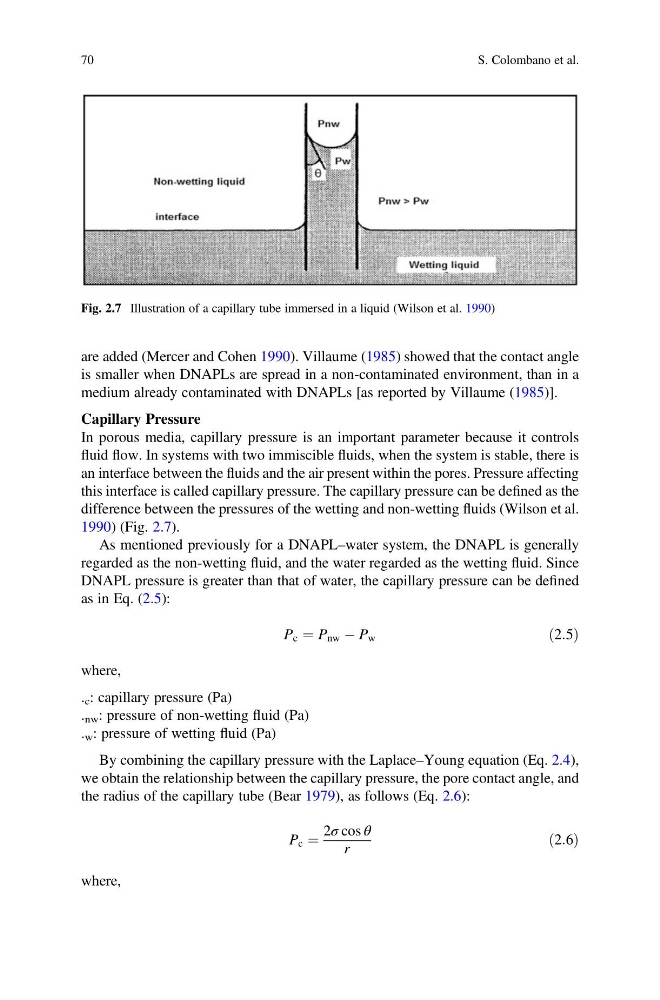
this interface is called capillary pressure. The capillary pressure can be defined as the
difference between the pressures of the wetting and non-wetting fluids (Wilson et al.
1990) (Fig. 2.7).
As mentioned previously for a DNAPL–water system, the DNAPL is generally
regarded as the non-wetting fluid, and the water regarded as the wetting fluid. Since
DNAPL pressure is greater than that of water, the capillary pressure can be defined
as in Eq. (2.5):
P c ¼ P nw À P w
ð2:5Þ
where,
. c : capillary pressure (Pa)
. nw : pressure of non-wetting fluid (Pa)
. w : pressure of wetting fluid (Pa)
By combining the capillary pressure with the Laplace–Young equation (Eq. 2.4),
we obtain the relationship between the capillary pressure, the pore contact angle, and
the radius of the capillary tube (Bear 1979), as follows (Eq. 2.6):
P c ¼
2σ cos θ
r
ð2:6Þ
where,
Fig. 2.7 Illustration of a capillary tube immersed in a liquid (Wilson et al. 1990)
70
S. Colombano et al.
is smaller when DNAPLs are spread in a non-contaminated environment, than in a
medium already contaminated with DNAPLs [as reported by Villaume (1985)].
Capillary Pressure
In porous media, capillary pressure is an important parameter because it controls
fluid flow. In systems with two immiscible fluids, when the system is stable, there is
an interface between the fluids and the air present within the pores. Pressure affecting
this interface is called capillary pressure. The capillary pressure can be defined as the
difference between the pressures of the wetting and non-wetting fluids (Wilson et al.
1990) (Fig. 2.7).
As mentioned previously for a DNAPL–water system, the DNAPL is generally
regarded as the non-wetting fluid, and the water regarded as the wetting fluid. Since
DNAPL pressure is greater than that of water, the capillary pressure can be defined
as in Eq. (2.5):
P c ¼ P nw À P w
ð2:5Þ
where,
. c : capillary pressure (Pa)
. nw : pressure of non-wetting fluid (Pa)
. w : pressure of wetting fluid (Pa)
By combining the capillary pressure with the Laplace–Young equation (Eq. 2.4),
we obtain the relationship between the capillary pressure, the pore contact angle, and
the radius of the capillary tube (Bear 1979), as follows (Eq. 2.6):
P c ¼
2σ cos θ
r
ð2:6Þ
where,
Fig. 2.7 Illustration of a capillary tube immersed in a liquid (Wilson et al. 1990)
70
S. Colombano et al.